FRED & BRETT GRAHAM — carving memories                                                                                                                                                             

FRED GRAHAM, Whiti Te Ra, The Sun Shines, 1966 Venice Biennale 2024

Fred & Brett Graham, father and son, about 1974

carving memories on the surface of time by Rosanna Albertini

History vanishes if no one writes stories, but even written deteriorates as much as the paper, never absorbed. The writer is not able to open history’s mouth like a midwife, and collect the whole body of dragons and ladders disguised under a double name: matters of fact. After decades spent writing, my illusionary attachment to the past disappeared: we accumulate stories in books not to preserve their truth, whose truth? Thucydides’? Mark Twain’s? Primo Levi’s?  Shklovskij’s? All the Historians’? We mainly pack them in the closet and forget them. We like to be new, to look foreword. Only when the end of life approaches, we perceive what we don’t see.

“I was made of a changing substance, of mysterious time. 

Maybe the source is in me.

Maybe be out of my shadow

the day arise, relentless and unreal.”

“We are our memory,

we are this chimerical museum of shifting forms,

this hip of broken mirrors.”  Jorge Luis Borges

The printed age and the age of colonization cover the same volume of time. Fred Graham and his son Brett Graham are both Maori sculptors. Carvers of monuments in which Maori history resurrects from colonialist denial. Their art includes the inevitable integration – Brett’s mother is not a Maori – and yet their works, silent and powerful, let us face the indomitable energy of a living civilization. No isolationism, in either of them. 

After the war, Fred Graham found himself in between traditional Maori art and what he calls “the modern movement of forms toward a new order reshaped by human mind.” Leaning towards the echoes of Modernism — the chaotic, idealistic response to the worst face humans showed to each other in a half century of wars — Maori artists tried to hold together personal vision ( implying freedom about tools, language and materials) and attachment to the spirit of the old, without which they would have lost the unique character of their culture: a chain of love, fight, and trust. 

FRED GRAHAM, Tinirau and the Whale, 1971 Venice Biennale 2024

FRED GRAHAM, Maui Steals the Sun, 1971 Venice Biennale 2024

FRED GRAHAM, Tamariki a Tangaroa, 1970 Venice Biennale 2024

Grace, Hetet, To Kanawa, Rare, Harrison, Tukaokao, Matchitt, Nin, Graham, Wilson, Muru,  Hotere, Tuwhare were pioneer artists seeking more than survival or local recognition. For a short while, they shared the New Zealand Maori Artists and Writers Society, founded in 1973. They were river, and island, as in a poem by Hone Tuwhare: The River Is an Island.

FRED GRAHAM, Kaitiaki, 2004, in the Auckland Domain in Auckland, The 11.8-metre-tall (39 ft) piece depicts a kāhu pōkere (harrier hawk), a bird that features as a guardian in Ngāti Whātua and Tainui oral histories. (Wikipedia)

FRED GRAHAM, Washbowl of Sorrow, 2004 stainless steel, kauri, totara, and customwood 734 x 55 x 82mm Waikato Raupatu Lands Trust Visual Arts Waikato museum.

FRED GRAHAM, Waka Maumahare, 2022, stainless steel, 16 m. high, it weighs 5 tons. Photo Waka Kotahi (Inspired by the story of the Tainui waka – a canoe carved from a tree that was planted on the grave of Tainui, the son of a chief Tinirau and his wife Hinerau in Hawaiki. One of the first canoes to reach the New Zealand shore, according to the legend.)

The artist on his way to bless the art piece Photo: Waka Kotahi

Birds are a constant presence in Fred Graham’s vertical, tall and elegant monuments for more than half century. They stand on the land, and look as if wanting to fly toward the sky. Birds were the only animals in New Zealand in a pre-historic time, before Maoris arrived; how closer to creation not even the myth can say.  Fred never broke the chain, he is the prince of Aotearoa’s Maori artists. A living ancestor whose moral authority will never disappear. Brett says that his own closeness to his father’s art was not transferred by words. He calls it sort of ‘osmosis.’ How lucky Fred is as a father! Not only Brett did not break the chain, he added his own vision. He carves the Maori stories in wood. Mallet and chisel are his pen. His pieces often cross the ocean. They are astonishing.                  

In 2024, Fred and Brett’s artworks were together in the same space of the Corderie dell’Arsenale, at the Venice Biennale. The first time for Fred, not for Brett, whose Aniwaniwa  had been installed in Venice in 2007. 

Maoris don’t have books. Past and present, since the first canoe from Polynesia reached the shore of New Zealand —it was about the thirteen century— are only one thing: generations passing on memories from mouth to mouth. Easy to say… Let’s change mode, from history to personal stories. I have been in Aotearoa. Brett Graham was my guide in his Maori tribe. Journalist, I was trying to learn as much as possible about contemporary art of every kind and origin in New Zealand, to convince Flash Art it was worth writing about it.  My intellectual baggage? “That’s not reality, not for us,” Brett told me. After my pitch, Flash Art told me: too far away, why bother? Not their reality, neither. I  worked for myself and wrote a book. 

Facts are like boxes in which reality dries up, and dies of artificial stillness. But beforehand, there are coincidences, chances, wishes, delusions along with rare, unexpected moments in which you are certain  that your inner freedom has found where to be, in a tangible form. Life in the marae, the Maori communal house, pulled me out of many boxes.

2008   Pohara. Church starts before sunrise. At 7 a.m. the whole tribe stands outdoors under a spotless sky.  A flag is the only religious symbol, lifted on the top of a pole: a flying field of images assembled by an artist for people who still read the face of the day. Frosted vapor has made the grass a carpet of needles. In spite of the low temperature — and a strange sensation of endurance and sublime self-effacement —  everyone stands still until the singing starts, and hands and arms sway like waves through the fullness of feelings, and vapor spreads from the flock of humans.  Buon giorno, Good morning, Kia Ora, Bonjour. While the sun rises in front of us, overcoming a curtain of trees, singing birds join the humans for the most vibrant orchestra, as crispy as the air.  Who am I? For an instant, it doesn’t matter.

Such illusion is only mine; mythology and history for a Maori person melt into a collective preservation of memory. Roots and rituals climb like vines around care for family, friends, animals and the land. A single identity doesn’t have contour without fathers, mothers, queens and kings, ancestors. For an Italian woman like me, born to a Southern mother, mythology is no more than a fantasy unless my eyes touch it, on the curves of my mother’s shoulders just the same as the sculpted forms in the Greek statues. Personal genealogy is lost, becomes archeology. 

Dinner at Fred and Norma Graham house.  I couldn’t take my eyes off his hands. They seemed to me bigger than they should be, strong hands softened by work, hands finding a visual language for Maori stories since the very first: Rangi and Papa separated by their seven offsprings. “In the beginning Ranginui (the sky father) and Papatūānuku (the mother earth) were joined together in an eternal hug, and their children were born between them in darkness. The children decided to separate their parents, to allow light to come into the world as we see it now.”  (Wikipedia)

After dinner, I couldn’t wait to ask him, “Is the myth of creation to you something more than a vague fantasy lost in time?” “It’s a beginning carved in each contemporary story,” he answers, “a beginning oddly reminding the sons and daughters of time that their life, their stories, are inscribed into a natural universe. The carver brings them out, as if they were already existing inside the wood, only needing to be revealed, and be born.” The dog snores in the corner of a quiet studio by the dining room. Fred Graham and I enjoy the warm solitude one feels when the house has family in the next room resting, talking, cleaning the table. His fingers leafing through images of his early sculptures, those recently migrated to Venice, the same his son Brett remembers as sounds in the evening, when his father was sculpting in his studio after a day spent teaching. Brett remembers them big, he was seven at the time. I found online a recent speech of Fred’s, telling that Brett’s recent sculptures seem to him so big!  “Flesh and wood – Fred told me that evening – they are both bodies of the living. Death is only displacement. We Maori believe that when we die we become stars. I often looked at them as a child, wondering which one was grandfather.”

Brett Graham

Brett drives back to Auckland along the Waikato River’s curves. He resists my wish to talk about his artworks. See, he says, this is the way the land is forced to accept corrections. The Maori cemetery, steep on the hillside, was separated from the riverbed by the flux of cars. His grandparents, three Maori kings and their people rest there. This time too, as in many other trips, his car stops on the road when the cemetery appears. For a while, a magic silence. It’s church, inner quiet amid an outbreak of noise and billboards. 

Brett was angry at colonialism, young, and anxious to introduce the foreign person I was to the Maori’s real life and culture. We became friends. Although he still doesn’t know, I suspect, how deeply was I changed by meeting his people. Talk about art, analyze and dissect? He gave me much more. 

His recent pieces create symbolic places where fragments of Maori life —stigmatized as historical —  cannot be corrected, appropriated, in the end destroyed. Celebratory monuments that give a magnificent body to past feelings forced to withdraw under the pressure of wars in name of civilization. 

GRETT GRAHAM, Wasteland, 2024 wood, synthetic polymer paint Venice Biennale 2024

A different angle

Detail

Wetlands dried up by the British conquerors to improve agriculture, had been a mine of gold for Maoris, full of eels. Wet and eels disappeared.  Brett overloads with sculpted eels the room in which precious things were stored, put it on wheels and adds two long arms to the treasure trove. Nine months of work. Wetland. The two arms are a desperate prayer merging past and future, asking for simple understanding and respect, offering the strength of real stories. When I grew up, they told me words are stones, as if meanings could be separated by people who care about them. I am now the opposite: afraid to force real lives into the page and crush them like dry leaves. Maybe, can you tell?  Maybe words forgetting self-realization, ignoring the judgment to come, maybe they can be written and fly, happy to forget universal truths or solipsistic illusions. Brett’s artworks, at my eyes, fly in the same way. Caring is their secret core.   

BRETT GRAHAM, O’ Pioneer, 2020 Wood and plaster, 3 x 4m Photo: Mark Tantrum (Modeled on the gun turrets of ship Pioneer, an armed steam-drip built by the British New Zealand government, that invaded Waikato in 1863)

BRETT GRAHAM, The Great Replacement, 2022 12m wide. Yellow cedar 12 x 5.3 x 2.7m. Photo: John Collie. (It is an inverted ship’s hull. The materials recall Christchurch’s colonial architecture. The title connects to the white-suprematist manifesto of the terrorist who attacked Christchurch’s mosque in 2019.)

 Kia ora Fred and Brett,

back to Los Angeles after the third trip to Aotearoa, on October 15, 2009,  I tried to make the point with myself, who was I after my journey through the Maori land, and I ended up bickering with my new self. I send the botta e risposta now, in 2025, as it was the beginning of a new direction in my work that is still moving on with the same spirit. Rewriting, I made it new.                      

“I can hardly believe you went to the end of the world to the Southern hemisphere, to feel again in your bones the same chilly sensation you had in your childhood, in houses with no heating.”

Please, let me stop you. We can play with doubts and uncertainties. I knew for sure I could not plan my movements. At the same time, I did not feel deceived. 

“What a sentimentalist.”

Not at all. Reality can reveal itself.

“That’s why shivering and smelling mold was important?”

Perhaps a Demon made me dull. The main intention was not to repeat colonialist mistakes, with candies of truth in my pockets. Questioning my story, my own perception, was inevitable. Words can approach a feeling of absurd freedom. Remember W. B. Yeats? The poet who listened to the friendly silences of the moon? “It is not permitted to a woman who takes up pen and chisel, to seek originality, for passion is her only business.” I turned his words into a feminine mode. 

“You want to write about nothing, just the clouds of your own soul.”’

Exactly. Would you prefer a detailed description of the Auckland Museum? 

“You don’t care about facts.”

Precisely. Press, Internet, radio, TV, track them down. It’s more than enough.

“You are so old-fashioned!”

Even romantic. I like graveyards. Besides, if you take fashion away, you will have a fact.

“How does art fit into the picture?”

Art is a short term, personal deviation, commitment, investment, you decide.

“So you were short-sighted in Aotearoa?”

Undeniably.

“Why such an absurd report?”

If I don’t, who would? — Not worth a damn, André Gide already wrote it. We believe our ideas are smart, and belong to us, because we have not read enough. The best thoughts have already been written.

“So, why do you persist?”

My feelings are truly mine; thoughts are common domain.

“What counts then?”

Relations: with any thing or any person. Not what you think about them, what they really are. History is a spiderweb lacerated by fingers to make holes for the present.

“Great. And by doing that you are not yourself?”

If identity is the point, I would put chains around myself. Where does freedom go if physicality becomes a burden, so much so that my mind burns out the heaviness, and I must vanish in the air like the spirit from Aladdin’s lamp? But if my muscles instead, calves and heart, along with arteries, skin, bones and hair, give me my sense of myself at every second  — a human clock sculpted by time  — I feel as a tree, filling a living time that changes and expands with the body, fed by sparkles of chemistry the same as rocks, sticks, fish, leaves and grasshoppers. Solitude goes away, time fondles me. 

“Consciousness?”

Do you mean the sense of guilt, endlessly pricking the liver like Prometeus’ eagle? I can roast it and eat it.

“Do you give up with intelligence?”

No, I use it. It is a tool, not a goal.

Fred Graham

Thinking of you both Fred and Brett, from the distance of space as well of time, I see the Maori myth of creation once more releasing it’s meaning in your family story: Rangi and Papa giving birth to Brett but, this time, his life is instantly in the light as soon as he takes the first breath. Kia ora, Rosanna

BRETT GRAHAM, Cease Tide of the Wrong-Doing, 2020. 9.6m tall 3m wide, kauri and metal Photo: Vanessa Laurie/Stuff Permanently at the Govett-Brewster collection. (Ka pari te Tai Moana Ka timu te Tai Tangata –
When the Ocean tide rises, the Human tide recedes. Memorial in the form of a niu, a Pai Mārire ritual practice. In memory of the Maori resources expropriated by the British settlers
.)

SIMRYN GILL

when finger tips try to see and eyes try to caress, far from words’ noise

Simryn Gill, Fall Then at  1301PE Los Angeles March 2024

She is Malaysian and lives in Australia, I am Italian and live in Los Angeles. Geographic and cultural distance. But, what if distance can approach the most remote parts of what is visible and discernible, the ungraspable emotions moving our mind through the myriad of sensory data, always contained between physical edges, until we disconnect from  the immediate perception as if it was lost, and “acquire the gift of giving a more durable form to real things vanishing around us.” As life moves on, language, in exchange, does everything she can to erase herself  “to open a space to the pure vision, starting an intuition completely forgetful of the words’ noise.” We flow through time. We flow hoping to keep alive the feeling of change; we take some notes, avoid stopping for too long. 

The world flows into the self, or mingles with it or bears it, and the like. One participates in things (understand the language). In this condition understanding is not impersonal (objective), but extremely personal, like an agreement  between subject and object.” 

I’m serious in what I’m doing here: in two paragraphs I have sucked in, translated, and recombined some thoughts from my beloved Robert Musil, Jean Starobinski, and Johann Wolfgang von Goethe —an unrequested inheritance. I made a parody of myself as an old scholar who can’t give up the beauty of thinking and accepts the strange fusion in the mind. Fact is, Simryn Gill practices these same ideas in her journey as an artist.  Reading her Passing Through  I could follow step by step the formation of an art piece she produced starting from the exploration of a real thing,  a derelict mid-century seaside motel in Malaysia, now liberated from the perfect modernist combination of squares after the attack of  roots, leaves, trees, animals and the human devastation of the walls in search of copper wires or pipes.  

I could read her mind looking for structures and decorations in detail, and follow her hands, the tip of her fingers asking the stones and floors to tell her their “internal porosity and openness…a kind of self referential, self-contained vulnerability.” “I had been – Simryn says– crawling on the floors and stroking walls in a ritual of appeasement. My cousins and I weren’t allowed to come here when the motel was in its full flight and we were in our teens, because it would have exerted a bad influence on our impressionable minds.”

Simryn  wanted to graphically render the patterns as archeologists used to do. Her words:  “In my version, I applied ink directly onto the patterns and details, and took the impression by rubbing the paper onto the stained surface with the back of a metal spoon.”

“I ran a bush studio out of the boot of my car: a folding table to hold a thick pane of glass for rolling the inks on, and the inks themselves, in tins; in a cardboard box under the table, my cleaning materials, cloths and solvents; on the back seat of the car, rolls of buttery Japanese paper, which is so deceptive in its fragility, so sympathetic to the heavy treatment of being beaten and rubbed.”

I wish I had seen the motel prints. Instead, I saw the bush prints at Brian Butler’s gallery, the exhibition title is Fall Then.  Same kind of technique described above. Same “dexterous hands and serene intentions.” 

A ritual, again. Dead branches, grasses and vines, destined to die in their new, aerial situation, are restored to life as if each of them had impressed a silent, visual speech on vertical papers. A last word, a unique symphony of forms. Tempos are visible, between each sheet and layers and superpositions behind. Light vibrations appear in transparent shadows. The forest, or the garden, aren’t in the gallery, so we only find well dressed ghosts. They maintain the freshness of the living and, let’s be clear, the artist’s tenderness, her attachment to the entire natural story as if she were a substantial component. Not an observer. Not only an observer. A wanderer, a passing bird. 

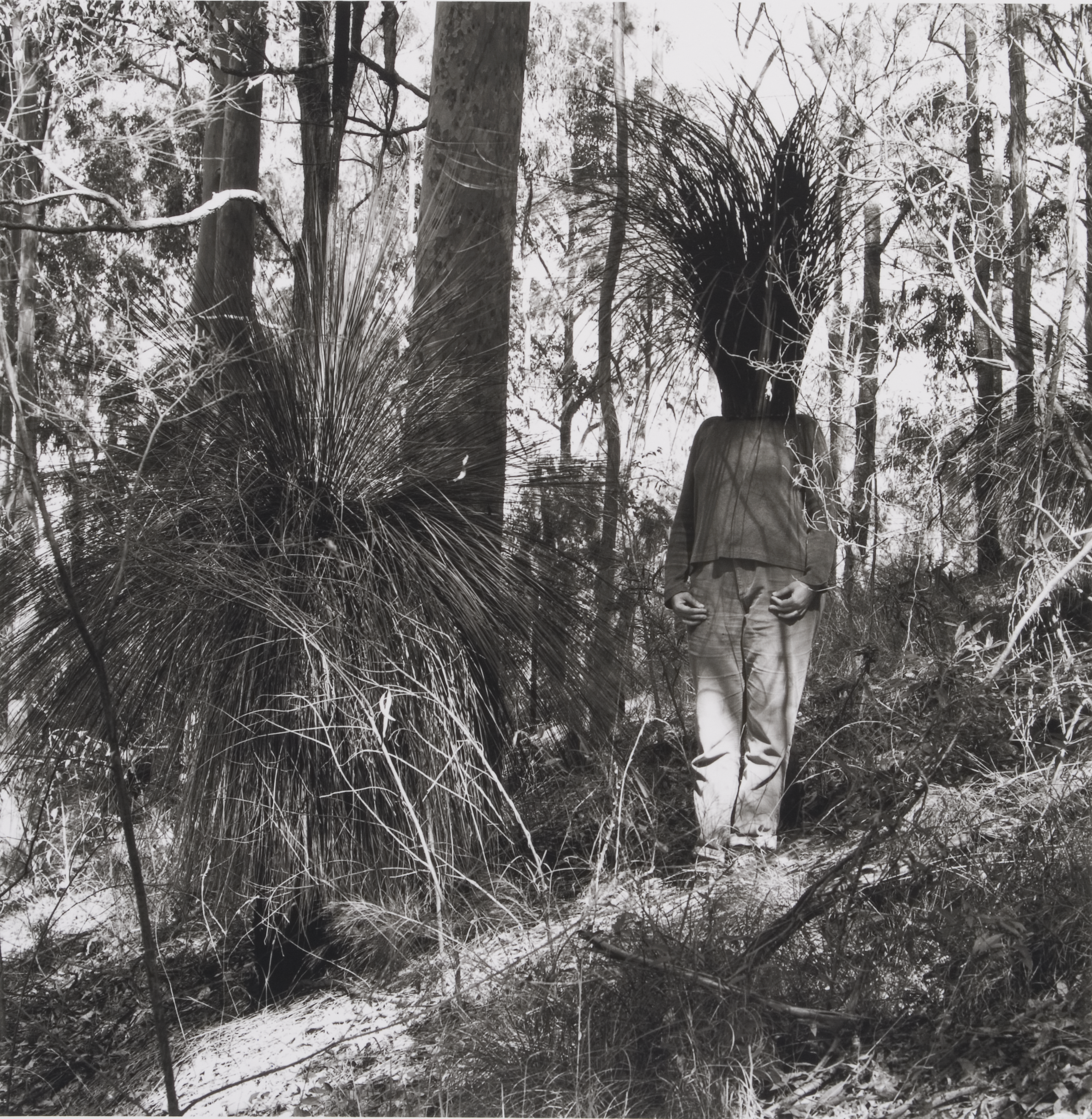
Simryn Gill, Vegetation 1999 Photograph: Jenni Carter

This is what she is in her 1999 Vegetation photos that she has printed in 2015… the reason for the delay is clear, they are moments of a life long journey, merging future, past and present, maybe stealing a story from the forest, and paying the penalty: colors are lost. Almost everything is secret in those images. The human head is lost as well, replaced by vegetation.

The mode of the person becomes the mode of the world,
For that person, and, sometimes, for the world itself.
The content of the mind becomes solid show
Or almost solid seen show—the way a fly bird
Fixes itself in its inevitable bush …
It follows that to change modes is to change the world. 

Wallace Stevens, from Conversation with three women of New England, Opus Posthumous, Vintage Books, 1990 ©1957 by Elsie Stevens and Holly Stevens

The mode of the artist becomes for me the mode of the world. The solid seen show of humans’ physical sensations:  an active exchange with the vegetation’s world, by contemplating or passing through.  

I wish I had had the same impulse Simryn had saving and printing branches from Maria’s Garden when the garden was destroyed to be replaced with a building.  One day the trees of the garden next door to my house, in Los Angeles, two enormous ficus and three pine trees have been killed, eliminated to build a wall. The shock I received was so strong that my mind stopped working properly and I ended up at the hospital, for suspected heart attack. It was not in my body, heart and brain were healthy. I couldn’t tell the same for  my spirit. My spirit had a heart attack. I still see them, but touch them I can not.

photos RA

Edgar Honetschläger : E LA NAVE VA – AND THE SHIP GOES

Edgar Honetschläger, E la nave va, Melk Abbey, Austria, 2023 Photos: ©Edgar Honetshläger

January 1st 2024, a day of happiness ? 

by Rosanna Albertini

“Happiness is a force in movement. Not a gratuitous movement, it is openness to the world.” As well as reason, “Reason is an energy we can only understand in its development, in its growth.”   JEAN STAROBINSKI, Montesquieu par lui-meme, 1967

In three lines, this is the quintessence of one of the most influential eighteenth century philosophers. Let’s put the name aside for a moment. He provided the foundations for the American constitution.

In a strange manner, artist Edgar Honetschläger is navigating the same kind of ideas and installing them as an art piece in two rooms of one of the most admired baroque European religious buildings: the Melk Abbey in Austria, a Benedictine monastery. 

If Edgar were an egg, I would say his shell is encrusted with Viennese, Japanese and Etruscan civilizations. Mental habits integrated with each other to the point where they affected his sensitivity, they made him a stranger to the rest of the world, although capable of engaging hands and the whole body in creating the biggest, most delicious strudel one can imagine in my Los Angeles kitchen. The dough was as large as the table and thin, almost like a sheet. He is a very refined crafts person. His art is gentle, and he would like to fill it with a generosity that passes through it and leaks out, for other members of the strangers tribe. 

Painted on a huge white egg he brought the bugs into the abbey, giving them precise figures with a spirit that is not the one of scientific illustrations: they look alive, ants walking on the egg repeating the same choreography they create when they invade our kitchen. Organized dancers. Bigger bugs are majestic, proud to be where they are, underneath the power of a painted king radiating sunlight from the ceiling.  

Beware their elegance: they are messengers of a real crusade the artist started in 2018 to give the bugs places on earth in which they are not threatened by pesticides, pollution, or other deadly agents. No bugs = no pollination = no food for humans. 

The artist had reached a tipping point of exasperation. Too much talking about ecological disasters, rare practical interventions, what to do as an artist? He started GOBUGSGO : a non-profit organization including biologists, entomologists, notaries, lawyers, rangers working pro bono for GBG. They acquire land where bugs can thrive with no attacks : THE NON – HUMAN  ZONES. 

Back to the art, I’m tempted to write, but GBG is an art piece as was the ceramic urinal for Marcel Duchamp. The installation at Melk Abbey is a double limb of the GBG body. 

A white paper boat holding a vertical dry Ferula picked up in an Etruscan archeological site (where archeology protects plants from receiving pesticides) floats on a cloud of feathers, real geese feathers. 

The contrast between Edgar’s art piece and the images covering the rooms from floor to ceiling, painted by Johann Wenzel Bergl in 1760, is striking. The contemporary piece is a scream of despair spreading from three symbols pared to the bones; FRAGILITY, DRYNESS, HOPE. Yet, the ferula almost tickles the palm leaves and the clouds on the walls, and the paper boat echoes in b-flat minor the galleon triumphant between the ocean waves. The whole thing is wonderfully absurd as are most of the eighteenth century images covering the whole interior building. 

They shape imaginary dreams, joyful paradises in far away continents discovered by travellers sent by European conquerors. They give form to an imaginary state of nature that is dried up after only 3 centuries. “Efficiency….efficiency”  laments Joseph Conrad in Heart of Darkness. Cruelty, and for what? For an idea. Maybe they believed in it. Redemption is a wish drowned in the waves. Disasters followed as a chain that makes us all prisoners of so called ‘rational’ decisions. For those who believe in absolute values and crash reality under their soles, with inevitable lack of soul, this art piece by Honetschläger is a beautiful reminder. Reality. It’s simple. Not easy. Art never is. !!!Gobugsgo!!!

These are THE NON-HUMAN ZONES acquired during the last five years:

Weitra Austria, 2500 m2  2019

Kallendorf Austria, 52.000 m2  2021

Breitenbrunn Austria, 4000 m2  2021

Capodimonte Italy, 2000 m2  2022

Langenlois Austria, 32.000 m2  2023              Photos: ©Danilo Donzelli

GOBUGSGO.ORG 

SUPPORTERS ARE WELCOME FROM ANY COUNTRY ALL OVER THE WORLD.

let’s save the bugs

PHILIPPA BLAIR – the demon of painting versus human affairs

I believe that the borders of our mind are ever shifting, and that many minds can flow into one another, as it were, and create or reveal a single mind, a single energy … and that our memories are part of one great memory, the memory of nature herself.

W.B. Yeats, Ideas of Good and Evil

Philippa Blair, Tell me your story … Conquistadore? Sept. 2022 Acrylic, oil, mix media 60″ x 100″

“I can’t stop working”  Philippa writes to me. Philippa has reached a peak of solitude in her life. She is diving through a space from which the future has been banned. She delves into it, painstakingly inquiring the infinite mutation of her feelings. Is it so important not to see a future? I can touch a similar ghost around myself, we are the same age, Philippa and myself. A long life behind us. Long enough to dim obsessions of personal separate journeys shrunk into a name. For how long? Does it matter? We are single energies trying to break through the stillness, the stiffness of a world, our world and yours, dear readers, that Philippa calls Headland, or Eyeland. Everything visible, clear edges, tormenting need of evaluations, fast messages, reassuring. About what? The myriad computations covering with layers of numbers the vast surface of illusions sometimes clogged in a name, democracy for instance, as if organizing, making easy and functional multiple moments of collective living, would save the earth from suffocating under the constant and uncontrolled power of the human HEADS. INSANITY. ABSENCE OF VISION. GREEDINESS.

Philippa Blair, Headlands 2022

Philippa, your Headlands reveal our reality. They open up the Euclidean order and bring back the biological chaos that stirs your need of painting without resting, avoiding  stopping the living flow before the body machine crumbles. The neat packages of life around us disappear. 

“What in reality remains found together like a molten drop is here dissolved, untangled, interwoven— made divine, made human”. (Robert Musil, Precision and the Soul

I was so happy savoring Musil’s words of a hundred years ago, words as sharp as knives: artists can set their work free from conventions, from mental habits that had congealed their inner power to conquer what never stops changing, and escapes the high res of thoughts. This what I retained and transformed for sure, a hundred years after. 

Philippa Blair, “Cambiare”(to change) 60″ x100″ sept 2022 Oil, acrylic, tapes, fabric, collage

In each of us lies a spring of emotions, ideas and will, a realm of affinities and resonances not to be defined nor contained. It is so close to your father’s microbiology. Our molecules at work with all the possible nuances and irregular burst of fountains like the erupting volcano we follow every morning from the Big Island of Hawaii. Natural history in us, hidden and magical. We feel it, do not see it. But something gushes out on your canvases, spreads on your papers. Not memory, not really. Images seem to come out from a mental sensation of vagueness, uncertainty, intangible wounds, figures incapable of taking only one shape, escaping, avoiding the prison of forms, or the tricky clarity of words. 

That’s why I must stop. Your paintings refuse description, they must be felt. 

Philippa Blair, Counter-flow March 2019 acrylic/oil/camvas 60 x 80 inches

Photos: Kallan MacLeod

BIBLIOGRAPHY

Robert Musil, Precision and Soul, Edited and Translated by Burton Pike and David S. Luft, The University of Chicago Press, 1990

J.D. Blair Microbiologist, Micro-organisms and Human Affairs, Canterbury Agricultural College Publication,  Christchurch, New Zealand, 1948. 

ALBERTO ALBERTINI : CASTLES IN THE AIR

Alberto Albertini :  CASTLES IN THE AIR

August-September 2019  Alberto is ninety two

from Milan (Italy)- DRAWINGS AND PHOTOGRAPHS by Alberto Albertini


Note of the editor and translator, Rosanna Albertini

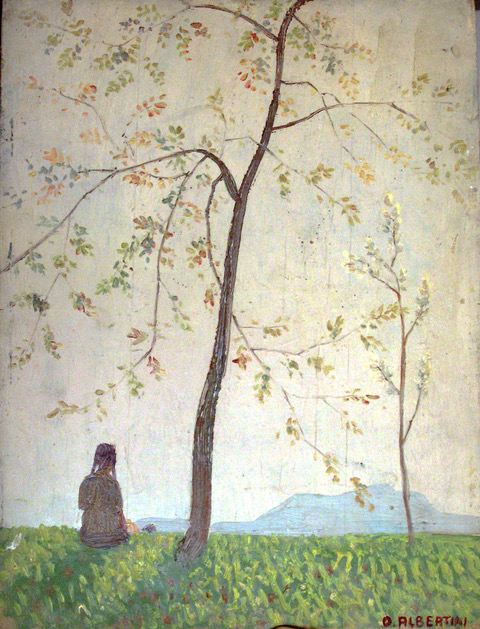
Alberto’s father was my grandfather, the painter Oreste. The family gave us a common humus in the same village and a pull of genes, but this blog is the place of our reciprocal discovery, challenge and collaboration. To be part of the same family is a coincidence, whereas to think and write together is a double journey, the way to question our attachment to the arts through the knotted branches of our lives. 

Each time Alberto sends me a new piece, I know that this project makes sense. The whole blog, not only the single chapters. Why? Fernando Pessoa already wrote it better than I could: 

“The simplest —but really the simplest— things, which nothing can make semisimple, become complex when we live them.” 

A sort of “shame of existing” most of the time shuts my voice off in public situations, as if having to speak out loud implied audacity. The blog doesn’t make any noise. Through the blog Alberto and myself listen to each other’s secret voice. I truly feel at home, if he also does I don’t know. I hope so. 

“The /constant/ analysis of our sensations creates a new way of feeling that seems artificial to anyone who analyzes it with his intelligence instead of with his own sensation.” (Pessoa) 

That’s why I open this post with a few lines Alberto wrote about infinity. They interestingly connect to Kuitca’s sensation of painting, in the post that precedes this one. And they perfectly fit in my vision.

The surface.

The canvas in tension immaculate.

A provocative portion of infinity, the infinite power to represent ideas on canvas. In front of the surface the dismay of tracing an essential sign that could express by itself not ideas, rather the act of opposing infinity, a sign containing every thing.

Fontana, with a slashing cut, hits this power that the surface gives off.

The surface is still there, and is not. The slash broke infinity as well as its power. It tells us the gesture, the extreme attempt at expressing by only one sign another infinity, unfathomable, of the artist.

Alberto’s canvas is his life slashed by the war, and lightened by simple things, like the castles. 

CASTLES IN THE AIR

by Alberto Albertini

I was nine years old when Snow White and the Seven Dwarfs was released, in 1937. I believe it was the first time I saw a castle. It grew bold in the sky, arousing my fantasy, in the movie it didn’t have to be rooted on the ground. Despite the boring songs and the shaky images, a sort of hitch, the movie revealed a dreamworld that could be extended afterwards. My brain started to produce its fancies, and I tried to draw more beautiful castles, more daring.

Having the right conditions, maybe I would also have built a castle as Ludwig II did in Neuschwanstein. I only dreamed of castles by making drawings. But drawing is a privileged activity: while you do it, it allows you to travel beyond the drawing, fancying romantic stories of young women in the clearing of the enchanted wood. That’s why maybe I couldn’t learn poems by heart; they were not fantasies produced by me! In the end, to stimulate fantasy is the true meaning of reality. Why should we stop reality in one click?  To preserve the starting image of a journey. 

Castles, castles, castles…

Castles in the air, as when I dreamed of having a camera I couldn’t buy and drew it in a project, taken by the illusion I could build it; or a little later, in 1945, I was struck down by the ERMANOX, Salomon’s fotocamera from the twenties, it was already vintage. In order to buy it I wanted to make an amplifier and sell it to have the necessary money. The amplifier was made but not sold: it ended being rented by the improvised after war ‘balera,’ an unpretentious dance hall nearby. 

Heart-wrenching mazurcas, tangos and waltzes, sounds reaching us from afar as she and I leaned out of the window of our room trying to absorb the pleasure of that sadness. Desire and imagination are also good for building and inventing as I eventually did: dreams in a drawer from which sometimes one takes something out. Because an intense activity of imagination requires time, if one doesn’t have enough time, it happens that his brain follows two directions at the same time: taking care of the job with the mind away from it, thus running the risk of losing the job. It happened to me just when I was beginning to go back up.

My conversion, nevertheless, was never complete. The business trips were a perfect opportunity: I could quickly abandon my contact person to get the train to the airport, glad when I saw from the window a profusion of broom flowers. I could breathe! And what about brooms near Lake Trasimeno?

Such alternative work can be also practiced quite late in life, but it’s less satisfying of course, one can’t throw himself too far and eventually makes do with sensations, atmospheres. Not memories! I detest memories. What are they for, to be stirred by happiness again? Certainly not. Facts existed, there they stay. Atmospheres are something else: a smell of wood’s sawdust instantly evokes the sawmills of the alpine valleys, the pinewoods. For a moment one feels there. Or the smell of the sea…

ALBERTO ALBERTINI, Roofs in Corso Garibaldi, from his window.

I take my time reading the newspaper, then I stop and start looking at the objects around me: bookcases, books, photographs, memories piled in containers that I will not open; boxes, playthings scattered on the shelves blocking the access to books I don’t care of looking for, or on hold to be shelved. It will not happen. My big screen PC contains a life, my life taking photographs: I have in mind to select them by subject, to make virtual albums. I will certainly do it. There are also the paintings but I don’t see them, on the side walls. Their presence is enough to keep my mind at rest. The sun makes a square of light on the wooden floor that reverberates heat in the room, the window open, the morning air still pleasant. 

Twenty, twenty-two years in such an intimate island so much inside the city, almost unreal, to go down and communicate, to go up and meditate. How much more time? Not so much, it can’t be, yet I take it in wanting to exalt sensations that age is wearing out. What can be done in order to have such a long life? a lady asked me while waiting for her number: to have a project, a destination, a purpose! still I have some projects, if I don’t hurry I can keep them to prolong my life. 

I know I’m not eternal, I’ve started to feel my years a while ago and yet I also feel I’m eternal, who knows. Who knows who I really was, some remorse resurfaces, is it possible to live with nothing to regret? I can stand the stains spread on my consciousness.

ALBERTO ALBERTINI, Outline of the nocturnal city, from his window

Late in the night, from the window I see the street, it’s almost empty. Somebody comes by. A few windows are lit: didn’t they go on vacation? What are they doing still on, at that time? 

ALBERTO ALBERTINI, Looking out the rear windows of his building

Bibliography

Fernando Pessoa, The Book of Disquiet, composed by Bernardo Soares, assistant bookkeeper in the city of Lisbon. Translated by Alfred Mac Adam, Exact Change, Boston, 1998


YELLOW MOON – LENZ GEERK

About LENZ GEERK  “Mixed Blessings”

at Roberts Projects, Los Angeles, September 2019


LENZ GEERK, Untitled 2019, Acrylic on canvas, 100 x 70 cm
Courtesy of the artist and Roberts Projects, Los Angeles CA

LENZ GEERK, Croissant 2019, Acrylic on canvas, 24 x 18 cm Courtesy of the artist and Roberts Projects Los Angeles CA

YELLOW MOON

by Rosanna Albertini

No, says the child, the moon is white. That is not the moon, it’s a croissant. 

I am not in the mood for fighting, words assume they are right, so does the child. 

I keep seeing the moon wearing a puffy dress, looking kindly at the people of the house. 

They look at her or keep her in their minds in an uncanny way, even when the moon-croissant, the crescent moon, is off stage, or he looks as if he is wondering where she is, the man about to pick up his briefcase or maybe only passing by through the corridor. His thoughts, heavier than the bag, make him greenish. He might be a tree man growing out of the bag like a Houdini. It’s a painted reality, at the mercy of the marketplace.

 But the artist knows that and he is conscious at the same time, deeply conscious, that he makes people and rooms and objects in his paintings “the only way that he is able to get the picture to exist.” Therefore the story doesn’t have to be necessary,  “it has to exist but it doesn’t have to be necessary …. because the minute it is necessary it has in it no possibility of going on.” 

LENZ GEERK, Pearl Painting and Pearl Necklace 2019, Acrylic on canvas, 49 x 35 cm Courtesy of the artist and Roberts Projects, Los Angeles CA

Gertrude, you are welcome. Did you notice the woman adjusting the necklace underneath her hair, she only has a portion of an arm, maybe she is a statue. Her pearl is so powerful that turns into a giant pearl, a mother pearl? floating between painted waves in another painting. Mystery grows, for the two figures, the woman statue and the painting, float in the dark emerging from the canvas like Venus from the ocean. The painter, I wonder, maybe the painter is realizing he doesn’t have the soft, absorbing surface of felt underneath anymore, he is painting on canvas, not so easy, not so welcoming. He stops remembering the felt. He chops the arm, acts anew and lets the brush make the job.

Pirandello would call the figures six characters in search of their author, so lost in their own nature that they barely deal with the density of the living. Geerk’s painted creatures are not even completely human. They stand rigid, or slightly folded on themselves like leaves, or fall down in a strange angle as flowers do in a vase when the water has soaked the stem and petals dry up.  Impossible to imagine them in a less empty space, less anonymous. A man leans toward the crescent moon on the table, can’t reach her. His woman companion on the chair seems suspicious, keeps her distance.

LENZ GEERK, The Croissant 2019, Acrylic on canvas 80 x 115 cm Courtesy of the artist and Roberts Projects, Los Angeles CA

 Another woman in a small gray painting looks at the yellow presence from afar, half hidden behind the doorway. That is the epilogue of the mystery story, the same that unfolds in five views of the same place: one of the two corners of the moon has been eaten, or stolen. It’s a croissant, not a moon anymore. Exactly as in an old Inuit tale: the house was flying, people inside asked the house to stop, they were cold. The house stopped and the people put some light snow in their lamps, the snow burned and gave them light. Someone from the street went in and said, “the snow is burning!”  And the flame disappeared. 

In our story the flame remained lit in the painter.

An interesting closeness to Morandi’s palette, and to the soft edges of his painted cups and pitchers, goes along with the quiet intensity of the figures locked in themselves and unrevealed dreams. If the crescent moon is their dream, it’s obviously unreachable. But the painter ate it. 

LENZ GEERK, Untitled 2019, Acrylic on canvas, 150 x 200 cm Courtesy of the artist and Roberts Projects, Los Angeles CA

 BIBLIOGRAPHY

GERTRUDE STEIN, Look at Me Now and here I Am,  Writings and Lectures 1909-1945, Penguin Books, 1967

Inuit stories in Jerome Rothenberg, Technicians of the Sacred, Third edition, University of California press, 2017

MORANDI, Catalogue of Giorgio Morandi, San Francisco Museum of Modern Art, 1981. The catalogue I consulted belongs to Lucas Reiner, painter. He lent it to me with trepidation because it was one of his mother’s favorite books. Thank you Lucas, both the book and myself hope to see you soon.


JENNIFER NELSON : “From Zero to Gold”

JENNIFER NELSON: “FROM ZERO TO GOLD”    


Myths are the soul of our action and love. 

We cannot act without moving toward a phantom. 

We can only love what we create.   

(Paul Valéry, A Fond Note on Myth, 1928)

Jennifer nelson as a living Caryathid under the lintel of the National Bank of Greece

JENNIFER NELSON  at the National Bank in Athen (Greece)


THE LIVING CARYATID, by Rosanna Albertini


This is a story of time going in a circle and art losing the pace 

of climbing eternity and rather emerging from human turmoil 

like a white lily from the mud

for Jennifer Nelson is an adhesive substance attracting 

as a magnet the needles that four years ago History scattered 

in Greece giving the country entropy in a broken vase leaking 

disorder and randomness feelings of pain and dreams of hope

that usually remain buried for us looking from afar

under the surface tension of the news

and sink and disappear in the ocean of human despair

which remains untold because life collectively doesn’t have commas or periods

those only belong to single humans not so clear about their meaning


her family life in Greece was blessed by motherhood a spring of joy 

while austerity appeared like a collective disease invading the citizens’ soul

stifling them under neutral computation as if numbers had ingested 

a secret justice held by the clock of the European Central Bank

International Monetary Fund European Stability Mechanism


July 3, 2015 Alexis Tsipras  OXI Speech NO to the EUROVULTURE

 mythological politics where time present and time past are only one

 “…it was from this very place that Zeus abducted Europa.

 [and with her generated the Minotaur]

It is from this very place that austerity technocrats want to abduct Europe again

from its democratic traditions. NO. We tell them NO on Sunday. 

[The referendum brought up 61% of NOs]

Our NO will make History. Whatever happens, we are the winners. 

I urge you to ignore the sirens of terror. Greece is and will remain

the cradle of European civilization.”

From LINKS, International Journal of Socialist Renewal. July 31, 2016

had the prime minister mentioned the small man in the streets of Athen who 

revealed some time ago in the past the beauty of human conversation 

including lack of illusions and ended his own life Socrates drinking cicuta

to obey a power stronger than his philosophical approach to life

this contemporary prime minister would have known he was only

postponing his poisonous drink …. nine months after

“Europe offered Greece 86 billion euros of loan in exchange 

for a tightly policed Greek government implementing a package of reforms:

pension cuts tax increases privatizations labor market deregulation”

and Tsipras said YES

We were at that speech in Syntagma Square. It was quite moving as we got off the train, we couldn’t get out of the station, there were so many people. 

And everyone was amazed. We’d all thought we were alone in our thoughts and then suddenly it was clear that we were a massive democratic block standing against this insane policy. 

As everyone looked around in surprise to find that people of all stripes and persuasions were agreeing with this resistance, a chant of “No” broke out in the metro.

The square was, in fact, a huge party that night…But democracy didn’t help us. The banks were more powerful. (Jennifer Nelson)


Nothing grandiose or expensive was possible for Jennifer Nelson 

American artist who moved to Greece to discover she was married 

to the place with “heavy commitment and light material” 

“wind in and wind out breath and sound and voice held by the lungs 

ingesting the seeds of grief from which one gets coughs and bronchitis”


Greece 2015 – Austerity time

Pointless to add that any country could fall into the same pit. 

Debts: the way they become visible, is on paper. People read them as if they were a natural outcome of the banking machine, “instead they are constructed, games of power, art isn’t any different,” says the artist. One has only to decide what kind of game, who are the participants. Jennifer wanted to be fertile despite every challenge, to do something out of nothing. 

An artist friend who had been close to Joseph Beuys, Soulis Moustakidis, showed her the way: ZERO CAN BE GOLD. Moustakidis made an underground press carving messages in potatoes and used potatoes to stamp on papers he stuck under unknown cars so when the cars moved all the papers flew around like leaves. This action took place under the Junta dictatorship.


Jennifer Nelson’s ART piece: UNTITLED ( MESOGHEIA) 2016

The Caryatids Porch of Erechteion, Athens, 421-407 BC (Wikipedia image)

Intricate hairstyle of a Caryatid, displayed at the Acropolis Museum in Athens (Wikipedia image)


Standing between two columns underneath the lintel of the Greek National Bank,

Nelson embraces the posture, silent exposure and stillness of the feminine statues   

holding the ceiling of the porch that sticks out of the Erechteion, a temple placed on an Acropolis ledge facing an ocean of petrified waves. Poseidon’s rage after throwing his  trident against this temple? This is the city of Athens. The six Caryatids, steady and quiet, lift a knee as if starting a step to fly out of their temple. If they go, the porch doesn’t have any more reason to be.

JENNIFER NELSON, Untitled (Mesagheia), 2016-present, Bills, Home made glue, Gold paint (from Germany) Work in Progress,  Photo Panos Kokkinias

A PAPER WEDDING DRESS. Jennifer’s phantom is in her mind. The idea moved her knee towards an art piece born in Greece, wrapped by the stone walls of her husband’s family house. The PAPER DRESS  was her reaction to the hours spent in long lines in front of the banks’ doors waiting for the weekly money, like everyone else, in a dignified solitude. Banks were shut down. It was like “being taken prisoner of the contingent numbers and times” Jennifer says, “you can loose house, electricity, commodities, but also something bigger. Dead end has been experienced individually, in secret and in shame, within each small family unit.”

Delving mind and hands into the bills’ paper our Jennifer artist captured the numbers negative energy, and touched the paper’s resilience, to readdress them into a new life of opposite sign. She collected as many papers she could and used them to make a replica of the traditional Attic wedding dress, symbol of fertility and richness, mostly embroidered with gold and covered with jewelry. Around her, with her, many other hands -children, women and men- worked and are still working to accomplish the artwork. The enormous neckless is exclusively made out of paper bills whose fibers were broken and made flexible again by human tips of fingers, also by her son Nasos’s fingers.

Working Hands, Photo by Athena Stamatis

Her long hair braided exactly like the Caryatids’ hair, Jennifer Nelson has made herself a Caryatid of our time. Nameless and voiceless. Except for her dress that spreads a j’accuse louder than thunder, and brings the feelings of shame to a glorious, collective ending.  

As she wears them, all those numbers printed on paper, credit cards, bonuses, bank symbols, are changed into embroidery, decorations, become talismans. But the art is not the dress by itself. It is the dress around the artist’s body, touching her skin and bones, keeping her flame alive. 

Jewels of Debts

Fragility turns into strength. Such a delicacy is probably the best adhesive substance. It gave to the makers of the piece an uncertain space in their minds through which a personal dream could appear, for a second or perhaps forever. We don’t know. Socrates again: the value of thinking, and of exposing thoughts to the public. Ancient myths were based on the belief that, when we think, we touch something despite distance and separation. Our mind’s eyes have fingers. Sensations from our physical life are saved inside the mind, their energy can be replicated and amplified. 

This PAPER DRESS is the kind of art piece I would like to see as the prototype of a generation of pieces, all over the world, the talisman to get out of a misery that is not from lack of money. As T.S. Eliot’s words put it:

“Internal darkness, deprivation

And destitution of all property,

Desiccation of the world of sense,

Evacuation of the world of fancy,

Inoperancy of the world of spirit;

This is the one way, and the other

Is the same, not in movement; while the world moves

In appetency, on its metalled ways

Of time past and time future.

T.S.Eliot, Four Quartets 


And Jennifer Nelson:

Of egg opportunities lost

and debt that won’t be forgiven

naked to your math,

I loved I love I will love 

The Alchemist’s Account (four line excerpt)

JENNIFER NELSON, Democracy is a Party, 2019, videostill


Bibliography

T.S.Eliot, The Complete Poems and Plays, 1909-1950, Harcourt Brace & Company New York, San Diego, London, 1980

Rosanna Albertini, Technological Rituals, USC Annenberg Center for Communication, 1999


Lenz Geerk : MAGIC SOLITUDES

In the exhibition ‘The Table Portraits’ at ROBERTS PROJECTS, Culver City, CA – September-October 2018


LENZ GEERK. Untitled, 2018 Acrylic on wool 60 x 40 cm
Courtresy of the artist and Roberts Projects

MAGIC SOLITUDES

by Rosanna Albertini

“I like the way the art world is changing in the last few years, especially since Trump and #Me Too, there is more focus on relevant topics, psychology, society – which for me is often more meaningful than art about art.”  Lenz Geerk


The sky is flat and gray over the rain. As gray as the pages of a book Geerk painted with no words inside; only a small branch with leaves  appears, it might be an alien presence. 

There must be something personal I share with Geerk’s paintings. And it is not only a sense of familiarity with a painted world explored by Italian modern artists from the beginning to the middle of the 20th century, such as  Massimo Campigli, Mario Sironi, Filippo De Pisis, Giorgio De Chirico, Carlo Carrà and others – even Amedeo Modigliani. Their sceneries were often called ‘metaphysical.’ Big word in these days, I let it go. Perhaps these Italian artists only preserved an ossified gallery of figures and buildings to replace a landscape of ruins dominated by wars and misery — humans and cities under the same spell —  with imaginary monuments of their minds. Artists avoided resemblances to reality, bringing to life new under-cover mythologies wearing beauty and distance.

LENZ GEERK, Study for Gray Flower, 2018 Acrylic on wool 30 x 40 cm  Courtesy of the artist and Roberts Projects

LENZ GEERK, Bee, 2018 Acrylic on wool 40 x 60 cm    Courtesy of the artist and Roberts Projects

LENZ GEERK, Blue Flower, 2018 Acrylic on wool  50 x 40 cm
Courtesy of the artist and Roberts Projects

Although holding some vague echoes from the past, Lenz Geerz figures belong to this present time, and are completely physical. I meet him here. And  I need to keep his painted images as soft as the compressed wool on which they appear. I want to see them through the body of the painted world, many steps before understanding. 

They are all equal in their lack of gaze. Their eyes are closed or they look down, absorbed by the body itself or by it’s action: eyes focused on a gray flower became gray, maybe thinking of a dirty look. Pupils lost among gray pages are opaque, inert like felt. It seems the act of throwing the gaze around, or looking far, is deadly dangerous. The grabbing is questioned: long fingers more like flowers stems than bony limbs, touch  without trying to possess, to appropriate. Yes, reality as we know it has become a disturbing, invasive machinery. The artist isolates his creatures from the ordinary, tired visual language of our time, he lets humor and tenderness take shape apparently without effort, a blue flower on his belly. He is not protesting nor letting go, he calls for intimacy, introversion, and pensiveness. 

These bodies  expose themselves and in so doing they conceal their own secret. Folding, throwing the arms in odd gestures, or magically sitting on the water, birdlike, in a space out of time, they could be boneless figures finally free from  the renaissance myth of the man bringing the whole reality into the measure of his mind, and replicating the fruits of his intellectual power until he can’t control them anymore and starts devouring them, like Chronos with his children.  There is the pressure of reality, but Geerk’s painted images resist, their secret untouched. I don’t want to break it, do not know what the artist had in mind, but I have to the impression to breath a secret pleasure of solitude. 

LENZ GEERK, Pressed Leaf, 2018 Acrylic on wool   60 x 40 cm
Courtesy of the artist and Roberts Projects


“They are more than leaves that cover the barren rock

They bud the whitest eye, the pallidest sprout,

New senses, in the engendering of sense,

The desire to be at the end of distances,

The body quickened and the mind in root. 

They bloom as a man loves, as he lives in love.

WALLACE STEVENS, The Poem as Icon


LENZ GEERK, Beach Scene, 2018 Acrylic on wool 24 x 30 cm
Courtesy of the artist and Roberts Projects


Each painting is filled with interrogative figures, they are human and yet, they seem to miss something. Their state of mind is sucked into their body. A head, her long dark hair and the hands turn into silent, physical language: while she heavily lays her jaw on a table her hair and hands expand, growing bigger as cats know how to do. It’s a humanscape shaped by sleep’s heaviness, an island smothered by a coat of snow. 

LENZ GEERK, Sleeping, 2018 Acrylic on wool   20 x 30 cm
Courtesy of the artist and Roberts Projects

I see myself as one of those figures, a twenty-seven year old woman turning her eyes inside her own body dumped in a large chair surrounded by palms, in the hall of a Parisian student housing. Daydreaming, she was lost in the palms’ movement: hands with more than five fingers, too weak and floppy to grab anything around. In Paris she was completely alone for the first time in her life. She was confused. Suddenly the barricades of books she had physically built in ’68 during the student upheavals, and the imaginary ones she had constructed in her mind, trying to make sense of an incomprehensible decision her parents had taken when she was ten, fell apart all at once.  Dust from the Berlin Wall made her memory even fuzzier. Almost twenty-eight years old! Life doesn’t solidify in the twenties; the only thing one can do is to move on. Her desires had been chopped as well as her hair since she was ten. They both grew again. Not immediately, not fast. I look at her embraced by the chair. I see an immaculate conception taking shape in her mind puzzled by a bundle of feelings. During that daydream, she received a desire of pregnancy she had never had before. I don’t know where such grace came from. From the absence of immediate pressures? From solitudine, perhaps. A few months after, a new life was in her. 

Lenz Geerk is twenty-eight years old. 

LENZ GEERK, The Lovers, 2018 Acrylic on wool   80 x 59.9 cm
Courtesy of the artist and Roberts Projects

Bibliography

WALLACE STEVENS, “The Rock” in  The Collected Poems, p.525,  Vintage Books Edition 1990

FRANK MASI : The Remote Life of Images

FRANK MASI : THE REMOTE LIFE OF IMAGES

after his recent journey to Japan


 Rosanna Albertini to Frank Masi — Los Angeles, December 2018

Dear Frank,

Your photographs of Japan are a dream of unreality. They are beautiful in an odd, almost disquieting way. I look at them and think, maybe Japan is not the point. The man I met many times in the past is a well organized, a practical person in love with the arts, and a very interesting collector of art. But these images that you grabbed and printed: the partial opacity of a window through which you saw the uncertainty of a blurred garden, and the frame of leaves tickling your curiosity; your oblique gaze through another window big this time that seems to protect from intrusion the peace of an inner space; the silent observation of manufactured clay cups waiting to dry – you call them ‘quiet’- these are works of a dreamer. A less mercantile term than the word artist.

Did you ever meet Fernando Pessoa?

 In dealing with any object, the dreamer should try to feel the clear indifference that that object, taken as an object, inspires. The dreamer should know, with an immediate instinct, how to abstract from each object or event anything in it that is dreamable, leaving for dead in the Exterior World anything in it that is real — this is what the wise man should seek to achieve in himself.”  The Book of Disquiet

Still drying Kutani clay / quiet tools / no wind no fire / waiting

Haiku by Frank Masi

It seems to me that’s exactly what you do, whether the object of your attention is a river, a branch, a stone in a forest or an old wooden house falling apart, or a pair of pink gloves hung behind a glass door of a simple house, a daily routine sanctuary. Don’t mistake me, pulling the door of history shut behind you makes you free from the devils of History, objectivity and documentation.  But then, is Japan as a real country the center of your work? And, does it matter? Problem: the questions come from a limited experience that came to me via Japanese artists and friends in Los Angeles. My gardener Eto is my largest source of information. He was born near Hiroshima. He is reader of old poems whose language is today obsolete, forgotten.  He remembers trucks filled with corpses passing by his village, and stories of his life as an after war child, when he and his school friends worked in the countryside cutting vegetation with machetes. By accident, the head of one of them was cut along with the leaves. See, History is a bitch, a cutting weapon against art. 

Fact is, looking at your photographs I didn’t think of Japan, I mainly tried to unveil your perception while you captured moments that became images and in so doing mutated, moving from the surrounding reality to your instinct that hunted for silent meaning in a dreamed landscape. Photography is a surgical act, images are cut out from the body of reality. And yet it’s an act that guides me to your own sensations. Your images are the two faces of the same human reality: preservation of nature and urban variety of dignity and decay.

Forest shadow moss / mountain child rock / river clouds / sky somewhere

Haiku by Frank Masi

Visually omitted, the human presence is embedded in the scape of the land. And your eyes through the camera seem to rediscover fragments of a remote life in places and objects, a life that escapes time as well as control. Objects and landscapes are more foreign than national identities.  Maybe I felt something similar on a beach in Turkey, such a pristine and isolated site that I almost forgot about civilized life.  There was no sand, only red pebbles with round shapes sculpted by the waves. Not rocks, they were remains of pottery from ships sunk to the bottom of the ocean during ancient storms. I was walking on naked bones. 

Nature is not mechanical to that extent for all its mornings and evenings, for all its inhabitants of China, or India or Russia, for all its waves, or its leaves, or its hands. Its prodigy is not identity but resemblance and its universe of reproduction is not an assembly line but an incessant creation. Because this is so in nature, it is so in metaphor.”  Wallace Stevens, The Necessary Angel 

The true poem [or painting, or photograph] is not the work of the individual artist; it is the universe itself, the one work of art which is forever perfecting itself.” Ernst Cassirer,  An Essay On Man 

I must tell you, your photographs of Japan brought me into a cloud of nostalgia, reopening themes that never leave this blog, like termites attacking an old piece of wood. Nostalgia not for Japan, where I’ve never been, I’m thinking rather of an intellectual paradise with many comfortable chairs and humans sharing, comparing ideas, sometimes fighting to the death around the objects of their efforts, hoping to understand and to enjoy tremendously, face to face, the mysterious disconnection between images and words. How many times do we really feel the power of our voice, a sound which adds time and physicality to the bunch of words that we call ideas? Once more, writing eliminates sounds. Thoughts for eyes, strange as they are.

We are not far from Christmas, maybe the tail of The Kite will turn into a comet, and lift your images in a luminous constellation. 

I wish I had a kimono / and walked with others /wearing kimonos

Haiku by Frank Masi

BIBLIOGRAPHY

Fernando Pessoa, The Book of Disquiet, Translated by Alfred Mac Adam, Exact Change, Boston, 1998

Wallace Stevens, The Necessary Angel, Essays on Reality and Imagination, Vintage Books, New York, 1942-1951

Ernst Cassirer, An Essay On Man: An Introduction to a Philosophy of Human Culture, Yale & New Haven, 1944


E’wao Kagoshima: WHITE AUTUMN and other visual stories

E’ WAO KAGOSHIMA

at THE BOX, Los Angeles, June-August 2018

After his exhibition, the artist started a mail art communication with the gallery and Mara McCarthy. 

E’wao Kagoshima, White Autumn 2016. Acrylic, pastel, ink, and collage on paper, 15″ 1/2 x 18″3/4 (framed dimensions)  Courtesy of the artist and The Box Gallery


BODY BOX BINDING 

— about E’wao Kagoshima’s world of physical language —

By Rosanna Albertini

Maybe the autumn wants to be white. A flood of summery red brightness fills his memory, he can’t get rid of it. Dryness is drifting across his eyes. The place is real and inscrutable. Shrunk to the bones or happily swimming in water, fish pull my hair and push my brain into an unfamiliar space, as if “rejecting the idea that everything is in its right place; there isn’t any.” (Robert Rauschenberg) A tree grows from a bone and a pink branch from a woman. There is no land or sky, we see an abstract space of transformation. The artist’s duty is to an absolute living, out of time or common sense.

Let’s pretend the alphabet starts with B. Art, area, affection, affliction, adoption, adulthood would disappear from language. Same kind of displacement wrings the world of physical language, E’wao Kagoshima’s pictorial world, out of any expected grammar. Every thing, and each form, have a mind of their own. Humans along with butterflies, toys, birds, plants and words communicate with the living landscape they are in as they like it, as they dream, without rules or restrictions. The same happens to humans, animals, objects or undefined figures.

Everyone is right. Things become true as soon as someone believes in them. Reality is within us; our mind creates its truths. And the best truth will not be the one sanctioned by reason.”  

André Gide, The White Notebook

Kagoshima’s colors might be the prevailing message, they fade or intensify like the daily mood. The artist has absorbed the natural beauty and sends it back as luminous islands from his brain: sometimes dry, often wet images, can he feel his brain is wet, as neurobiologists have discovered? They didn’t see red fish though, with smiling lips after swallowing dreams of government (John Kennedy), a cat, now part of their aquatic body — red fish looking after a red human baby.  But E’wao did. 

E’Wao Kagoshima, Parallel Case 2012. Pastel, colored pencil, ink, graphite, and collage on paper, 10″ 3/4 x 13″ 3/4 (framed dimensions)  Courtesy of the artist and The Box Gallery  

E’wao Kagoshima, Breathing Skin 2012. Pastel, colored pencil, acrylic, ink, and collage on paper, 10″ 3/4 x 13″ 3/4 (framed dimensions)   Courtesy of the artist and The Box Gallery

It’s a space beyond limits where some artists like to be. John Baldessari taught a plant the alphabet in 1972. He showed the plant the letters with patience, repeating their sound to make sure that the plant’s brain could grasp and memorize. And Nico Muhly composed I drink the air before me in 2010. Sounds and atmosphere of the living environment enter his entire body, not only filtered by the ears. Steve Galloway placed American alligators walking on the clouds in mid-air. Many other artists can probably be added, but these I know well, as well as Haruki Murakami’s books in English translation.  

E’wao Kagoshima, Saving Diaspora 2016. Pastel and colored pencil on paper, 15″ 5/8 x 18″ 3/4 (framed dimensions)  Courtesy of the artist and The Box Gallery

But in the end, I see what I see, missing Japanese language and Japanese life experience. I don’t understand Kagoshima’s images, like a blind woman talks of colors never having seen them. Simply, I love them. There is a stark naked reality in his painting and drawings: a spellbound territory, completely personal, that seems to me distant from either Japan or New York, where E’wao  moved  in 1976. My illusion? Could be. I hoped to learn from Japanese literature, only to realize that many characters and situations of Murakami’s books also belong to the Western tradition; they circulated all around the world in fables and stories for centuries. As I would like to pick out some Japanese evidence in Kagoshima’s images of Saving Diaspora, I could cry like his blue mouse, my mind lost and taken by the transparent lines of a butterfly, almost invisible, which to me is the feminine organ — as my grandmother called it since I was able to understand language. Of course I loved to detect the butterfly in such a claustrophobic room where a face cries blood and memories are petrified on her forehead.

 Storytelling is a universal art, each artwork by Kagoshima is a visual story. A woman slips out from the elephant’s trunk, maybe the cats dancing around her came from the elephant’s nostrils. The elephant seems happy to throw a shower on her and the cats. There is no separation between the three different species.   They bear the same light colors of nakedness and celebrate their closeness.

E’wao Kagoshima, Distortion One 2015. Acrlic on paper and pencils, 24″ x 19″ 1/4 Courtesy of the artist and The Box Gallery

E’wao Kagoshima, Nose and Tails 2018. Acrylic on canvas, 80″ x 60″ 1/2 Courtesy of the artist and The Box Gallery

Breathing Skin opens an incongruous series of dialogues: a fish with a crab, a bird to a fox, a woman to another identical woman, an undefined human creature bubbles water in a tank that could be a head. An exquisite gentleness permeates the drawing, lines are smoothed by water. It could be mist, or a layer of air flattened on paper.

Kagoshima’s life wasn’t easy at times, his art congealed feelings into poetry of distortion, and open-eye dreams. In his personal new world fish are bigger than the Statue of Liberty, and Sleeping Beauty floats in a miraculous clarity in the middle of an intestinal maze. The forest around the castle grows in green spots so powerful they cannot be contained, and spread on the frame. Happy birthday E’wao, it’s so good to meet your dreams. 

E’wao Kagoshima, Sleeping Beauty 2017. Mixed media on canvas, 24″ x 20″ Courtesy of the artist and The Box Gallery

“It’s all a question of imagination. Our responsibility begins with the power to imagine. 

It’s just like Yeats said: in dreams begin responsibilities.

Flip this around and you could say that where there’s no power to imagine, no responsibility can arise.

Just like we see with Eichmann.”         Haruki Murakami, Kafka on the Shore                  

Kagoshima was born in 1945 in Niigata, one of the 4 cities destined to become a target for The Atomic Bomb in Japan. The town was spared in favor of Nagasaki.  We are both children of the war sprouting from the same year, new leaves in a time obscured by lack of imagination. Only one Italian scientist around Enrico Fermi in his laboratory imagined the scientific monster they were pursuing. He was a Neapolitan dreamer. He quit, and disappeared. To write it now, it sounds like a fairy tale. Our little brains born then did not know anything and yet kept growing as if their souls had been wrinkled by the fears and destructions around. To these days, any personal deception is linked to a primeval spot of darkness in human hearts. As an art student, one afternoon with friends E’wao was enchanted by the sunlight going through the beer falling from the pitcher into the glass. He had the idea of two metal sculptures that made him one of the few pop artists in Japan.

At the Box I saw his artwork for the first time during the summer, a one person exhibition. Immediately after, E’wao’s mail art to Mara started, almost weekly, from New York to Los Angeles, sending little by little fragments of his life to a place of trust, of friendly reception, a sort of harbor.