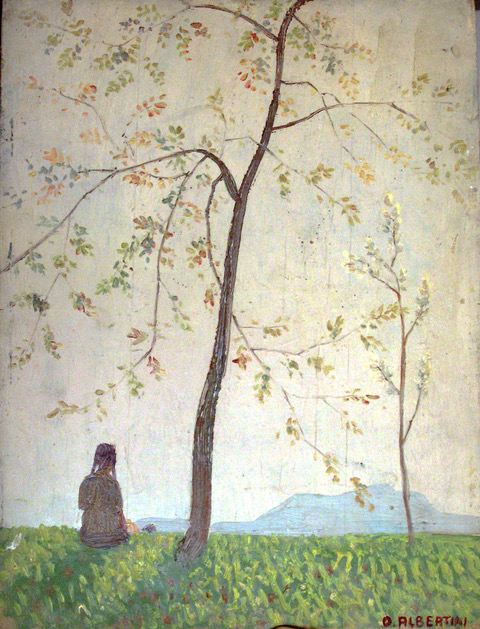
when finger tips try to see and eyes try to caress, far from words’ noise

Simryn Gill, Fall Then at 1301PE Los Angeles March 2024
She is Malaysian and lives in Australia, I am Italian and live in Los Angeles. Geographic and cultural distance. But, what if distance can approach the most remote parts of what is visible and discernible, the ungraspable emotions moving our mind through the myriad of sensory data, always contained between physical edges, until we disconnect from the immediate perception as if it was lost, and “acquire the gift of giving a more durable form to real things vanishing around us.” As life moves on, language, in exchange, does everything she can to erase herself “to open a space to the pure vision, starting an intuition completely forgetful of the words’ noise.” We flow through time. We flow hoping to keep alive the feeling of change; we take some notes, avoid stopping for too long.
‘The world flows into the self, or mingles with it or bears it, and the like. One participates in things (understand the language). In this condition understanding is not impersonal (objective), but extremely personal, like an agreement between subject and object.”


I’m serious in what I’m doing here: in two paragraphs I have sucked in, translated, and recombined some thoughts from my beloved Robert Musil, Jean Starobinski, and Johann Wolfgang von Goethe —an unrequested inheritance. I made a parody of myself as an old scholar who can’t give up the beauty of thinking and accepts the strange fusion in the mind. Fact is, Simryn Gill practices these same ideas in her journey as an artist. Reading her Passing Through I could follow step by step the formation of an art piece she produced starting from the exploration of a real thing, a derelict mid-century seaside motel in Malaysia, now liberated from the perfect modernist combination of squares after the attack of roots, leaves, trees, animals and the human devastation of the walls in search of copper wires or pipes.
I could read her mind looking for structures and decorations in detail, and follow her hands, the tip of her fingers asking the stones and floors to tell her their “internal porosity and openness…a kind of self referential, self-contained vulnerability.” “I had been – Simryn says– crawling on the floors and stroking walls in a ritual of appeasement. My cousins and I weren’t allowed to come here when the motel was in its full flight and we were in our teens, because it would have exerted a bad influence on our impressionable minds.”
Simryn wanted to graphically render the patterns as archeologists used to do. Her words: “In my version, I applied ink directly onto the patterns and details, and took the impression by rubbing the paper onto the stained surface with the back of a metal spoon.”
“I ran a bush studio out of the boot of my car: a folding table to hold a thick pane of glass for rolling the inks on, and the inks themselves, in tins; in a cardboard box under the table, my cleaning materials, cloths and solvents; on the back seat of the car, rolls of buttery Japanese paper, which is so deceptive in its fragility, so sympathetic to the heavy treatment of being beaten and rubbed.”

I wish I had seen the motel prints. Instead, I saw the bush prints at Brian Butler’s gallery, the exhibition title is Fall Then. Same kind of technique described above. Same “dexterous hands and serene intentions.”
A ritual, again. Dead branches, grasses and vines, destined to die in their new, aerial situation, are restored to life as if each of them had impressed a silent, visual speech on vertical papers. A last word, a unique symphony of forms. Tempos are visible, between each sheet and layers and superpositions behind. Light vibrations appear in transparent shadows. The forest, or the garden, aren’t in the gallery, so we only find well dressed ghosts. They maintain the freshness of the living and, let’s be clear, the artist’s tenderness, her attachment to the entire natural story as if she were a substantial component. Not an observer. Not only an observer. A wanderer, a passing bird.
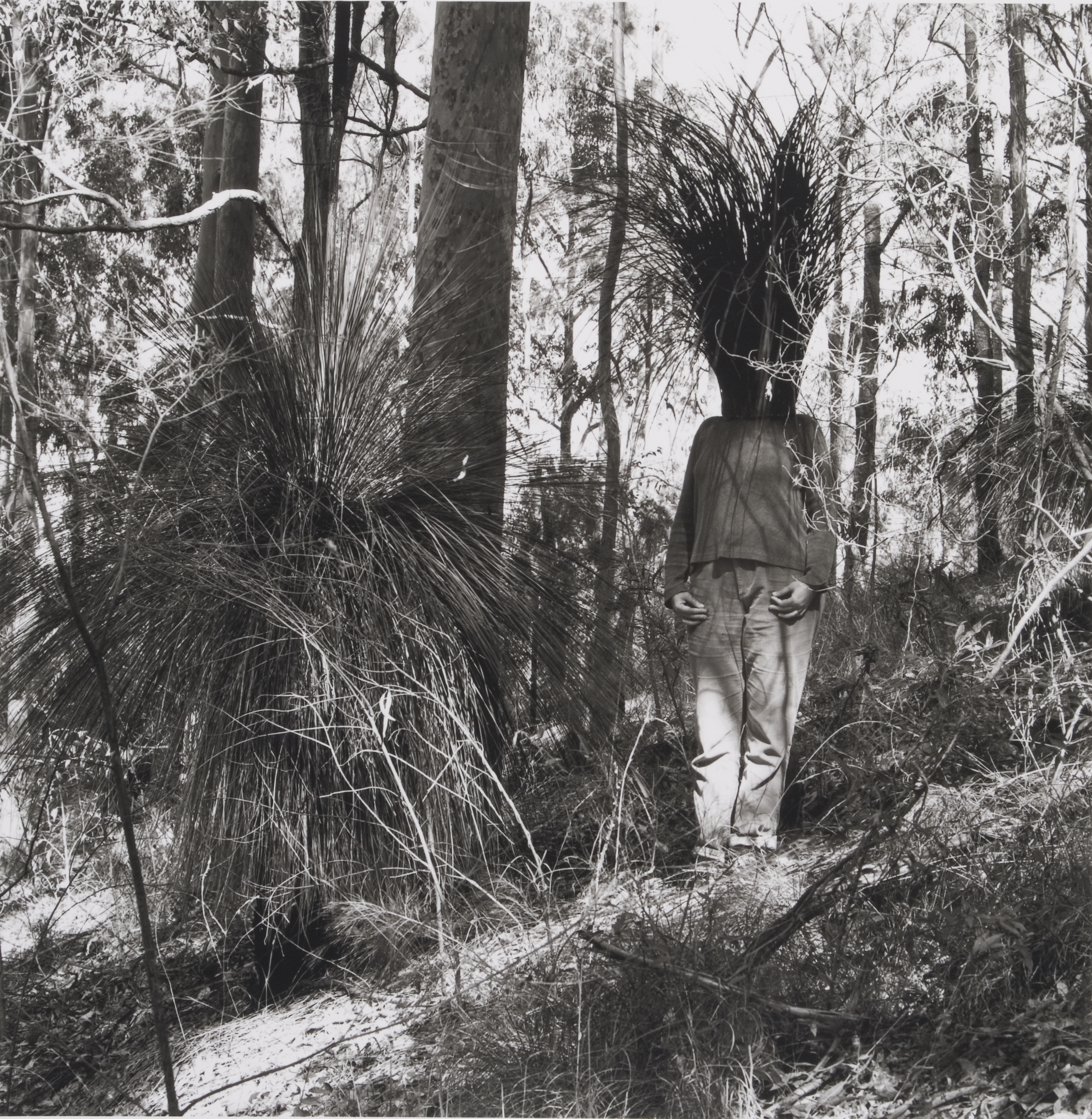
This is what she is in her 1999 Vegetation photos that she has printed in 2015… the reason for the delay is clear, they are moments of a life long journey, merging future, past and present, maybe stealing a story from the forest, and paying the penalty: colors are lost. Almost everything is secret in those images. The human head is lost as well, replaced by vegetation.
The mode of the person becomes the mode of the world,
For that person, and, sometimes, for the world itself.
The content of the mind becomes solid show
Or almost solid seen show—the way a fly bird
Fixes itself in its inevitable bush …
It follows that to change modes is to change the world.
Wallace Stevens, from Conversation with three women of New England, Opus Posthumous, Vintage Books, 1990 ©1957 by Elsie Stevens and Holly Stevens
The mode of the artist becomes for me the mode of the world. The solid seen show of humans’ physical sensations: an active exchange with the vegetation’s world, by contemplating or passing through.
I wish I had had the same impulse Simryn had saving and printing branches from Maria’s Garden when the garden was destroyed to be replaced with a building. One day the trees of the garden next door to my house, in Los Angeles, two enormous ficus and three pine trees have been killed, eliminated to build a wall. The shock I received was so strong that my mind stopped working properly and I ended up at the hospital, for suspected heart attack. It was not in my body, heart and brain were healthy. I couldn’t tell the same for my spirit. My spirit had a heart attack. I still see them, but touch them I can not.

photos RA

You must be logged in to post a comment.