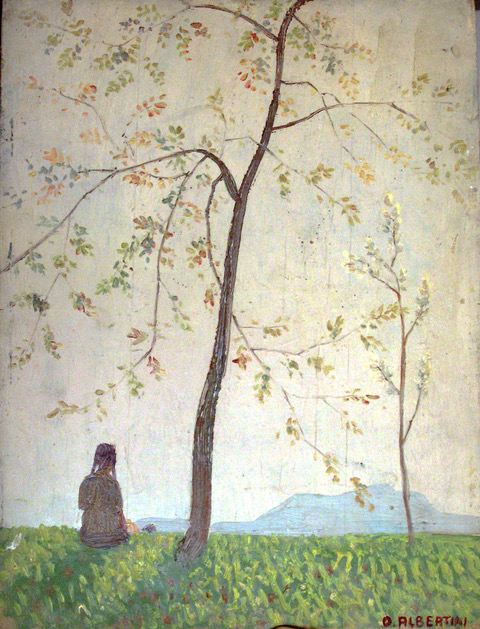
ALBERTO ALBERTINI : A legitimate future

Photographs and texts by Alberto AlbertiniMilano, Italy

LIFE AT 98

My contract with the manager of eternity is about to expire, no, not the contract itself, just the earthly clause which, due to its material nature, is objectively a nuisance. Eternity, because time doesn’t exist, doesn’t exist either. I feel cheated out of my legitimate future!

Now I’ve accumulated so many years that I can no longer go back without stumbling, and I realize that through experiences, mistakes, and enthusiasms, many personalities have followed one another like layers glued on top of each other. I’m trying to peel them off, like an adhesive label sealing a box of strawberries from the supermarket.

Among the many projects I have in mind to keep myself busy in the future, there’s also the one of studying Mahler. I’ve already made some attempts, but without the necessary conviction. There must be something more, beyond the first impression, even the second one; it can’t be that simple and therefore disappointing, despite the substantial size of the orchestra.

Alberto Albertini, Photomontage, 2025

The impression I get is that he’s a professor who knows his subject very well but doesn’t enrich it with musical ideas, at least that’s how it seems to me. I could be wrong: perhaps this is the music he wants: serene walks along paths through green valleys, visions of luminous Alps on a clear morning, the glaciers and the scent of larch resin, the tinkling of cowbells. Serenity, lightness, an almost heavenly boredom, with Heidegger hovering in Bavarian costume.

I can hear the First Symphony from the other room; I have the impression that a film is playing on television, with the symphony serving as the musical commentary: the charge of our heroes arriving, the clash and the battle, the truce, the vast prairies of the West, Monument Valley… Visconti used the Fourth Symphony to accompany the opening credits of Death in Venice, credits superimposed on a long tracking shot of the sea, thus confirming the descriptive nature of Mahler’s music. Hence, film music. A scene can completely change its meaning depending on the musical commentary, provided that the musical discourse is not valid without the scene to which it is associated, as it could distract the viewer. Will a scene always be necessary to support Mahler, or will it be sufficient to listen to him in the other room?

The room is silent, the objects surround me affectionately, the control is mine. I could turn on the radio and fill the room with music, but the atmosphere would change immediately, and the control would pass to it. I wouldn’t mind, but I don’t do it. Why? I don’t know. Is it always a delicate balance? Two worlds separated by a thin line of indecision.

When I told myself that I loved women so much that I would accept them even as just friends, I was lying. The pleasure I felt in conversation wasn’t just friendship; it was a controlled intrigue, a subtle thread stretched between two brains that were weaving a dialogue hidden from both of us. I’m sure the conversation was more pleasant and flowing because the two opposite poles were circulating the fluid, the electric current. The conversations were longer, more relaxed, and more fulfilling, and now I feel calmer.

To keep his brain responsive to the social and political present moment in Italy, AA writes regularly his observations and sends them to a Milanese Daily Newspaper: DOMANI (TOMORROW) Most of the time they are published. Here one of most recent: RA

DOMANI, November 10, 2025  What if human intelligence were in charge of governing us? I booked an appointment through the National Health Service at the Monzino Cardiology Center. I arrived at the appointment early. Ten minutes before the scheduled time I was called in for a preliminary examination, and at the exact time of my appointment I was taken in for the consultation. Before I left, the doctor advised me to keep in touch for any event or need, and I was given a phone number to book my next appointment. A (human) person answered the phone and scheduled my next appointment.

Due to a mistake in the email address, I sent a message to customer service, and the next day I called.  At extension number 6, a person (always a real human being!) answered and told me that they had read the message and forwarded it to the person in charge! So it is possible! I think that even within the intricate web of bureaucracy, much can still be done to improve the quality of life.  The lingering question remains: what will become of human intelligence? The ancient masters built palaces and cathedrals that we don’t fully understand how they constructed, how they took measurements and performed calculations. Today, a surveyor no longer carries a tape measure in their pocket, but a laser, and without walking back and forth, the laser instantly takes the measurements and performs the calculations. Why shouldn’t they use it? Thanks to it, they could have more free time, but instead, they use it to work even more.

The situation can be summarized as follows: an ever-deepening chasm splits our society: on one side, increasingly specialized scientific excellence with remarkable achievements in research and invention; on the other, the broader society that embraces and uses scientific progress to avoid thinking, leading to cultural decline.  Between these two sides of the chasm lies a new political class detached from both, incapable of understanding them and seeking to consolidate an ephemeral power by manipulating democracy before the next elections. Perhaps this is the great project that is missing: how to heal the wound. AA

Buon Natale Merry Christmas Joyeux Noel

To all my readers

Nativity is in my mind for all beings on earth, not only human.

I like the creche more than the tree.

The lyric I found

quoted by William Carlos Williams poet in a rumination

about language labored “with speech and history”

turned on surprising reaction in the readers

unimaginable to me I am Italian

my husband Peter read it with the rhythm of a song

Dominique Moody told me when she was young

during the winter those lyrics were used to advertise Campbell Soup,

a company where her father used to work.

Yet, it was the freshness of the caring words

I cherished, people we love they belong to us.

You belong to me only a little bit, dear readers,

for the time you spend grazing my words

and whipping art images to peel off a meaning.

To all of you my goodwill, not yet contaminated by thinking.

The lyrics of Button Up Your Overcoat were written by B.G.De Silva and Lew Brown. The music was written by Ray Handerson. The song was published in 1928.

Penso alla natività per tutti i viventi, non solo umani.

Il presepe mi piace più dell’albero.

La lirica che ho trovato come citazione

in una pagina di William Carlos Williams poeta

che ruminava le parole pregne di lingua e di storia

ha acceso nei primi lettori

una reazione sorprendente per me italiana.

Peter il mio consorte ha letto la lirica con un ritmo di canzone a lui ben nota.

Dominique Moody mi dice che quando era giovane

queste liriche d’inverno erano in uso

come pubblicità delle Campbell Soups, la ditta dove suo padre lavorava.

Quanto a me invece, ero presa dalla freschezza

di parole tenere, accostate per unire le persone care

all’idea che stranamente ci appartengono.

Caro lettore anche tu mi appartieni per un momento,

nel tempo che passi a brucare le parole

e a frustare le immagini delle opere per svelarne il senso.

A tutti la mia volontà buona, incontaminata dal pensiero.

Rosanna Albertini

FIONA BANNER : KICKING THE WEIGHT OF LANGUAGE

Fiona Banner    time, the anti-hero

at 1301PE 6150 Wilshire Blvd., Los Angeles

November 2025 – January 2026

The artwork gives a body to an intellectual drama. Our thinking gives up with prestige accepting to be nothing more than intelligence making appearances visible and covering them with images that don’t have reason to be.  If the world was clear, art would not exist.

Expression begins where thinking stops. 

ALBERT CAMUS. From Le mythe de Sisyphe, 1942

Dis-like, dis-quiet, dis-member, dis-traction, D I S, the 3 (greek) letters that have lived hundreds years and found a place in many languages of today, give the words a strange uncertainty: DIS ARM for instance, it’s an arm and it is not. Fiona Banner decided it is the arm of a clock. Time is gently held inside the hand, it’s human time. As the arm moves around invisible hours the human touch replaces certainty. Time is not written. Movement, inner timing, the unpredictable, surprising clock in our body hosts an infinite shrinking, or enlarging time, the son of emotions. Silent and invisible. Not a hero. 

We all are, including the artist, prisoners of languages that we love and dislike. 

They are a constant challenge. Words are the most tricky. On paper they slip away fast. If we stop on them more than a few seconds each word becomes a deep hole, understanding goes to hell. Paul Valéry showed me that. But placed on the floor cast in industrial fonts — using melted aluminum that was once the wing of a jet attack aircraft originally used by the British Royal Air Force and the French Air Force — the surviving word, V U L V A, becomes heaviness, sculpted mixture of meanings; an object, an absurd object in our face. 

As I look down between my legs, I feel my vulva — the delicate architecture of the porch to my sexual life: a soft, flexible, humid and warm system of lips — falling down to be transformed into a metallic word. What language does. The common usage of it. In her countryside wisdom my grandmother used to say, bathing the child me, that my butterfly needed care and constant cleanliness, because it was my second face. Another usage of language. 

 V U L V A :   Fiona Banner exposes the hard core of this word : there is no way out. She is right. And I thank her, because feeling the vulva pulsing in me I do know it’s an unwritten fairy tale. The artist also must have felt the harshness of the metal. She added her own feelings in graphite on paper with soft, nuanced images. VULVA is barely readable, absorbed into a cloud of gray. 

But my mind surprises me. She starts dancing, my camera moves around the still word on the floor: yes, upside down, diagonal, with Brian’ s feet, without, how much time is congealed in it, devoured by language. Not a hero. 

Camus wrote that the artwork comes from intelligence giving up: art is “the triumph of the carnal. Clear thinking gives rise to it, yet in so doing abandons its claims.”

The whole exhibition dances around me, pieces of body painted, or thrown in the air for a video. The scene is completely separate from the earth, only clouds and the blue of the sky. Real pieces of a plastic mannequin dance among the clouds apparently having a lot of fun. No AI, no 3D computer graphics. Feet, hands, head, hair, and a bust with only one leg, don’t seem destined to come back to the ground. A headless, painted feminine bust floats on the canvas upside down. ORCHESTRA is written over the breasts. 

We are so imperfect that we can’t even be always unhappy, wrote an old French guy. Art makes no exception. 

I walked out of the gallery thinking of writing as a crazy dance picking ideas from everywhere, and moving them in a smiling, displaced, imaginary conversation with the artist. I can’t avoid thinking that in music, and rhythm, time is a hero. 

Rosanna Albertini

Fiona Banner, time, the anti-hero, 2025, Mixed media, mannequin arm, paint, clock mechanism, electrical components, 57″ diameter

Fiona Banner, VULVA VOLVO (2021 now), 2025, Aluminum from Sepecat Jaguar XZ118, 63 v 6 x 4″

Fiona Banner, Vulva Volvo (2004-2012), 2025, Graphite on paper, aluminum from Tornado ZE728, glass, 16.5 x 31.5″

Fiona Banner, Obsolete, 2025, oil on canvas, 7 x 5″

Fiona Banner, Recto, Verso, 2025, Oil on canvas, 7 x 5″

Fiona Banner, Orchestra, 2025, Oil on canvas, 7 x 5″