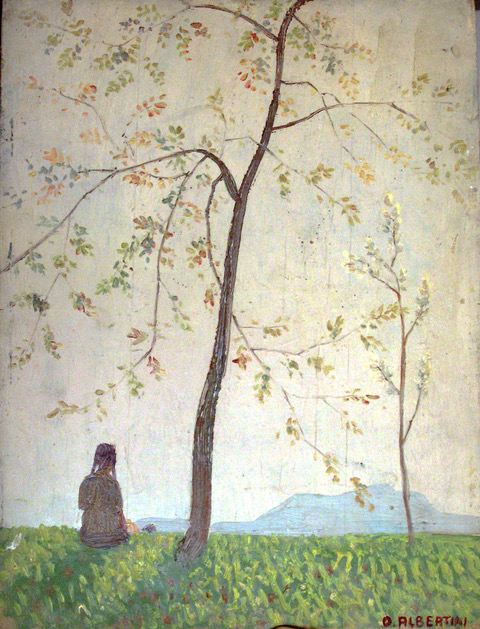
Drawings by Edgar Honetschläger
Text by Rosanna Albertini

One word: Napoli, and immediately those absurd, harsh and fascinating ten years, hard to tell which attribute in accordance with reality, my years from ten to twenty, come back with a big bag of emotions. Instead of turning them off, this time I keep them simmering for a couple of months, trying to understand why I love Naples more than any other Italian city, as my growing body and my mind’s displacement stretched muscles and bones of a person becoming more and more a stranger, a stranger to both her family and the city, maybe to any urban place. As a matter of fact every year I was in Naples only the three months of summer, the rest of my life was in Milan, in the house of two Neapolitan aristocratic women. To tame the savage girl from the woods seemed to be their mission. They poured into me the same education they had received.
That age is the most confused. Had I let space to feelings, I wouldn’t have survived. Keeping them quiet under my feet, instead, I walked out of the house every morning. The city of Naples was my new space, unfamiliar, captivating, calling for walks all day long … through days of a solitude that was welcomed. The city as well — notoriously crowded —- was empty in my eyes, with phantoms from the ancient days more real to me than people all round about. I went everywhere by myself as I used to do in my northern village as a child, exploring every inch of the woods on the mountains, memorizing the sites of the first snow flowers, and of the first violets. In Naples, I was surprised by capers growing in the cracks of the old stones, by large steps climbing the hillside in acute angles. Their geometrical shape, to tell the truth, was altered by irregularities inflicted on the stones by aging and abandonment, so they could be in agreement with the natural chaos around.


When my friend Edgar Honetschläger told me he was in Naples for an exhibition of paintings, and was about to spend two months there, I asked him please to go and visit my favorite places and take photos or, better, make drawings. He did it. The drawings he sent me are, surprisingly, the exact portrait of perceptions I still cherish, as if engraved in my heart. Images of emptiness and solitude vanishing, delicate, through the noise of the living. I wish my thoughts, my words, could be weightless like the lines traced by my artist friend. Floating outside of time. Impossible: many of my words will be covered with spines.
I could fill the emptiness around the roman theater, the infinite amount of steps, the fountains with no water and the flat facades of big buildings condemned to a decay that is almost philosophical, simple: every thing moves and changes and shows the many faces of time. I could bring you to my favorite convent and its hidden garden decorated with blue tiles, it would be stupid, a post card. And because memory is a chemical blender reshaping fragments of life according to the present mood, not at all a gallery of images, right now I get rid of it. Briefly, I want to see inside me: what was I, what that damned girl in a blue skirt had built up by treading herself into the hot sidewalks and the crumbling stones of a Southern city.


First of all, she forgot fear even existed. No TV in those days. Nobody will bother you if you look at them in the eyes — I thought. I might call it an instinct. At twelve, thirteen, sixteen, the smell in the air, attitudes, sounds, push thoughts into a corner. Colors and spaces are devoured by the eyes. Plus, the education from the Neapolitan ladies: if the door is closed, never intrude. You can knock if time is right. Meandering through the vicoli of Spaccanapoli, a narrow street that splits the city like the pulp of a melon, from the hill to the sea, she felt people were keeping their privacy even if the door was wide open, even when their life spilled into the street. Look at their eyes, not at their space. Back home, she didn’t have to report. Decades later, in Pazcuaro (Mexico), she found herself in the same situation: an old man who sat on a bench in the middle of a sidewalk was peeling a heap of onions using a knife. The passage was almost blocked. We looked at each other for awhile. After which he silently offered his hand to her, a hand almost blackened by onion juice. We had a strong, frank shaking more eloquent than a long conversation. She was allowed to pass.


Milan, in the North, was another world, the realm of a working class whose dignity, after the end of World War II, had been rebuilt at the price of incredible sacrifices. Cleanness and order a rule for everybody, rich and poor. Pride hidden in the chest, no eye contact, but attention was a duty, as help if necessary. Chacun pour soi. The human forest like drops in the fog. In the 50’s and 60’s the fog was so thick that to cross the street was hard, without seeing the other side. Smog. Cold from September to May. In a corner room where the library was, frequently shaken by the tramway on rails curving around the building, the girl found a major way out from the strange situation in which she had been placed, and abandoned. Books became a safe world. Nobody could reach her there. And she fell in love with archeology. Yes, Foreign countries and excavations, but also, for her, a mental space populated by Homer and Virgil stories, with languages she could feel in Neapolitan dialect. Latin and Greek alive like her present Italian. Being within each word. Becoming a present. In Naples, she searched for sites, names, or looked at people as if belonging to an unfinished time. Her mother was the perfect animated Greek statue, perhaps more acceptable because of her physical features. She was from old Capua, where Hannibal lost the war losing time with women and wine. Was father like Hannibal? And god knows how many African genes.
The girl followed all the inviting pathways in both cities, South and North. Transition was the most difficult. Twelve hours by train, back and forth. The other travelers were migrants from Germany, Belgium, Northern Europe. They passed on wine and food, cutting cheese and apples with a knife and bringing the slice directly into their mouth using the blade. They were kind, offered food to her. She never accepted, her stomach tight like a fist, struggling against nausea.


Although the South was attractive, the girl’s belonging was nowhere. A blind poet of these days talks of the “spectral realms of memory.” Along with growing taller, the girl carried her baggage of confusion. In Naples she missed the soft grass of the countryside near the lakes not far from Milan; In Milan she missed the unruled spirit spread all over the daily adventures, her mother negotiating the price of a bunch of flowers as if it was a bracelet of diamonds, or the 12 year old boy transporting fruit and veggies to the house, a strong and arrogant outsider. “Italian, myself? I am not Italian, I’m Neapolitan!”


In her blue skirt, the girl was a seed lost in the immense realm of human struggle for millennia, along with all the dead, some echoed by poems, graffitis and frescos, statues and paintings. It was astonishing that so many made it to the present. She needed her own ground to become a person, to feel free from all the boxes imposed by survival needs. And she found it, or built it, I don’t know. Or perhaps she was shaped little by little by reality, that was thick and ancient, and blowing up the last night of the calendar like a bomb of unhappiness finally exploding, vaporized in dark, choking smoke. Right now, of course, I am a “chimerical museum of shifting forms. A heap of broken mirrors.” Thank you Borges. And thank you life, in which I discovered the joy of imaginary presences, linked to my own cave age, mental shadows quivering in me in front of mountains opening their mouths in caves where ancient Etruscans were placed for their eternal rest, or when my hands paused on the Roman stones, or the pages of old volumes, trying to absorb the unknown of past lives. The girl was searching for a new beginning, the core of the apple. She fell in love with mother earth.
The night could well be the unfinished part of the day. And she is as vast as the day is.
Edmond Jabès
Writing became a passion much later, pleasurable dirt on paper. The shadow took the shape of words. The arts became another passion, the phrenesis (frenzy) of giving to unknown readers some sparkles of surprise, questions, — contemporary arts still do not have an easy reception — and my own dreams of enthusiasm. This happened, maybe, thanks to that separate, isolated flexible bubble I had wrapped around myself in Naples, like an ancestors’ toga. Or it was a sculptural gesso, in Naples crumbling like tufo, the local rock, that solidified around my personal emptiness, and filtering experiences ended up protecting the tender branches of my brain. I know artists have their own bubble, each a different one. I never tried to undress them, I only give myself the freedom to put my finger on their core. A never ending, almost impossible task. That’s my dream for the day. Goodnight.


You must be logged in to post a comment.