following the flowers at FRIEZE LA 2023

by ROSANNA ALBERTINI –

photos RA (visual notes highly improved by my husband Peter Kirby)

One step inside, and the Stendhal syndrome alters my mental clarity. Confusion, dizziness: art fairs are not the place for celestial sensations. They are not the best place to encounter art at all. Personal sensations are overflowed by a loud orchestra of colors and forms, and shrunk by the effort of reading microscopic labels. Very few doing that. 

I’m too curious to give up. To keep my sanity I think of David Hockney’s flowers, and follow the flowers, if there are any. My visit turns out to be surprising, it takes a long time. Yet, I’m not writing a review. I was in an odd space, parallel to the commercial effort at the origin of this big show, that’s why I don’t mention galleries. I keep myself there. Looking for art of today, wanting to savor something new.

The first painting that stops me is familiar and unexpected: Piero D’Orazio geometric abstraction  Light Colors, 1962. Those colors are a musical space weaving the spirit of flowers so tiny and delicate they hardly last a day; they just open the eyes and sleep, protected by a grid that doesn’t hurt them. Of course, they are mental. And the mind perceive them more than the eyes. World War II is around the corner, I am seventeen, I buy a newspaper for the first time, get lost. In Italy we are all survivors. Light colors are hope and a sense of flutter in the stomach. 

William Kentridge – Black & white flowers in a vase, as tall as a human. Art of now. Really, they are two drawings emotionally clinging one to the other. The small on the ground is a contemporary Goya, soldiers shooting at people. Life and death crept into the flowers sucking out every color. The eyes’ sensors transfer this feeling in my brain, blindness not allowed. 

“I want to know how it feels to be them.” Words by Chantal Joffe. She means the people she portrays; her flowers share with them the same powerful manner of her painting. Stems and leaves are forced in an undesirable place, cornered. The vase as well isn’t comfortable. I keep seeing the two round sides of the vase as if they were stems folding down. Not reasonable, I know. Believe me, these painted flowers are pushing themselves out of the canvas. (Cornflowers, 2020) Let’s praise this artist, without nostalgia for Van Gogh.

Ana Mendieta – Flower person, 1975. She convinces me. Real flowers for the body and a stick as a pillow, with fake flowers. Nothing’s heavy. Her soul is dressed white and pink, as is her body. For a moment flesh and blood are forgotten. I forget her death. I had a similar vision when I was nine, on a hot afternoon, while covering my body with tiny white flowers just before a hemorrhage started from my nose, that no one was able to stop. 

Yoshitomo Nara, Under the Hazy Sky, 2012   Like a piece of music, bringing all the vibrations of the empty space around a little person completely absorbed into the mystery of thinking: what are those minuscule double leaves? Did I killed them picking them up? They didn’t cry. They smell a little, must be alive. 

Michal Rovner – Pragim (Poppies) 1 2023 LCD Screen.      A sculptor of time in video forms, Michal makes visible the uninterrupted movement of people and things. Her effort is to reveal the truth of their movement. It can be a human population or leaves or flowers. The universe plays in their lives more than we imagine. Poppies float in a restricted space; withered petals are subdued into gray, brown, or white colors. The physical soul of the stems remains thin, tall, extremely fragile. Is the artist giving a vegetable look to the endless battle between Israeli leaders and Palestinian? An image of exhaustion?

 Paul McCarthy – Silicone 2020-2023  Painted silver, it is not silver. The three stereotypes of Disney’s characters are caricatures: a loquacious duck is for Snow White. Comedy replaces drama & dreams, vive Stendhal. OMG Paul, this is so sad! You know? Even more because those flowers, to me, are thick and round, like money. This little sculpture is a mournful monument to the end of an empire, also the end of so many people dreams. My father would have been one of them. One day he appeared in the garden, where I used to spend the whole day as a child, waving a sheet of paper. “He answered!” he told me barely containing his excitement, “This is Walt Disney’s Picture and his signature!” He had sent to California an advertisement offer from the Italian version of Topolino, Micky cartoons, pretending he did it for me. To his dismay, I couldn’t care less and did’nt open my mouth. 

Jean-Marie Appriou – Cherry blossoms 2022 Painted bronze.  A French sculptor. From the on-line display I see he made many of these pieces, to express peculiar feelings. It’s a beautiful, strange piece, a stranger in the show. It brings me to remember similar decorative sculptures in Italian cemeteries. (The place where Lucio Fontana came from, working with his father). Today, in Los Angeles, it seems like a gentle alien from another time, I liked the surprise it gave me, still I am touched.  

Jeff Koons  Puppy, 1998  Porcelain vase, Edition of 3000. A dog 3000 times humiliated to hold flowers. I have sympathy for him.  

Doron Langberg – Sunflowers 2, 2022   A young painter from Israel who lives in Brooklyn happily sharing ideas and experiences with a small community of artist friends. It sounds new to me, as new as Gertrude Stein Picasso and others in Paris in the 20s. One reads about them, hoping it happens again. One hundred years after. Doron declares his connection to Bonnard or Van Gogh in a simple way. Right. His artworks are completely new, original  and inspired, incorporating hints from the past. I would never be tired watching these sensual, hard-living and dying sunflowers. I thank him. 

Giorgio Morandi   – Surprised, in my quest for flowers, I can’t avoid an act of devotion to Morandi’s still life. Flowers were in the vases, now empty. Their cycle ended, the whole painting holds onto the idea of tender colors, inorganic bodies reflecting pink. 

Laura Owens –  Untitled 2023  But I see flowers. Don’t mistake me. The real flower in this piece is the act of painting: thickness and flatness without conflict; delicate small details between spots of color that seem to come directly from the tube; a vine with leaves is the background of a red and blue dance of large commas with no text; it’s an earthly painting that includes the sky and the sea in a luminous window, superposes day and night. There are no clock hands turning these colors off and on. Only a marvelous crack in the artist’s mind. No photograph can render such work. 

John Chamberlain, Untitled 1962     Painted copper. Isolated in a corner, the 15x21cm sculpture fell from the sky of unreasonable objects, wishing the market will find a place for her. It was an outgrowth from the artist’s hands. I see a bud with 2 geometrical pistils expanding in search of pollen, a desiccated flower magically turned into copper, whose colors never fade.

Pae White,  Cyan I am  104.5 x 10⁵ in  A big tapestry, extraordinary. Once more, not for photos. Forgive the images’ imperfection. Based on colors: cyan is dominant and yet yellow and pink are a massive presence. Flowers, maybe, or and fireflies? Not the point. The visual impact is powerful and gentle at the same time. Not that far from D’Orazio texture of light colors. As a portrait of a natural fable it makes you forget the urban scene in which you move. It makes you want to stay, and lie down in the grass and look at the fireflies at the end of the day. You also become Cyan.

A marathon of writing. After all, I crossed Frieze like a knife on a couple of legs, and this post is my own Fontana cut through the art I saw. Fontana must be mentioned by necessity: his works were the largest presence in the whole exhibition. Among many honest and often interesting artworks, perhaps burdened by absorbing the immense amount of perceptions and data, natural and artificial, and by struggling to find a personal focus —the ‘domestic heart’ in our garden of dramas and contentment— I feel grateful. Grata, we Italians say. We are particles in the sand of history.

The present is the only reality we belong to. Some of the last words by Marcel Duchamp say the Art of today is the only one we understand. What about the past? (Future is in question) I would say Art made before is a visual vocabulary enlarging our experience. No copy, no appropriation by young artists. Just available information like words we speak and melodies we sing. Some contemporary composers remake in their own spirit classic pieces they love. It isn’t stealing. It’s digesting. Visual artists do the same with impressionism, cubism, ancient art and are completely themselves. Nothing is hidden.

The artist as a hero was a myth. Fontana in the middle of all that is a good reminder: the foliage of the world gives us a home, but we still have to cut the surface to the core, if we want our existence to move on.

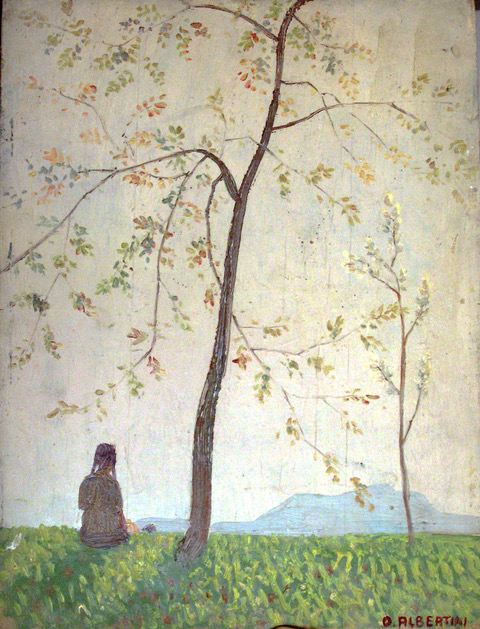
Origins are sweet, though. The following image is a painting by Oreste Albertini, my grandfather, and the girl is me. A fantasy landscape. I only have a B&W photo.

JEROME ROTHENBERG and CHARLIE MORROW: BREATHING

BREATHING …. our perennial COMEDY OF MISTAKES

with JEROME ROTHENBERG and CHARLIE MORROW, ROSANNA ALBERTINI and CHARLES-LOUIS de MONTESQUIEU


RA    missing eternity and perfection, we rely on counting, measuring and forgetting

JR    There are worlds here / hidden from sight / whose ends are like / their beginnings

RA    and yet we move on changing confident that time will do the right job and memory will be a safe

JR    that farce replaces tragedy / obscene even to think it / & yet to come into another age / & find it proven true

MONTESQUIEU    I’m not a poet, but I know it, the becoming is universal soul, almost a wind, a  life-giving breathing: a “principle” produced by an infinite chain of causes interwoven through centuries, until they tune the spirit of one age.  Once the tone is given, it is the only governing force, it dominates until the total destruction. If the tone is corrupt, humans can only forget themselves.

 RA    I’m not good at counting. Please Jerry, tell me it is not true we must be reminded of a vanishing earth

JR    some will proclaim the word / against all odds / others can only wait / & wonder  


 Rothenberg’s house, Saturday, August 24 — Videos by Peter Kirby 

Charlie Morrow playing various instruments, Jerry Rothenberg reading


Jerome Rothenberg, NEVER DONE COUNTING, 2019

Enclosed by matter /all my thoughts / scream for prophecy. / When I wake up on Mondays / the night is still hanging / above me galaxies / shedding their images /fading unknown / in the half light / a light that confounds me. / Nothing we know is unreal / & nothing is real. / There is only the face / of a woman / blind in the sun / & a voice that cries out / in a language like French. / When she raises her arms / they look distant and lame, / something there / that won’t work but falls flat / against me. I will follow her / up to the moon, will watch her / paint herself red / with no sense / of the distances still to be traveled, / no plot to adjust to / but numbers / that show me / the little i know,  /  the way one / vanishing universe /  shrinks till it swallows / another. / There are worlds here hidden from sight / whose ends are like / their beginnings,  / the world in daylight / turns dark / the blaze of noon / caught in their mirrors, / as the sun slips / through our fingers / never done counting / where the globe / has dropped / out of sight.*

Jerome Rothenberg, THE POEM AS LANDSCAPE, 2019   

the definition of place / is more than / what was seen / or what was / felt before / when dreaming / of the dead / the way / a conflagration / wrapped itself / around his world / leaving in his mind / a trace of dunes / the fallout from / a ring of mountains / reminders / of a vanished earth / the landscape / marked with rising tufts / the hardness of / clay tiles / that press against  / our feet like bricks / the soil concealed / beneath its coverings / through which  a weave / of twisted wires / crisscross the empty / fields as markers / to commemorate / the hapless dead / the ones who fly / around like ghosts / bereft of either / home or tomb / in what would once / have been their world / the count fades out / beyond 10,000 / leaves them to be swept / down endless ages / fused together / or else apart / lost nomads / on the road / to desolation / a field on mars / they wait to share / with others / dead at last**


The mystery is all contained in speaking

then the little silences

surround my words like poetry

I breathe them in & out***


Whiteness grows around Charlie Morrow’s images and words, around which we should imagine a space expanding, with no edges.  Each verbal suggestion is the core of a sound event. Our mind can hear.


CHARLIE MORROW

1 

 B o o k  of  B r e a t h

2

3


Life birth                                                                               breathing in

                                                    two hearts two years early on

4

Breath Chant

5

Kaddish Tibetan

6

Breeze

vegetable breezes

7

Whisteling in and out

8

Breath and Bells

9

Wind Song

10

Birth of the Eagle Voice

11

Remembering Breaths

12

Breath of Love

13

la petite mort

14

Death                                                                                 breathing out

                                                                            On the assent of the fragile


As for me, I hold my breath.

I hold my breath trying to keep it in me as long as I can, facing the last edge. That’s the way my life moved, from an edge to another, suddenly immersed in spaces where everything was new: faces, language, smells, temperature, colors. I was I because my dog recognized me? Not even that. My dog had been killed by cigarette smugglers near the house of my birth. I was moved to the city. My dialect, the freshness of leaves in the wind, and the small white, soft flowers climbing the bushes, careless of spines, were replaced by the odor of soup mixed with vapors of bleach at the entrance of my apartment building. The fog sucked me in, licking my adolescence out of me. Later the lagoon cuddled me every day on my way to work on the boat, the bus, the train, the boat again, shaking my more mature energy out of my body. Life was breathing, not me. And I was not more than one of the many particles she digests, like the ogre of fairy tales. One story after another, waves of living pealed the years off, bringing me in front of the unknown, one more time. What’s after the last breath? I am so curious I can’t express it. I am so happy. The desert where I am now erases all fears: it’s a blooming of nothingness, for the nothing we are. 

Now I see what my grandfather painted when he placed me sitting on the edge of a landscape, looking at the void. The painting was made in his studio, a fantasy about my future, probably. He also placed himself in the scene. He is the tree behind me, as I felt him all my life long. We are wrapped in light, and mad with love for this life that annihilates us.  

Rosanna Albertini

ORESTE ALBERTINI, Title and year unknown, about 1950

Bibliography:

*Jerome Rothenberg, The President of Desolation & Other Poems, Further Autovariations Reminders of a Vanished Earth, Arrangement and edition © 2019 Black Widow Press

**Jerome Rothenberg, The President of Desolation & Other Poems, 2019, Further Autovariations Reminders of a Vanished Earth, Arrangement and Edition © 2019 Black Widow Press

***Jerome Rothenberg, from The Mystery of False Attachments, Word Palace Press, @ 2019 

Charles-Louis de Montesquieu, Storia vera, with translation and postface  by Rosanna Albertini, Palermo, Sellerio Editore, 1983


ALBERTO ALBERTINI : CASTLES IN THE AIR

Alberto Albertini :  CASTLES IN THE AIR

August-September 2019  Alberto is ninety two

from Milan (Italy)- DRAWINGS AND PHOTOGRAPHS by Alberto Albertini


Note of the editor and translator, Rosanna Albertini

Alberto’s father was my grandfather, the painter Oreste. The family gave us a common humus in the same village and a pull of genes, but this blog is the place of our reciprocal discovery, challenge and collaboration. To be part of the same family is a coincidence, whereas to think and write together is a double journey, the way to question our attachment to the arts through the knotted branches of our lives. 

Each time Alberto sends me a new piece, I know that this project makes sense. The whole blog, not only the single chapters. Why? Fernando Pessoa already wrote it better than I could: 

“The simplest —but really the simplest— things, which nothing can make semisimple, become complex when we live them.” 

A sort of “shame of existing” most of the time shuts my voice off in public situations, as if having to speak out loud implied audacity. The blog doesn’t make any noise. Through the blog Alberto and myself listen to each other’s secret voice. I truly feel at home, if he also does I don’t know. I hope so. 

“The /constant/ analysis of our sensations creates a new way of feeling that seems artificial to anyone who analyzes it with his intelligence instead of with his own sensation.” (Pessoa) 

That’s why I open this post with a few lines Alberto wrote about infinity. They interestingly connect to Kuitca’s sensation of painting, in the post that precedes this one. And they perfectly fit in my vision.

The surface.

The canvas in tension immaculate.

A provocative portion of infinity, the infinite power to represent ideas on canvas. In front of the surface the dismay of tracing an essential sign that could express by itself not ideas, rather the act of opposing infinity, a sign containing every thing.

Fontana, with a slashing cut, hits this power that the surface gives off.

The surface is still there, and is not. The slash broke infinity as well as its power. It tells us the gesture, the extreme attempt at expressing by only one sign another infinity, unfathomable, of the artist.

Alberto’s canvas is his life slashed by the war, and lightened by simple things, like the castles. 

CASTLES IN THE AIR

by Alberto Albertini

I was nine years old when Snow White and the Seven Dwarfs was released, in 1937. I believe it was the first time I saw a castle. It grew bold in the sky, arousing my fantasy, in the movie it didn’t have to be rooted on the ground. Despite the boring songs and the shaky images, a sort of hitch, the movie revealed a dreamworld that could be extended afterwards. My brain started to produce its fancies, and I tried to draw more beautiful castles, more daring.

Having the right conditions, maybe I would also have built a castle as Ludwig II did in Neuschwanstein. I only dreamed of castles by making drawings. But drawing is a privileged activity: while you do it, it allows you to travel beyond the drawing, fancying romantic stories of young women in the clearing of the enchanted wood. That’s why maybe I couldn’t learn poems by heart; they were not fantasies produced by me! In the end, to stimulate fantasy is the true meaning of reality. Why should we stop reality in one click?  To preserve the starting image of a journey. 

Castles, castles, castles…

Castles in the air, as when I dreamed of having a camera I couldn’t buy and drew it in a project, taken by the illusion I could build it; or a little later, in 1945, I was struck down by the ERMANOX, Salomon’s fotocamera from the twenties, it was already vintage. In order to buy it I wanted to make an amplifier and sell it to have the necessary money. The amplifier was made but not sold: it ended being rented by the improvised after war ‘balera,’ an unpretentious dance hall nearby. 

Heart-wrenching mazurcas, tangos and waltzes, sounds reaching us from afar as she and I leaned out of the window of our room trying to absorb the pleasure of that sadness. Desire and imagination are also good for building and inventing as I eventually did: dreams in a drawer from which sometimes one takes something out. Because an intense activity of imagination requires time, if one doesn’t have enough time, it happens that his brain follows two directions at the same time: taking care of the job with the mind away from it, thus running the risk of losing the job. It happened to me just when I was beginning to go back up.

My conversion, nevertheless, was never complete. The business trips were a perfect opportunity: I could quickly abandon my contact person to get the train to the airport, glad when I saw from the window a profusion of broom flowers. I could breathe! And what about brooms near Lake Trasimeno?

Such alternative work can be also practiced quite late in life, but it’s less satisfying of course, one can’t throw himself too far and eventually makes do with sensations, atmospheres. Not memories! I detest memories. What are they for, to be stirred by happiness again? Certainly not. Facts existed, there they stay. Atmospheres are something else: a smell of wood’s sawdust instantly evokes the sawmills of the alpine valleys, the pinewoods. For a moment one feels there. Or the smell of the sea…

ALBERTO ALBERTINI, Roofs in Corso Garibaldi, from his window.

I take my time reading the newspaper, then I stop and start looking at the objects around me: bookcases, books, photographs, memories piled in containers that I will not open; boxes, playthings scattered on the shelves blocking the access to books I don’t care of looking for, or on hold to be shelved. It will not happen. My big screen PC contains a life, my life taking photographs: I have in mind to select them by subject, to make virtual albums. I will certainly do it. There are also the paintings but I don’t see them, on the side walls. Their presence is enough to keep my mind at rest. The sun makes a square of light on the wooden floor that reverberates heat in the room, the window open, the morning air still pleasant. 

Twenty, twenty-two years in such an intimate island so much inside the city, almost unreal, to go down and communicate, to go up and meditate. How much more time? Not so much, it can’t be, yet I take it in wanting to exalt sensations that age is wearing out. What can be done in order to have such a long life? a lady asked me while waiting for her number: to have a project, a destination, a purpose! still I have some projects, if I don’t hurry I can keep them to prolong my life. 

I know I’m not eternal, I’ve started to feel my years a while ago and yet I also feel I’m eternal, who knows. Who knows who I really was, some remorse resurfaces, is it possible to live with nothing to regret? I can stand the stains spread on my consciousness.

ALBERTO ALBERTINI, Outline of the nocturnal city, from his window

Late in the night, from the window I see the street, it’s almost empty. Somebody comes by. A few windows are lit: didn’t they go on vacation? What are they doing still on, at that time? 

ALBERTO ALBERTINI, Looking out the rear windows of his building

Bibliography

Fernando Pessoa, The Book of Disquiet, composed by Bernardo Soares, assistant bookkeeper in the city of Lisbon. Translated by Alfred Mac Adam, Exact Change, Boston, 1998