by ROSANNA ALBERTINI –
photos RA (visual notes highly improved by my husband Peter Kirby)
One step inside, and the Stendhal syndrome alters my mental clarity. Confusion, dizziness: art fairs are not the place for celestial sensations. They are not the best place to encounter art at all. Personal sensations are overflowed by a loud orchestra of colors and forms, and shrunk by the effort of reading microscopic labels. Very few doing that.
I’m too curious to give up. To keep my sanity I think of David Hockney’s flowers, and follow the flowers, if there are any. My visit turns out to be surprising, it takes a long time. Yet, I’m not writing a review. I was in an odd space, parallel to the commercial effort at the origin of this big show, that’s why I don’t mention galleries. I keep myself there. Looking for art of today, wanting to savor something new.

The first painting that stops me is familiar and unexpected: Piero D’Orazio geometric abstraction Light Colors, 1962. Those colors are a musical space weaving the spirit of flowers so tiny and delicate they hardly last a day; they just open the eyes and sleep, protected by a grid that doesn’t hurt them. Of course, they are mental. And the mind perceive them more than the eyes. World War II is around the corner, I am seventeen, I buy a newspaper for the first time, get lost. In Italy we are all survivors. Light colors are hope and a sense of flutter in the stomach.

William Kentridge – Black & white flowers in a vase, as tall as a human. Art of now. Really, they are two drawings emotionally clinging one to the other. The small on the ground is a contemporary Goya, soldiers shooting at people. Life and death crept into the flowers sucking out every color. The eyes’ sensors transfer this feeling in my brain, blindness not allowed.

“I want to know how it feels to be them.” Words by Chantal Joffe. She means the people she portrays; her flowers share with them the same powerful manner of her painting. Stems and leaves are forced in an undesirable place, cornered. The vase as well isn’t comfortable. I keep seeing the two round sides of the vase as if they were stems folding down. Not reasonable, I know. Believe me, these painted flowers are pushing themselves out of the canvas. (Cornflowers, 2020) Let’s praise this artist, without nostalgia for Van Gogh.

Ana Mendieta – Flower person, 1975. She convinces me. Real flowers for the body and a stick as a pillow, with fake flowers. Nothing’s heavy. Her soul is dressed white and pink, as is her body. For a moment flesh and blood are forgotten. I forget her death. I had a similar vision when I was nine, on a hot afternoon, while covering my body with tiny white flowers just before a hemorrhage started from my nose, that no one was able to stop.

Yoshitomo Nara, Under the Hazy Sky, 2012 Like a piece of music, bringing all the vibrations of the empty space around a little person completely absorbed into the mystery of thinking: what are those minuscule double leaves? Did I killed them picking them up? They didn’t cry. They smell a little, must be alive.

Michal Rovner – Pragim (Poppies) 1 2023 LCD Screen. A sculptor of time in video forms, Michal makes visible the uninterrupted movement of people and things. Her effort is to reveal the truth of their movement. It can be a human population or leaves or flowers. The universe plays in their lives more than we imagine. Poppies float in a restricted space; withered petals are subdued into gray, brown, or white colors. The physical soul of the stems remains thin, tall, extremely fragile. Is the artist giving a vegetable look to the endless battle between Israeli leaders and Palestinian? An image of exhaustion?

Paul McCarthy – Silicone 2020-2023 Painted silver, it is not silver. The three stereotypes of Disney’s characters are caricatures: a loquacious duck is for Snow White. Comedy replaces drama & dreams, vive Stendhal. OMG Paul, this is so sad! You know? Even more because those flowers, to me, are thick and round, like money. This little sculpture is a mournful monument to the end of an empire, also the end of so many people dreams. My father would have been one of them. One day he appeared in the garden, where I used to spend the whole day as a child, waving a sheet of paper. “He answered!” he told me barely containing his excitement, “This is Walt Disney’s Picture and his signature!” He had sent to California an advertisement offer from the Italian version of Topolino, Micky cartoons, pretending he did it for me. To his dismay, I couldn’t care less and did’nt open my mouth.

Jean-Marie Appriou – Cherry blossoms 2022 Painted bronze. A French sculptor. From the on-line display I see he made many of these pieces, to express peculiar feelings. It’s a beautiful, strange piece, a stranger in the show. It brings me to remember similar decorative sculptures in Italian cemeteries. (The place where Lucio Fontana came from, working with his father). Today, in Los Angeles, it seems like a gentle alien from another time, I liked the surprise it gave me, still I am touched.

Jeff Koons Puppy, 1998 Porcelain vase, Edition of 3000. A dog 3000 times humiliated to hold flowers. I have sympathy for him.

Doron Langberg – Sunflowers 2, 2022 A young painter from Israel who lives in Brooklyn happily sharing ideas and experiences with a small community of artist friends. It sounds new to me, as new as Gertrude Stein Picasso and others in Paris in the 20s. One reads about them, hoping it happens again. One hundred years after. Doron declares his connection to Bonnard or Van Gogh in a simple way. Right. His artworks are completely new, original and inspired, incorporating hints from the past. I would never be tired watching these sensual, hard-living and dying sunflowers. I thank him.

Giorgio Morandi – Surprised, in my quest for flowers, I can’t avoid an act of devotion to Morandi’s still life. Flowers were in the vases, now empty. Their cycle ended, the whole painting holds onto the idea of tender colors, inorganic bodies reflecting pink.

Laura Owens – Untitled 2023 But I see flowers. Don’t mistake me. The real flower in this piece is the act of painting: thickness and flatness without conflict; delicate small details between spots of color that seem to come directly from the tube; a vine with leaves is the background of a red and blue dance of large commas with no text; it’s an earthly painting that includes the sky and the sea in a luminous window, superposes day and night. There are no clock hands turning these colors off and on. Only a marvelous crack in the artist’s mind. No photograph can render such work.

John Chamberlain, Untitled 1962 Painted copper. Isolated in a corner, the 15x21cm sculpture fell from the sky of unreasonable objects, wishing the market will find a place for her. It was an outgrowth from the artist’s hands. I see a bud with 2 geometrical pistils expanding in search of pollen, a desiccated flower magically turned into copper, whose colors never fade.


Pae White, Cyan I am 104.5 x 10⁵ in A big tapestry, extraordinary. Once more, not for photos. Forgive the images’ imperfection. Based on colors: cyan is dominant and yet yellow and pink are a massive presence. Flowers, maybe, or and fireflies? Not the point. The visual impact is powerful and gentle at the same time. Not that far from D’Orazio texture of light colors. As a portrait of a natural fable it makes you forget the urban scene in which you move. It makes you want to stay, and lie down in the grass and look at the fireflies at the end of the day. You also become Cyan.
A marathon of writing. After all, I crossed Frieze like a knife on a couple of legs, and this post is my own Fontana cut through the art I saw. Fontana must be mentioned by necessity: his works were the largest presence in the whole exhibition. Among many honest and often interesting artworks, perhaps burdened by absorbing the immense amount of perceptions and data, natural and artificial, and by struggling to find a personal focus —the ‘domestic heart’ in our garden of dramas and contentment— I feel grateful. Grata, we Italians say. We are particles in the sand of history.
The present is the only reality we belong to. Some of the last words by Marcel Duchamp say the Art of today is the only one we understand. What about the past? (Future is in question) I would say Art made before is a visual vocabulary enlarging our experience. No copy, no appropriation by young artists. Just available information like words we speak and melodies we sing. Some contemporary composers remake in their own spirit classic pieces they love. It isn’t stealing. It’s digesting. Visual artists do the same with impressionism, cubism, ancient art and are completely themselves. Nothing is hidden.
The artist as a hero was a myth. Fontana in the middle of all that is a good reminder: the foliage of the world gives us a home, but we still have to cut the surface to the core, if we want our existence to move on.
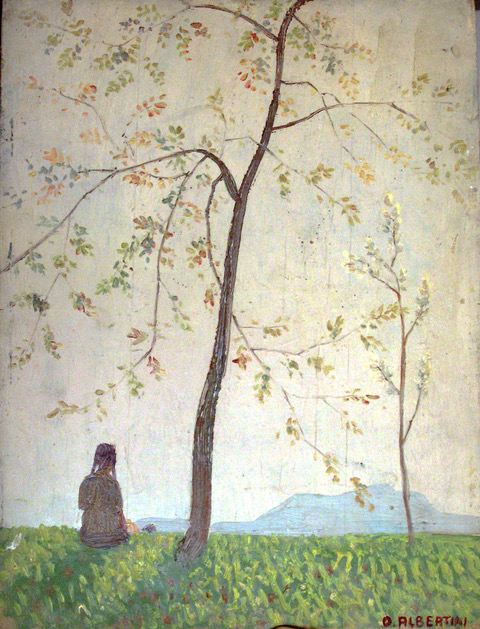
Origins are sweet, though. The following image is a painting by Oreste Albertini, my grandfather, and the girl is me. A fantasy landscape. I only have a B&W photo.


You must be logged in to post a comment.