MATT WEDEL : 8 PLATES OF MYTHOLOGY

an on line exhibition presented by LA Louver Gallery, Los Angeles, February 2026

“whereas life or reality confines itself to proliferating within the instant, the mind has spun for herself the myth of myths, the undefined element of all myths—which is Time…”

Paul Valéry, 1928

All my thanks to Paul Valéry’s spirit, who assisted me and helped me to decipher Matt Wedel’s plates. All the quotes are from ’A Fond Note on Myth’.

A FEAST FOR THE MIND

by Rosanna Albertini

A dinner for a hungry mind, a forest of branches longing for tentative movements, the same efforts of a vine that elongates her limbs to embrace a dead tree — secretly wishing to bring him back to life? 

Let’s blend gradually into our “natural depth and darkness” a place in which the mind looses clarity and gives up, for a while, with problem solving, efficiency, organizing, planning, or looking for fast revolutions, faster political changes, misled by illusions. As if dreams could have a practical side and could walk on a carpet of money plus will to become reality. 

In the penumbra – as the curtain is down –  the mind forgets  how to be busy, then walks on the irregular streams of the imaginary world, only guided by uncertainty, mistakes, hesitations and an infinite number of possibile images or words. No explanation is required, yet the mind sees far, ahead and behind, and is cuddled in between, resting on an impossible, soft image of the present — something that doesn’t exist, a transparent cloud.

From there the mind gives birth to events, stories, situations setting on the table “a candid cosmology,” and more and more naive images nourished by a need of broken causes, human stretches of time, and simple actions: if our heads share a field of blue, shall we call it sky or water? The image doesn’t know. Because, it’s a matter of language, either made of visual signs or words. It is just story-telling; a true intuition sometimes, or a shredded cloud. 

“All our language is composed of brief little dreams.”

Matt Wedel is so familiar with the almost natural transformation -looking natural- of heads and vegetal bodies into ceramic creatures, that I’m sure he doesn’t decide what he is making. So many myths are in him, in the garden which is his body, where every part interacts incessantly with near and far parts, with lack of separation between the busy chemical activity of the cells, the movable forest of neurons, and the constant request from outside to open the doors of the mysterious organic machinery, that he has to react creating new myths. Children do it incessantly, with no restraint, before writing and reading educate them to a strange unnatural style: the linear universe. Masters of brief little dreams as they were in the beginning, they quit the imaginary island where it was hard to distinguish dreams from reality.

Rational clarity kills the myths. And “the fauna of vague things and vague ideas wither away… Myths decompose in the light spread by our body combined to utmost degrees of consciousness.”

Apparently, such a disaster doesn’t happen on Matt Wedel’s plates: ideas remain vague. The upcoming risk of disappearance seems incorporated in the way stories are painted and cooked. It’s a physical process. Stories are not easy to decipher. The figures’ edges are soft, flowers are no more than spots of color. The naked cavalier is a white ghost on the back of a goat lost over an unfamiliar site of emptiness. Two women in conversation are on their way to dissolve among the flowers that invade the plate, while both women and flowers start vanishing under the power of the light. Red fruits on a tree aren’t sure where they sprout from: a tree or a head?  

My favorite plate (also Dominique Moody’s favorite) is a pre-copernican cosmology: the universe is flat. The long curve of hair woven into a braid, in continuity with the curve of vapor from a boiling pot, are a circle of fantasy flowers around the young girl face to face with the beast.  (First image, under the title)

Another girl? Another plate. Maybe she is not, a bow is on her hair, but the body is brown, soft with fur like a teddy bear. The packed non-geometry of stones behind her tells a story of undefined emotions, there could be danger in the air

Once more, details are canceled by light in the plate of the woman giving birth. The contrast is striking between the figures of fear around her, even in her arms, and the placid resilience of her body. Upside down pots become masks. They are incapable to close their mouths. Red, brown, bloody.  From the depth of time to the physical depth of the major event in human life. I do remember. I loved to keep the nine months of pregnancy a mystery revealing some of itself at each day. I refused to read books or ask for medical details. Little by little I slipped into the awareness of my animal nature, waiting with joy for the miracle at the end. I was kissed by the sensation of belonging to a time without Chronos, bringing to light a new human being. Out of me, she stood in another time, forever separate from me. It was the only moment I knew without doubt that names, identity, documents, are dead leaves. I was one with any living beast on earth. 

BIBLIOGRAPHY

Paul Valéry, ‘A fond note on Myth‘ in The Outlook for Intelligence, Princeton University Press, 1989

from Bollingen Series XLV, The Collected Works of Paul Valéry, Edited by Jackson Mathews Copyright 1962 Translation by Denise Folliot and Jackson Mathews.

This selection was first published by Harper & Row, Inc. in 1963

REBECCA CAMPBELL : WOMAN OF THE FLOWERS

LA LOUVER Los Angeles – January 2026 Photos: Matt Emonson

I am a woman, my woman.

I am a girl, my girl. 

I am woman, the woman.

I am girl, the girl.

I know how to work.

My feet work.

My hands know.

I am girl, my girl.

I am woman, my woman.

You made me woman.

You gave me woman.

Woman of the Flowers.

Mother of the Sky.

Woman of the Roses.

Girl of the Roses.

Flowery Woman of the Roses.

Daughter of the Rose in Bloom.

You gave me woman.

You gave me girl.

You took a girl out of me.

You took a woman out of me.

……..

You gave me my spirit.

You gave me my death.

You put my soul inside…

—Loxa Jiménez Lopez 

Loxa Jiménez Lopez is Mayan woman from an untold time. The legend says that Anjel, “daughter of the Lord of the Caves, whispered in her ear and then, in dreams, showed her the Book with all the magic words to be learned.”*** 

I imagined Rebecca the painter was not just giving us portraits of flowers. She adds words for each painting, and titles sound like a ritual she started for herself, about herself: the flowery woman. A face surrounded by Gold Hair, wearing a mask of colors from the flowers hidden in her body, blooming from her hands. 

Pink Punk Rose — A punk rose starting out like a kid starts out, inexperienced. A flower not yet knowing about her destiny, aggressively confused, spreading fullness and tension. The blue tries to contain the edges, before giving up, becoming lines from the sky.

Dahlia Uprising — The dahlia’s flower is a miracle of geometry. Soft with petals, a head full of hair. The artist brings an inconceivable disorder among the petals, a nervous uprising as if flowers were refusing the vase, trying to go away from the corolla, perhaps asking themselves “why” are they here. Why were they cut off.

Pink Heirloom — Who are they their name doesn’t matter. They are valuable forms. Heavy as if full of juices, ripe to death. So is the vase. The last wish of both flowers and vase was picked up by the artist who suspended disbelief: they float in the air.

Nasturtium Crown — They climb, or fall on the ground. Nasturtium hold all their energy in their colors, they do not raise vertical from stem to stern. As a painted crown, they float in the space missing a surface where to pose, and smile. Except the artist gives it to them, filling the wall with a fan of light that pushes the texture of stick strokes away from oneself, and encourages the flowers to be up, for a while, all they can have. 

Blue Hydrangeas — I had them as a child in the back of the house, the shadowy side. Blue and round small umbrellas that stole their color from the sky. In this drawing they look particularly happy, luxuriating in a hat for the lady vase still like a stone, while they play with the light not knowing, maybe, how long. 

Afton’s Abutilons — Red lanterns looking down, imperial, full of themselves as they can be. Although, they might shiver inside, and activate inaudible bells, warning about the yellow danger of the table, an alien flatness they cannot avoid. 

Preppy Poppy — The starch in their look makes them rigid, or slightly perplexed. Red edges around the petals merge pain into their beauty. 

Self Portrait in Green and Red — How vulnerable she makes herself! Yet, to use Eliot’s word “vulnerability was an opening – an ‘entrance.’ Where people were vulnerable was where they had once made room for other people.” Modern people struggled to find a language  to “render what is unacceptable about themselves intelligible.” (Adam Phillips) Rebecca Campbell is an artist,  feelings and desire are her stem. Images are her language. Not everything can be explained, nor understood. That’s why she lets herself unfold, until touching the ground. She apparently accepts her (our) fate: accepting things that cannot be ignored and cannot be understood. But in the end, green is resilience. 

“I am woman, my woman”

REBECCA CAMPBELL

1. Self Portrait with Gold Hair, 2025 oil pastel and UV varnish on paper, Image: 14 x 10 in.

2. Pink Punk Rose, 2025 oil stick on paper Image: 21 x 29 in.

3. Dahlia Uprising, 2025 oil stick on paper Image: 74 x 49 in.

4. Pink Heirloom, 2025 acrylic, oil pastel and UV varnish on paper Image: 19 3/4 x 28 in.

5. Nasturtium Crown, 2025 acrylic, oil pastel and UV varnish on paper Image: 27 1/2 x 19 1/4 in.

6. Blue Hydrangeas for Dot, 2025 oil stick on paper Image: 29 x 21 in.

7. Afton’s Abutilons, 2025 oil stick on paper Image: 21 x 29 in.

8. Preppy Poppy, 2025 oil stick on paper Image: 74 x 49 in.

9. Self Portrait in Green and Red, 2025 oil stick on paper Image: 74 x 49 in.

BIBLIOGRAPHY

Jerome Rothenberg, Technicians of the Sacred, University of California Press, 2017 pp. 369-372. For Loxa Himénez Lopez see Incantations: Songs, Spells and Images by Mayan Women, (El Paso, Cincos Puntos press, 2009) a Tzotzil/English version. “The fruit of the work of 150 people across thirty years, these are the first books written, illustrated and put together by Mayan people in nearly a thousand years.”

Adam Phillips, Equals, Basic Books, 2002

Absinthe, Smoke, Sugar, Choice: SABRINA GSCHWANDTNER

Madame’s Cravings (Red Lollipop), 2025 35 mm b/w polyester film, polyester thread, etching ink, LEDs 19 3/4 x 20 x 3 inches

Madame’s Cravings (Red Diamond),, 2025 35mm b/w polyester film, polyester thread, etching ink, LEDs 17 x 17 1/4 x 3 inches

at Shoshana Wayne Gallery, Los Angeles, 

  Nov 1 2025 January 10 2026    

she makes me happy  

by Rosanna Albertini

She doesn’t need to split off from the fullness of life. She swims in it, stitching together private stories — her mother’s voice about her life before Roe —  with images of American stories far from our present or we believe they are far, as we ignore they existed. Their film version was mainly ignored, but the effects of legal/political decisions on giving birth, having the freedom or the medical necessity of not to do it, are and were visible to everybody.

Time is endlessly dark, hiding the edges of things. So this artist works on the edges: sewing into geometrical figures fragments of 35mm polyester film with polyester thread, and painting colored ink on sections of film. Kept in their regular sequence the photograms stretch the most simple gesture into a long geometrical time. Madame’s Cravings, a 1906 b&w film, becomes a dismembered story in film-quilts. The same happens to a 1934 documentary showing doctors and midwives on horseback in the snow riding to deliver home care in rural Appalachia. 

Imagine a pond with all these quilts like floating flowers… Yes they are vertical on the walls, and yet… In each of them the limited time of the original films disappears, and the layout is playful; the translation of moving images in a still system makes me think of a new birth helped by the artist’s hands, by her smiling mind. They float in my mind. 

The Forgotten Frontier (Kentucky Star), 2025 35 mm polyester b/w film, polyester thread, LEDs 27 3/8 x 27 1/8 x 3 inches

Madame’s Cravings (Absinthe), 2025 35 mm polyester b/w film, polyester thread, etching ink, LEDs 19 3/4 x 20 x 3 inches

Madame’s Cravings: Sweet, Bitter, Smoky,, 2025 35 mm film, polyester thread, etching ink, LEDs 19 x 19 x 3 inches

Reality remains, an unfriendly swing that seems to escape from human measure, feelings and physical risks. Legal, illegal, what? What’s humanly convenient? What’s a decision? An executioner’s sword chopping a previous decision? A glimpse into the past tastes like a bitter medicine, and yet it helps to perceive what’s really real: reality moves and changes. Timing is not geological. Things happen at human measure. No one more than an artist knows it. Each art piece comes out of the struggle between the single, personal effort to be in the world with an eye on its infinite possibilities, and a castle of facts all around that only look able to be here always, trying to obliterate any contrast, any “other condition.” ( Robert Musil) It can happen that the castle crumbles before the goal is reached. 

“Therefore there is the universe.

Because it is flying around.

It is interesting.

Anything that is flying around is interesting.

Human nature government propaganda is not flying around adventure is not flying around, it is flying to or from therefore it is not interesting.

And romance and the human mind.

….

The human mind is interesting and the universe.

About romance well supposing we just like it like that but not by definition.”

That’s a different story, The Geographical History of America by Gertrude Stein, 1936.

Sabrina Gschwandtner’s as well as Gertrude’s art make me happy. In the film-quilts beginning and end disappear. Movements appear and turn and bring us in, and we don’t disappear. In Gertrude’s pages we get mad at our own impatience, stumble over the words that are often jewels, we do not get lost. 

One participates in things (understands their language). In this condition understanding is not impersonal (objective), but extremely personal, like an agreement between subject and object.

In this condition one really knows everything in advance, and the things merely confirm it. (Knowing is re-knowing.)”

Robert Musil not afraid of subjectivity. 

That’s why the film-quilts are flowers. I’m trying to bring Sabrina’s art out of art formalisms. Back into the big world she has embraced with humor and intelligence. Nothing could be better than the subversive idea she had picking a story where the pregnant mother smokes a cigar, steals candies, drinks absinthe and in the end, quite naturally, squats down on a cabbage. The baby is born. A nativity? Why not? 

We are in “the art of the every day.” 

1984  Allen Ruppersberg, Fifty helpful hints on the art of the every day:

I pick five of them:

“Art should be familiar and enigmatic, as are human beings.

“Use everything.

“Art should make use of common methods and materials so there is little difference between the talk and the the talked about.

“There is a quotidian sense of loss and tragedy.

“The individual search for the secret of life and death. That is the inspiration and the key.”

Madame’s Cravings (Yellow Lollipop), 2025 35mm b/w polyester film, polyester thread, etching ink, LEDs 19 3/4 x 20 x 3 inches

Madame’s Cravings (B/W),, 2025 35 mm b/w polyester film, polyester thread, LEDs 72 x 48 inches

BIBLIOGRAPHY and FILMOGRAPHY

Alice Guy-Blaché, Madame’s Cravings, B7W 35 mm. film, 1906

Marvin Breckinridge, Chronicles from the Frontier Nursing Service, documentary film, 1931

(after the 1934 Hays Code, childbirth and abortion disappeared from American cinema for decades)

Robert Musil, Precision and the Soul, edited and translated by Burton Pike and S. Luft. The University of Chicago Press, Chicago & London, 1990. Paperback edition, 1994

Gertrude Stein, The Geographical History of America, Copyright 1936 by Random House, Inc. The John Hopkins University Press, Baltimore & London, 1995. The John Hopkins paperback edition, 1995, was published by arrangement with Random House, Inc. 

Allen RuppersbergThe Secret of Life and Death, The Museum of Contemporary Art Los Angeles, Black Sparrow Press, February 1985. Published in occasion of Allen Ruppersberg’s retrospective exhibition at The Museum of Contemporary Art, Los Angeles. 

LENZ GEERK : WHEN COLORS MOVED OUT

Lenz Geerk, Pears, 2024 Acrylic on paper, 84 x 200 cm

Lenz Geerk, Vampire, 2024 Acrylic on canvas, 180 x 130 cm

Lenz Geerk, Table-Tennis Player, 2024 Acrylic on paper, 41 x 30 cm – Lenz Geerk, Bird, 2024 Acrylic on paper, 41 x 30 cm

Lenz Geerk – Schwarzweiß – 2025

at Roberts Projects, Los Angeles, January-March 2025

  “A thing must talk. Sometimes it’s very hard to find the reason why a thing to whom one has dedicated work for so long doesn’t talk.” Joseph Beuys

There is a time out of dates, from which facts have been erased and places forgot their names, populated by living beings, animals and objects mute like stones. Their features have been refused any expression. They are what they do. Of course, this has been written already, about a hundred years ago: “We should stop thinking that this creature does what it is: rather it becomes, for God knows what reasons, what it does. Man makes his own clothes, but clothes make the man too.” Robert Musil 1922. 

Here we are, in 2025, with an artist who paints the clothes hung on the handles of a wardrobe, Joseph Beuys style, adding  a matching pair of shoes, and a vase with flowers. No human in view, pants and jacket are silent. A small figure appears wearing a crown, a king? If it is, he is perfectly dressed, a boy floating on paper. Waiting. So does the bird not really flying, he seems to be sitting on a spot of air. A touch of magic pervades each painted scene if one reads what’s happening, without questions. A naked man walks between mountains in a sort of trance, following a branch of flowers that tickles his nose and loses petals. Fragrance is the living strength of the scene. 

Lenz Geerk, Untitled, 2024 Acrylic on paper, 41 x 30 cm

We rather keep quiet our temptation of putting meaning over everything we see forgetting the silence, the intensity of feelings that refuse to be squeezed in words. They bounce back against us like the small ping pong ball against the naked chest of a player. More and more when one imagines to be one of the standing figures holding the night sky with two hands, as if it was a blanket, or a tablecloth: feelings merge with mythological mirages, turning into a state of wonder. Yet the standing figure, her/his/its face in Gerz’s painting is deprived of expression. It happened, she don’t know what it is. The naked feet are big and steady on the ground.

Lenz Geerk, Woman Holding the Night Sky, 2024 Acrylic on paper, 118 x 101 cm

Feet: are they the steady balance in this colorless landscape? In this painted comedy of errors? Pointless to invent another name: Geerk recalls the vampire, a big figure dressed in black that glides in the blackness of an unknown space. It could be the place where colors were sucked in, and annihilated. Maybe the blood as well. Surrounding fears heavy on every minute of our existence disappear, turning into a nightmare: “a mountain of facts growing larger by the hour, knowledge won, life lost — a failure of the soul.” Let’s turn inside out like a glove our inner, invisible life and Geerk’s paintings will become the images we discover in ourselves if we recuperate “the open-eared attentiveness of the child: expanses; solitude; being led; letting reason growing out of thing and into man.” And women and children…

Lenz Geerk, Woman and Moth, 2024 Acrylic on paper, 41 x 30 cm

Lenz Geerk, Shakespearean Actor, 2024 Acrylic on paper, 41 x 30 cm

Lenz Geerk, Scent, 2024 Acrylic on paper, 87 x 28 cm

Lenz Geerk, Holiday Ceramic Course, 2024 Acrylic on paper, 133 x 82 cm

Lenz Geerk, Painter and Model, 2024 Acrylic on paper, 41 x 30 cm

Lenz Geerk, Untitled, 2024 Acrylic on paper, 41 x 30 cm

Nonsense is not excluded. A painter keeps the model behind her. It is the model who looks at her. The Holiday Ceramic Course is a school en plein air, three people undressed, lost in themselves, as the hands on the ceramics don’t care what they are doing. Impossible not to laugh. Oh the moth! Ugly, fat, big like a butterfly but missing the grace of the far cousin. In European popular culture, butterflies are the open wings of the feminine sex. It’s quite funny to see them replaced by a gigantic moth. No title for the man and the woman so strongly embraced, seemingly forever. They become a painted sculpture: the double stem of a flower, it blooms in their heads. 

After so much inside out between the painter’s mind, mine, and these paintings’, the major feeling I will send through my words remains the same I found in the first sentence, a time without dates. Not arbitrary at all, incorporate in the present as it was in many past situations for centuries, when not so many facts were hovering, written words were spare, most of the visual art lost or unknown. I can be wrong, delusional. Unable to find my way like an ant on the white tablecloth, a painting that strangely represents the classic power of center with a plate full of pears. Be it. Così sia. I eat a pear and read: 

With flowers You write,

O Giver of Life:

with songs You give color,

with songs You shade

those who must live on the earth.

Later You will destroy eagles and ocelots:

we live only in Your book of paintings,

here, on the earth.’

With black ink You will blot out

all that was friendship,

brotherhood, nobility.

You give shading

to those who must live on the earth.

We live only in Your book of paintings,

here on the earth.

I comprehend the secret, the hidden:

O my lords!

Thus we are, 

we are mortal, 

men through and through,

we all will have to go away,

we all will have to die on earth.

Like a painting,

we will be erased. 

Like a flower, 

we will dry up

here on earth.

The Painted Book, after NEZAHUALCOYOTL

A few years ago, Lenz Geerk shrunk his message to the viewers in painted stamps on a monochrome envelope with no address. Today he discloses a song of silence; “ombra mai fu di vegetabile cara ed amabile soave, never was a shade of any plant, more cherished, pleasant and gentle.” (G.F.Handel, opening aria from Xerses)

The painter’s shades, the darkness, are sheltering the cracks in the rational habits, replacing certainties with gentleness, bringing painted flowers already dry, but never dead. With flowers he writes, his Painted Book.

Lenz Geerk, Untitled, 2024 Acrylic on paper, 41 x 30 cm

All the quotes in this text are from Robert Musil, Precision and the Soul

All the images reproduced in this post are by Courtesy of the artist and Roberts Project, Los Angeles, California.

Photos by Paul Salveson

Bibliography

ROBERT MUSIL, Precision and Soul, vols 8 and 9 of Musil’s Gesammelte Werke, Hamburg 1978 The University of Chicago Press, 1990, Paperback edition 1994 Edited and translated by Burton Pike and David S, Luft.

Technicians of the Sacred, Edited with commentaries by JEROME ROTHENBERG, University of California Press, 2017 “Pre-conquest poets and books in Mesoamerica : a written tradition that reenforces and expands the spoken one. … Nezahualcoyotl (1402-1472) author of more than thirty surviving compositions & chief of Texcoco for over forty years. Books were “made of animal skins or of the amate-tree bark, …and the writing itself took the form of pictographs , ideograms & some limited forms of phonetic transcriptions” (Leon-Portilla, Native Mesoamerican Spirituality) p.543.

 Honetschäger-Albertini  — NAPOLI 2024 — the girl in the blue skirt 

Drawings by Edgar Honetschläger

Text by Rosanna Albertini

One word: Napoli, and immediately those absurd, harsh and fascinating ten years, hard to tell which attribute in accordance with reality, my years from ten to twenty, come back with a big bag of emotions. Instead of turning them off, this time I keep them simmering for a couple of months, trying to understand why I love Naples more than any other Italian city, as my growing body and my mind’s displacement stretched muscles and bones of a person becoming more and more a stranger, a stranger to both her family and the city, maybe to any urban place. As a matter of fact every year I was in Naples only the three months of summer, the rest of my life was in Milan, in the house of two Neapolitan aristocratic women. To tame the savage girl from the woods seemed to be their mission. They poured into me the same education they had received. 

That age is the most confused. Had I let space to feelings, I wouldn’t have survived. Keeping them quiet under my feet, instead, I walked out of the house every morning. The city of Naples was my new space, unfamiliar, captivating, calling for walks all day long … through days of a solitude that was welcomed. The city as well — notoriously crowded —- was empty in my eyes, with phantoms from the ancient days more real to me than people all round about. I went everywhere by myself as I used to do in my northern village as a child, exploring every inch of the woods on the mountains, memorizing the sites of the first snow flowers, and of the first violets. In Naples, I was surprised by capers growing in the cracks of the old stones, by large steps climbing the hillside in acute angles. Their geometrical shape, to tell the truth, was altered by irregularities inflicted on the stones by aging and abandonment, so they could be in agreement with the natural chaos around. 

When my friend Edgar Honetschläger told me he was in Naples for an exhibition of paintings, and was about to spend two months there, I asked him please to go and visit my favorite places and take photos or, better, make drawings. He did it. The drawings he sent me are, surprisingly, the exact portrait of perceptions I still cherish, as if engraved in my heart. Images of emptiness and solitude vanishing, delicate, through the noise of the living. I wish my thoughts, my words, could be weightless like the lines traced by my artist friend. Floating outside of time. Impossible: many of my words will be covered with spines. 

I could fill the emptiness around  the roman theater, the infinite amount of steps, the fountains with no water and the flat facades of big buildings condemned to a decay  that is almost philosophical, simple: every thing moves and changes and shows the many faces of time. I could bring you to my favorite convent and its hidden garden decorated with blue tiles, it would be stupid, a post card. And because memory is a chemical blender reshaping fragments of life according to the present mood, not at all a gallery of images, right now I get rid of it. Briefly, I want to see inside me: what was I, what that damned girl in a blue skirt had built up by treading herself into the hot sidewalks and the crumbling stones of a Southern city.

First of all, she forgot fear even existed. No TV in those days. Nobody will bother you if you look at them in the eyes — I thought. I might call it an instinct. At twelve, thirteen, sixteen, the smell in the air, attitudes, sounds, push thoughts into a corner. Colors and spaces are devoured by the eyes. Plus, the education from the Neapolitan ladies: if the door is closed, never intrude. You can knock if time is right. Meandering through the vicoli of Spaccanapoli, a narrow street that splits the city like the pulp of a melon, from the hill to the sea, she felt people were keeping their privacy even if the door was wide open, even when their life spilled into the street. Look at their eyes, not at their space.  Back home, she didn’t have to report. Decades later, in Pazcuaro (Mexico), she found herself in the same situation: an old man who sat on a bench in the middle of a sidewalk was peeling a heap of onions using a knife. The passage was almost blocked. We looked at each other for awhile. After which he silently offered his hand to her, a hand almost blackened by onion juice. We had a strong, frank shaking more eloquent than a long conversation. She was allowed to pass.  

Milan, in the North, was another world, the realm of a working class whose dignity, after the end of World War II, had been rebuilt at the price of incredible sacrifices. Cleanness and order a rule for everybody, rich and poor. Pride hidden in the chest, no eye contact, but attention was a duty, as help if necessary. Chacun pour soi. The human forest like drops in the fog. In the 50’s and 60’s the fog was so thick that to cross the street was hard, without seeing the other side. Smog. Cold from September to May. In a corner room where the library was, frequently shaken by the tramway on rails curving around the building, the girl found a major way out from the  strange situation in which she had been placed, and abandoned. Books became a safe world. Nobody could reach her there. And she fell in love with archeology. Yes, Foreign countries and excavations, but also, for her, a mental space populated by Homer and Virgil stories, with languages she could feel in Neapolitan dialect. Latin and Greek alive like her present Italian. Being within each word. Becoming a present. In Naples, she searched for sites, names, or looked at people as if belonging to an unfinished time. Her mother was the perfect animated Greek statue, perhaps more acceptable because of her physical features. She was from old Capua, where Hannibal lost the war losing time with women and wine. Was father like Hannibal? And god knows how many African genes.

The girl followed all the inviting pathways in both cities, South and North. Transition was the most difficult. Twelve hours by train, back and forth. The other travelers were migrants from Germany, Belgium, Northern Europe. They passed on wine and food, cutting cheese and apples with a knife and bringing the slice directly into their mouth using the blade. They were kind, offered food to her. She never accepted, her stomach tight like a fist, struggling against nausea.  

Although the South was attractive, the girl’s belonging was nowhere. A blind poet of these days talks of the “spectral realms of memory.” Along with growing taller, the girl carried her baggage of confusion. In Naples she missed the soft grass of the countryside near the lakes not far from Milan; In Milan she missed the unruled spirit spread all over the daily adventures, her mother negotiating the price of a bunch of flowers as if it was a bracelet of diamonds, or the 12 year old boy transporting fruit and veggies to the house, a strong and arrogant outsider. “Italian, myself? I am not Italian, I’m Neapolitan!”

In her blue skirt, the girl was a seed lost in the immense realm of human struggle for millennia, along with all the dead, some echoed by poems, graffitis and frescos, statues and paintings. It was astonishing that so many made it to the present. She needed her own ground to become a person, to feel free from all the boxes imposed by survival needs. And she found it, or built it, I don’t know. Or perhaps she was shaped little by little by reality, that was thick and ancient, and blowing up the last night of the calendar like a bomb of unhappiness finally exploding, vaporized in dark, choking smoke.  Right now, of course, I am a “chimerical museum of shifting forms. A heap of broken mirrors.” Thank you Borges. And thank you life, in which I discovered the joy of imaginary presences, linked to my own cave age, mental shadows quivering in me in front of mountains opening their mouths in caves where ancient Etruscans were placed for their eternal rest, or when my hands paused on the Roman stones, or the pages of old volumes, trying to absorb the unknown of past lives. The girl was searching for a new beginning, the core of the apple. She fell in love with mother earth. 

The night could well be the unfinished part of the day. And she is as vast as the day is.

Edmond Jabès 

Writing became a passion much later, pleasurable dirt on paper. The shadow took the shape of words. The arts became another passion, the phrenesis (frenzy) of giving to unknown readers some sparkles of surprise, questions, — contemporary arts still do not have an easy reception — and my own dreams of enthusiasm. This happened, maybe, thanks to that separate, isolated flexible bubble I had wrapped around myself in Naples, like an ancestors’ toga. Or it was a sculptural gesso, in Naples crumbling like tufo, the local rock, that solidified around my personal emptiness, and filtering experiences ended up protecting the tender branches of my brain.  I know artists have their own bubble, each a different one. I never tried to undress them, I only give myself the freedom to put my finger on their core. A never ending, almost impossible task. That’s my dream for the day. Goodnight.

FIONA CONNOR prova d’orchestra – an orchestra rehearsal

FIONA CONNOR, Drawing something under itself —2023— Düsseldorf, Germany

prova d’orchestra – text: rosanna albertini

photo credits: Cedric Mussano

Which one is the perfect verbal dress for Fiona Connor’ art pieces is almost impossible to say. I stick to my experience. She recently installed at the Kunstverein für die Rheinlande und Westfalen, Düsseldorf, five bodies of work. On February 20th she presented the whole project in a lecture at Art Center, Los Angeles. The event was memorable for unexpected reasons: her words could be counted, che le parole tue sian conte, we say in ancient Italian to avoid long explanations that spread from the lips like broth spilled on the tablecloth, sbrodolate. That evening, Fiona Connor counted her words, surprisingly and wittingly, wissentlich. The wittiest art speech possible. 

Intermittently, she threw little fistful of words in the air, projected plenty of photographic images and the video images of the Continuous Sidewalk, (her previous piece in Los Angeles). Pausing the show four times like a music conductor, she asked some students to read the words of apprentices from a German school of construction in Düsseldorf, those who had built the five unfinished squared constructions that seem to grow from the Kunstverein’s floor like ideas frozen in geometry. 

To call them unfinished is arbitrary. Maybe they are what they must be: a designed ridge, a landscape of the mind? Along with the hooks on the wall and the shoes on the floor (cast metal painted black, too rigid to walk away) the brick open cubes do not move. I’m comparing them to Giacometti’s heavy feet, the only part of the human body bringing safety and balance to his sculptures. The only one that is not gradually destroyed. Would the open cubes be the physical figure of the major, steady ridge in Connor’s mind? 

Hung on the hooks, invisible underneath her jacket, hides the story of Fiona’s father going to Germany in the mid 70’s to compare European to New Zealand modes of construction, especially how to organize the various elements of making buildings. True enough, the artist is obsessed by materials and process details no less than her father. I saw his eyes in a photo of that time: an intent look lit from inside, a contained  interior smile I observed many times in Fiona’s eyes when conceiving a project.  But honestly, to unveil such sparkle would risk to push the viewers toward a cause-effect logic: she made the ridge because… I would be the first screaming NOOOOO. This is history, art is something else.

An absolute Truth is in each art piece. And yet, unlike a flower we pick up breaking the stem, Truth, “like Beauty itself, floats elusive, obscure, half submerged, in the silent still waters of mystery.’ JOSEPH CONRAD, Lord Jim.

One should sit on them and think. Both on the words and on the bricks.  It goes with the title of Connor’s piece: Drawing something under itself, 2023. 

The most movable component of the Düsseldorf Installation is the artist herself: she spent the whole time of the exhibition going every morning into the lofty room, alone, looking at the ceiling that opens in stripes to the sky, moving the chairs around, then sitting on one or more than one and drawing small imperfections of the wooden boxes, other chairs, details, whatever her eyes wanted to pause on. Consequence: the frenzy and unrest in her own mind, helped by skilled hands, changed every day the sculptural configuration of the show. The installation is many views, and a mixture of different, implicit moments or decisions. Fiona seems to question her own process at every day. My impression, or something odd she said in her lecture (—her words from my notes on paper): “the metal chairs belong to the Kunstverein, they were available. Which is a failure, obviously.” “The fonts of the new alphabeth with a different style for each character were one of the five bodies of work. The public used the ink blocks to make posters. They were successful, another failure.” 

The artist covered with a nervous little laugh her secret irritation in front of the most obvious usage of her piece. Silent still clouds her mind obnubilating a simple contentment. 

In my view Fiona Connor made in Düsseldorf the most important piece of her journey as an artist. I tried to look at the whole process simultaneously in my mind, so I could see the images all together at the same time, not one after the other. A beautiful carousel appeared where the center is displaced horizontally —and why not, non-Euclidean geometries have existed since the 19th century—, the chairs are skinny horses incapable to trot having the four legs blocked in their industrial shape. They are meubles, mobili, furnitures made to be moved by somebody. And the artist does it in many ways: transporting them, sitting on them and drawing them. The drawings, afterwards, sit as well on the chairs and stay. Lighter, black and white, they can pretend to be butterflies, or graphic scores of a silent music.

 ‘Drawing’ is the first word of the title. I wonder: was the artist playing the conceptual symphony to the point she felt expropriated, as a person looking down at the implacable order of inanimate object, lifeless? To the point she needs to put her hands at work, the black and white papers become more and more convinced, rubbed, full of de-signs, as if “massaged” (her word) by the graphite.

Here, forgive me, I must distinguish ‘concept’ from ‘thinking.’ To think is to let the world flow into our self, and respond by uncertainty, feeling the borders between self and non-self as a buffer zone. Both influencing each other. (Forget quantum mechanics, let’s stay in the art world). Concept is grabbing, appropriation. Here the artist lets the presence of the damned chairs influence her hands. The act of drawing might be the buffer zone. I’m not attributing to the artist this idea, which is only a vague impression, a questioning totally mine.

Hang ideas!  —always Joseph tormenting me— They are tramps, vagabonds,  knocking at the back of your mind, each taking a little of your substance,  each carrying away some crumbs of that belief in a few simple notions you must cling to if you want to live decently and would like to die easy.” (Lord Jim)

Therefore Fiona Connor set on her own art piece. 

In 2017 she wrote about an artist she admires that she was “mapping the world, being out there exploring at her modus operandi, choosing a little thing  to help make sense of it.” Could these words be the present top of her awareness?  Like a forefinger pointing at the 2023 Drawing something under itself. Hard work, today, to map a world technologically altered, produced and reproduced as if the easy way was universal. Not so in this case. The crime is personal, the absence of the last word is beautiful.   

Allan Kaprow would praise this piece as lifelike art, not just intellectually, as a moment of experience only accidentally in a Kunstverein. 1979, more than forty years ago. Fiona Connor, today, has been brave enough to expose the low and high ebb of her intent in the questionable lack of a final definition for her piece.

Art is not a perfect myth anymore, nor a symbol. These reassuring words, just words, only verbal emissions would replace with a caricature the complexity of the living. Art can be unaccomplished and cracked and beautiful like the secret life of each human. 

A hundred years ago, a blur in Robert Musil’s notebooks: “…apparently a world in itself, the world of beauty is nonetheless incomplete, marked off, and secretly negative.” … “Nonetheless, art as a form is probably a special limiting and grouping of her contents of ordinary life, but remains within its compass.”

z

SIMRYN GILL

when finger tips try to see and eyes try to caress, far from words’ noise

Simryn Gill, Fall Then at  1301PE Los Angeles March 2024

She is Malaysian and lives in Australia, I am Italian and live in Los Angeles. Geographic and cultural distance. But, what if distance can approach the most remote parts of what is visible and discernible, the ungraspable emotions moving our mind through the myriad of sensory data, always contained between physical edges, until we disconnect from  the immediate perception as if it was lost, and “acquire the gift of giving a more durable form to real things vanishing around us.” As life moves on, language, in exchange, does everything she can to erase herself  “to open a space to the pure vision, starting an intuition completely forgetful of the words’ noise.” We flow through time. We flow hoping to keep alive the feeling of change; we take some notes, avoid stopping for too long. 

The world flows into the self, or mingles with it or bears it, and the like. One participates in things (understand the language). In this condition understanding is not impersonal (objective), but extremely personal, like an agreement  between subject and object.” 

I’m serious in what I’m doing here: in two paragraphs I have sucked in, translated, and recombined some thoughts from my beloved Robert Musil, Jean Starobinski, and Johann Wolfgang von Goethe —an unrequested inheritance. I made a parody of myself as an old scholar who can’t give up the beauty of thinking and accepts the strange fusion in the mind. Fact is, Simryn Gill practices these same ideas in her journey as an artist.  Reading her Passing Through  I could follow step by step the formation of an art piece she produced starting from the exploration of a real thing,  a derelict mid-century seaside motel in Malaysia, now liberated from the perfect modernist combination of squares after the attack of  roots, leaves, trees, animals and the human devastation of the walls in search of copper wires or pipes.  

I could read her mind looking for structures and decorations in detail, and follow her hands, the tip of her fingers asking the stones and floors to tell her their “internal porosity and openness…a kind of self referential, self-contained vulnerability.” “I had been – Simryn says– crawling on the floors and stroking walls in a ritual of appeasement. My cousins and I weren’t allowed to come here when the motel was in its full flight and we were in our teens, because it would have exerted a bad influence on our impressionable minds.”

Simryn  wanted to graphically render the patterns as archeologists used to do. Her words:  “In my version, I applied ink directly onto the patterns and details, and took the impression by rubbing the paper onto the stained surface with the back of a metal spoon.”

“I ran a bush studio out of the boot of my car: a folding table to hold a thick pane of glass for rolling the inks on, and the inks themselves, in tins; in a cardboard box under the table, my cleaning materials, cloths and solvents; on the back seat of the car, rolls of buttery Japanese paper, which is so deceptive in its fragility, so sympathetic to the heavy treatment of being beaten and rubbed.”

I wish I had seen the motel prints. Instead, I saw the bush prints at Brian Butler’s gallery, the exhibition title is Fall Then.  Same kind of technique described above. Same “dexterous hands and serene intentions.” 

A ritual, again. Dead branches, grasses and vines, destined to die in their new, aerial situation, are restored to life as if each of them had impressed a silent, visual speech on vertical papers. A last word, a unique symphony of forms. Tempos are visible, between each sheet and layers and superpositions behind. Light vibrations appear in transparent shadows. The forest, or the garden, aren’t in the gallery, so we only find well dressed ghosts. They maintain the freshness of the living and, let’s be clear, the artist’s tenderness, her attachment to the entire natural story as if she were a substantial component. Not an observer. Not only an observer. A wanderer, a passing bird. 

Simryn Gill, Vegetation 1999 Photograph: Jenni Carter

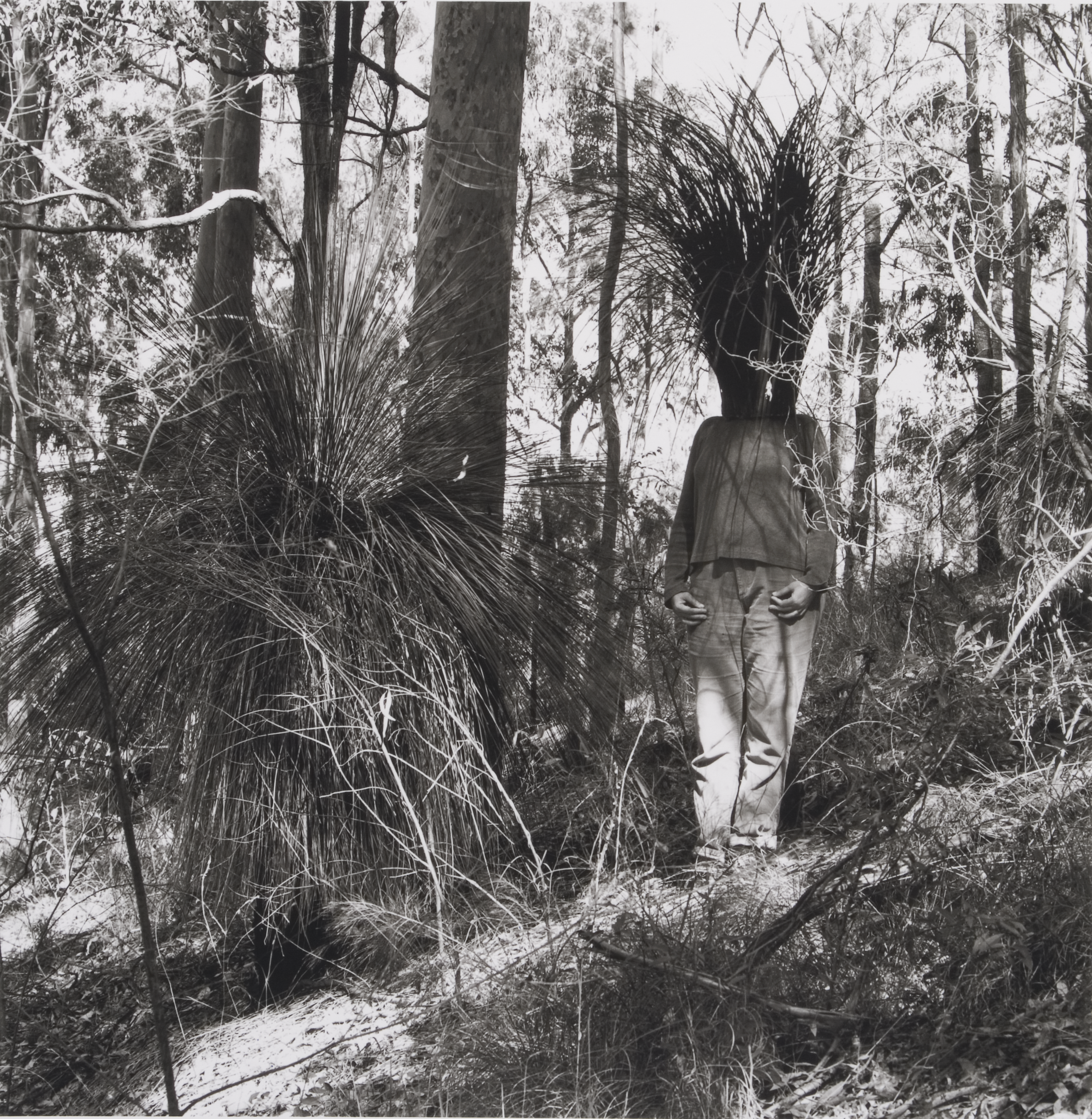
This is what she is in her 1999 Vegetation photos that she has printed in 2015… the reason for the delay is clear, they are moments of a life long journey, merging future, past and present, maybe stealing a story from the forest, and paying the penalty: colors are lost. Almost everything is secret in those images. The human head is lost as well, replaced by vegetation.

The mode of the person becomes the mode of the world,
For that person, and, sometimes, for the world itself.
The content of the mind becomes solid show
Or almost solid seen show—the way a fly bird
Fixes itself in its inevitable bush …
It follows that to change modes is to change the world. 

Wallace Stevens, from Conversation with three women of New England, Opus Posthumous, Vintage Books, 1990 ©1957 by Elsie Stevens and Holly Stevens

The mode of the artist becomes for me the mode of the world. The solid seen show of humans’ physical sensations:  an active exchange with the vegetation’s world, by contemplating or passing through.  

I wish I had had the same impulse Simryn had saving and printing branches from Maria’s Garden when the garden was destroyed to be replaced with a building.  One day the trees of the garden next door to my house, in Los Angeles, two enormous ficus and three pine trees have been killed, eliminated to build a wall. The shock I received was so strong that my mind stopped working properly and I ended up at the hospital, for suspected heart attack. It was not in my body, heart and brain were healthy. I couldn’t tell the same for  my spirit. My spirit had a heart attack. I still see them, but touch them I can not.

photos RA

Jeanne Silverthorne: And the Unfathomable Night of Dreams Began

Jeanne Silverthorne, Crate with Sneaker, 2023 Platinum silicone rubber 50 x 18 x 18.5 in
Courtesy of the Artist and MARC STRAUS

at MARC STRAUS  New York, 2023

SILENT OBJECTS- WORDLESS STORIES

by Rosanna Albertini

So, to introduce words is disruptive. It takes away the silence wrapped around each sculpture. I’m lucky the artist has a sense of humor, and isn’t afraid of throwing in our face her own struggle against explanations, in search of elusive, often movable meanings about feelings and experiences that are inscrutable, and stay hidden in the human carapace even when there is no need to keep the secret. On the other end, the visible objects she offers are soaked in lived and living real moments we all share, usually convinced they are uniquely shaped, personal, impossible to reveal or to compare with others’. Foolishness of course: there is a common, flexible mesh in which we are netted as we face the thread of our life, in which personal moments surge unexpected, at times unwanted. The artist follows what her hands draw on small notebooks, as if deciphering signals from her hidden self. 

Jeanne Silverthorne Double Sneakers (The Three Sillies), 2023 Platinum silicone rubber 25.5 x 51 x 35.5 in Courtesy of the Artist and MARC STRAUS

Jeanne Silverthorne End of Day, 2016-2022 Rubber, rubber glass, hair, plastic, metal, phosphorescent pigment 3.5 x 10 x 10 in
Courtesy of the Artist and MARC STRAUS

Jeanne Silverthorne, In My Mother’s House, 2023 Platinum silicone rubber,  75 x 20 x 20 in (190.5 x 50.8 x 50.8 cm)   Courtesy of the Artist and MARC STRAUS                            


Jeanne Silverthorne, Hanging Question Mark, 2020 Platinum silicone rubber  42 x 6 x 14 in Courtesy of the Artist and MARC STRAUS                         

Jeanne Silverthorne, Mom on Book, 2023 Platinum silicone rubber, hair, metal 7.25 x 10 x 8.25 in Courtesy of the Artist and MARC STRAUS

Not allowing us to decipher the hidden stories she sculpts giving legs and arms, shoes and boxing gloves to feelings that do not have a specific body, the artist sets free our will of understanding. Without permission, we put ourselves into a place where we are unwelcome. And it is the only way to appreciate Jeanne Silverthorne and her obsession with the invisible.

We try to grab her art out of any conventional definition, wondering at the same time about the effectiveness of our uncertain, entangled tools.  Not the theories.  In question are the uncontrolled interactions between eyes, invisible organs, emotions and ideas. Intellectual functions? Perhaps all of them. Our body thinks. 

Understanding as an English word for instance, is mostly used like the latin com-prensione, comprehension, grabbing together, but the word in English has a different nature: it’s visual, and talks of standing under something. Let’s have a fantasy: I stand under Jeanne Silverthorne’s sculptures. There is no because, nor cause and effect. They are symbols suggesting emotional moments transformed into funny little theaters. Were I standing under the crown of a tree, time and stories would be embedded in the trunk and the branches, weather and animals would tell poems made with wind, chirping and lightenings, what words can do? They come after, read and describe the after facts. 

Jeanne, or Banshee, — she calls herself Banshee in her self-portrait— is my tree. A fairy person from the Irish mythology in the form of a tree. 

Her visual stories are a silent speech. Physical language meager and simple. With a big question mark and a couple of tiny quote signs. No quote in between. Mental strength is

a sturdy dolly  9,25 x 18 x 12 inches, not big at all. But the Fly, that cuts my breath. Animal fragility. The sneaker in a crate. She pulls my hair. Consternation becomes ridiculosus, in a 16th century corrupted latin. Jeanne’s bodies, either objects, plants or animalia,  change as language always, adding colors and shapes, unraveling the tangled mess of thoughts. I’ll never forget her fly wearing glasses. 

Jeanne Silverthorne, Double Dolly with Fly, 2021 Platinum silicone rubber, 9.25 x 18 x 12 in Courtesy of the Artist and MARC STRAUS

At the end of day she,  Jeanne or Banshee, doesn’t want to see anymore. Dark glasses cover her eyes. The hammer remains in her hand.  Work is done. The black book lies on the minimal bodies that are human even if they don’t look like it. Her mother’s figurine stands on the black book, maybe sealing the secret baggage of her journey. The artist carries the same book in her mind keeping it closed, no words escape. 

Except in titles. Little crowns like night birds disappearing in darkness. As for me, the experience of the physical artwork asks for words expanding, deviating, using the eyes to caress the exterior surface of the sculptures, collecting possible meanings. Moreover, words have the power to navigate different times and make them durable on a page. 

In the middle of the incredibly noisy reality hovering with too many words, too loud, often unreasonable and pretentious, the only existence we have, this recent work by Jeanne Silverthorne is a magic antidote. A voice from far away, as if from another world. 

It echoes what Robert Musil wrote in 1925 (Toward a New Aesthetic):

If one simply extracts a few main, common characteristics from the purely descriptive accounts of a literature that is thousands of years old, one finds again and again the pressure of another world, like a solid ocean bottom from which the restless waves of the ordinary world have drawn back; and in the image of this world there is neither measure nor precision, neither purpose nor cause: good and evil simply fall away, without any pretense of superiority, and  in place of all these relations enters a secret rising and ebbing of our being with that of things and other people. 

It is in this condition that the image of each object becomes not a practical goal, but a wordless experience. “

It goes without saying that the dark baby, a book to be? starts his unfathomable night of dreams curling on the mountain of waves that we call reality.

Jeanne Silverthorne, And the Unfathomable Night of Dreams Began, 2022 Platinum silicone rubber, polymer clay, cloth
22 x 10 x 9 in  Courtesy of the Artist and MARC STRAUS

PHILIPPA BLAIR – the demon of painting versus human affairs

I believe that the borders of our mind are ever shifting, and that many minds can flow into one another, as it were, and create or reveal a single mind, a single energy … and that our memories are part of one great memory, the memory of nature herself.

W.B. Yeats, Ideas of Good and Evil

Philippa Blair, Tell me your story … Conquistadore? Sept. 2022 Acrylic, oil, mix media 60″ x 100″

“I can’t stop working”  Philippa writes to me. Philippa has reached a peak of solitude in her life. She is diving through a space from which the future has been banned. She delves into it, painstakingly inquiring the infinite mutation of her feelings. Is it so important not to see a future? I can touch a similar ghost around myself, we are the same age, Philippa and myself. A long life behind us. Long enough to dim obsessions of personal separate journeys shrunk into a name. For how long? Does it matter? We are single energies trying to break through the stillness, the stiffness of a world, our world and yours, dear readers, that Philippa calls Headland, or Eyeland. Everything visible, clear edges, tormenting need of evaluations, fast messages, reassuring. About what? The myriad computations covering with layers of numbers the vast surface of illusions sometimes clogged in a name, democracy for instance, as if organizing, making easy and functional multiple moments of collective living, would save the earth from suffocating under the constant and uncontrolled power of the human HEADS. INSANITY. ABSENCE OF VISION. GREEDINESS.

Philippa Blair, Headlands 2022

Philippa, your Headlands reveal our reality. They open up the Euclidean order and bring back the biological chaos that stirs your need of painting without resting, avoiding  stopping the living flow before the body machine crumbles. The neat packages of life around us disappear. 

“What in reality remains found together like a molten drop is here dissolved, untangled, interwoven— made divine, made human”. (Robert Musil, Precision and the Soul

I was so happy savoring Musil’s words of a hundred years ago, words as sharp as knives: artists can set their work free from conventions, from mental habits that had congealed their inner power to conquer what never stops changing, and escapes the high res of thoughts. This what I retained and transformed for sure, a hundred years after. 

Philippa Blair, “Cambiare”(to change) 60″ x100″ sept 2022 Oil, acrylic, tapes, fabric, collage

In each of us lies a spring of emotions, ideas and will, a realm of affinities and resonances not to be defined nor contained. It is so close to your father’s microbiology. Our molecules at work with all the possible nuances and irregular burst of fountains like the erupting volcano we follow every morning from the Big Island of Hawaii. Natural history in us, hidden and magical. We feel it, do not see it. But something gushes out on your canvases, spreads on your papers. Not memory, not really. Images seem to come out from a mental sensation of vagueness, uncertainty, intangible wounds, figures incapable of taking only one shape, escaping, avoiding the prison of forms, or the tricky clarity of words. 

That’s why I must stop. Your paintings refuse description, they must be felt. 

Philippa Blair, Counter-flow March 2019 acrylic/oil/camvas 60 x 80 inches

Photos: Kallan MacLeod

BIBLIOGRAPHY

Robert Musil, Precision and Soul, Edited and Translated by Burton Pike and David S. Luft, The University of Chicago Press, 1990

J.D. Blair Microbiologist, Micro-organisms and Human Affairs, Canterbury Agricultural College Publication,  Christchurch, New Zealand, 1948. 

SENGA NENGUDI : THE OTHER SIDE OF THE WORLD

 Sprüth Magers Los Angeles  August 2020–January 2021

Senga Nengudi, BULEMIA 1988-2018

About us fabula narratur  Act 1

By Rosanna Albertini

Macaronic latin, the morning light brings it to me, no reason to dismiss it. The new camellias drop tears of rain from the pink tutu of petals still swollen with water. Affection and admiration seem to be hidden in these flowers. Beyond the thick greenery of the fence a bunch of preschool children chirp names of things maybe for the first time and slip them into the fantasy game. How can I read the news? I don’t know where I am, walking through the garden first thing in the morning. It seems the other side of the world. News of the last six months condensed into a rock at the center of my body. Place undetermined. What’s wrong? History switched, it’s a new day. Something continues to feel wrong.

 I have no more the desire to know everything from the political arena; it was at the tip of my mind until a few days ago. And now I am surrounded by the power of security operations: the functional castle of women and men of good will trying to remake the country healthy, prosperous and happy. I see the grapes like the fox of the fable, can’t reach them. But I won’t say they are not ripe. The fox in me is moved around by a tornado of voices, opinions, commentaries; such a dense cacophony that it becomes an enormous cocoon. Simple facts of every day end up obliterated.

 Furthermore, it’s hard not to see that, as we search for certainty in this life, we avoid the sense of dread, the surprise that feeds the beauty of being alive. As we look for protection, we deplete the bag of energies moving our feet toward the unknown, inside and after the vanishing cloud that we call life. 

We always drew, wrote and told stories from the beginning of human time to keep track of existence. They were often indirect, or suggesting a moral, parables or metaphors. Truth only sits inside a story, becomes tangible at the end of day, an inner sensation, mostly invisible. In this life of today we don’t wait. But, to know everything at once? Impossible, it doesn’t make sense. 

Senga Nengudi, BULEMIA 1988-2018

Opening the file with Senga Nengudi’s installation images l finally find a visual story that is also, maybe, the other side of the world. Her collection of newspapers and the one of her mother, without separation. People of color and white, news, advertisements and portraits of the Pope and of Martin Luther King. “Bridging the gap”, “End the taboo, proceed with care,” “just hold on,” “See more love,” “an inside job,” “Remain Unshaken.” Isolated words with no context. You enter a room with a tapestry of papers on the 4 walls: a big mouth chewing words and images, inevitably throwing up the excess of BULEMIA from reading too much, as Senga calls it. She covered some areas with gold, painted over some sheets to establish a new space for mind and heart to recover, a space of undeniable beauty. Repeated, made of cut outs in different fonts, the word CLEARANCE goes through the gold like a river. Toward the floor, papers become an unreadable mass, the one human bodies had contained, and then expelled according to the laws of gravity. Yet they remain suspended on the walls like the news in our mind, bending their head and shrinking like a flower that has lost its ink.  Small golden paper balls rest on a shelf, more are on the floor. Even discarded, they belong to the humans and shine, perhaps, of living particles.

“We are all part of the same tapestry. It’s important that we know as much as we can know, and be exposed as much as possible, and be motivated, inspired, and show interest in something that’s beyond our own personal history.” SENGA NENGUDI

Senga Nengudi, BULEMIA 1988-2018
Senga Nengudi, SANDMINING B

That’s the real landscape of this time in history, a dejected and wounded land. Pain springing from forgetfulness and lack of care vibrates in the dark vertical creature near the wall, a body of spines in tension between two metal pieces. Not able to stand up by herself, the creature witnesses the miracle staged by the artist in her hopeful mind: little sandbreasts emerging from the desert bed, exposing their colored, bright nipples in the air. 

It’s a disconcerting, attractive scene sowing colors and industrial metals on the ground. They are hardly compatible. 

It’s a prayer asking for husbandry: “not a simple list of practices, but an attitude toward living that entails honesty and economy” (William Bryant Logan).

It’s a concert for crystallized physical evidence in the sand  and the heartbeat of the artist, and ours if we close our eyes and listen to her voice 

My ancestors I honor you,

I remember you I we need you

I we thank you for your guidance…

It is time. It is time… to chant the same song 

Hum the same melody of Now…

Heart to heart, our blood still flows from your origin 

Toes touching soil, muddied

1619, from human being to a commodity,

Soul of a nation, lost in an instant

Only love, still, only love can make it right

Only love can save the day  

Colors on the wall around the vertical creature and on parts of the sand are light, almost vanishing shades of pink, green and blue. They might announce the beginning of a new day, or the end of any day.

Senga Nengudi does not spread illusions, nor tries to seduce bringing up mirrors of eternal utopias.

She is just here, as we all are, turning pain and dread into gold.

A camellia to her from my grateful, quivering fingers.