BRENNA YOUNGBLOOD PAINTINGS: beauty is a rare, undeclared emotion

Brenna Youngblood R. A..D…I..O

Roberts Projects, Los Angeles, 2025

Photos: Rosanna Albertini & Peter Kirby

BRENNA YOUNGLBLOOD, America the Beautiful 2025, mixed media on canvas, 48×48″ detail

by Rosanna Albertini

There is no explanation. Only

 “Inescapable romance, inescapable choice 

of dreams, disillusion as the last illusion,

reality as a thing seen by the mind,

Not that which is but that which is apprehended… (Wallace Stevens)

Inescapable romance, and inescapable choice of dreams through a personal time of vibrations inside the artist sharing stories all around her since she was born in the high desert, slowly adjusting to different urban places, at times captured by details, walls, doors, shoes, art made by other artists…maybe the revolving movement inside a washing machine gives the idea. 

By all that undefinable chaos was generated America the Beautiful, an artworkpainted, composed by Brenna this year, 2025. Our life in America immersed in darkness, radio as a cardboard phantom hung on a nail, holding damaged lines of news that look like they have forgotten how spacious are the skies, how purple the mountain’s majesty. Noting down, before words disappear: America, sweet America. As I write my throat is shrinking, tears grow in my eyes. 

BRENNA YOUNGLBLOOD, America the Beautiful 2025, mixed media on canvas, 48×48″
BRENNA YOUNGBLOOD, BLACKOUT 2025, mixed media on canvas, 48×48″
BRENNA YOUNGBLOOD, The Rise of the Chocolate Bar 2010, mixed media on canvas, 48×36.125″

Damned Brenna, now you are a painter, a real one. And not because you show the portrait of our time as it took shape in your mind, “unreal as real can be.” It strikes me the way you did it. The extreme care of giving shape and nuances to the gray surface, suggesting that flatness is illusion, while colors and dimness are part of the space in which we live, they are not re-presentation. The visible is not easy.

You offered a key in the title of the whole exhibition, distancing the space/ or time? between each letter, Agatha Christie style. Timing, music. It goes with Ornette Coleman’s Beauty is a Rare Thing — the breath of his soul makes the music. And your breath, modulating uncountable layers of reverberations from things you experienced, dug into your person, reemerges shouting and smiling on the canvas, pretending flowers have been blown by the wind, those commercial fabrications sweeter than the cake’s sugary coat. 

America the Beautiful spreads the beauty of your attachment to the country as it is. Your voice stronger than news. I always thought, growing up with the radio, there was a special charm in voices of people I couldn’t see, and stories I couldn’t know where they were coming from. Music was strange, enchanting, jazz before bed time. If stories were funny, it was enough. Yet, through the radio, I had the feeling there was a larger world behind the speaker, certainly bigger than my Italian village of the after war (WW2).

Blackout 2025 is one more piece of congealed music, a volume of hidden stories from which, as if by magic gone bad, black bulbs come to populate the canvas. The word BLACKOUT works like a foreground but it is not what it looks like. Each letter is carved with signs, painted as if. The artist brain vomits decoration as Picasso’s brain used to do, throwing up on the canvas all the green his eyes had absorbed.  Had maybe Brenna stretched on the gray curtain of her theater an idea of separation? As if mumbling, the world around me is snowing  ashes, I work in the dark, I work anyway; here they are, more paper laces. 

Let’s be clear: when I say you are finally a painter, I put you in the number of artists of every time who did the same you are doing: waiting for the images to take shape inside, in your mind and inside the canvas. The painted surface ends up being a screen attacked by two sides: the infinite sequence of what the eyes see in reality or in memories, and the limited scene the artist wants to introduce into that same world. The painting reveals as much as hides.

BRENNA YOUNGBLOOD, The Backbone of Resentment and Reassurance 28 2007, mixed media on panel, 70.5×73.75″

Something similar you told in the title of an older work: The Backbone of Resentment and Reassurance 28, 2007. Although mistreated by life  you removed doubts and fears. The whole story is there, contained in physical layers of colors and papers flat in their silence. Finished in the pink. An odd flower breaks the flatness, a yellow voice whispering there is too much order and quiet. Can I push? 

 At this point I don’t know if I am telling your story or mine, but the paintings themselves reassure me: year after year they explode like the craters of volcanos, they vomit feelings and stories, as your artist’s hands scratch and unfold ruining the fragility of the surface, adding lines of color, pencil, whatever, digging red ponds, dropping a few spots of sky. 

BRENNA YOUNGBLOOD, Breakfast of Champions, from the Luxury Series 2011, mixed media on canvas, 51x35x2″
detail
BRENNA YOUNGBLOOD, Out of Blue (Figure) 2025, mixed media on canvas, 60×48″
BRENNA YOUNGBLOOD, OVERWATCH 2025, mixed media on canvas, 60×48″
BRENNA YOUNGBLOOD, Planet Pizza 2025, mixed media on canvas, 60×48″

Breakfast of Champions,  2011, cries its waking up to the most delightful freedom pointing at us two wide open eyes, fried eggs on two cardboard plates. The eggs are painted. Brenna’s humor is back, no limits, toward Planet Pizza, 2025, Puppet Master (tip toe)  2025, ill, 2025 and the other brother and sister paintings of this tormented year. In all of them the big surface is dominant, they are humanscapes without land, some words and three-dimensional objects join the dance which always turns around two opposite legs: joy and pain, inseparable. The puppet master tiptoes on red, yellow, green clouds. What remains of the earth after the fire? The whole painting is implacable fire, exhilarating to the point that eyes get watery, want to stop it. Yeah, no fear of emotions

dear Brenna, 

that’s why you paint and I write. 

BRENNA YOUNGBLOOD, puppet master (tip toe) 2025 mixed media on canvas, 60×48″

BIBLIOGRAPHY

WALLACE STEVENS, An ordinary evening in New Haven, in Collected Poetry and Prose, 1997, Penguin Putnam In, THE LIBRARY OF AMERICA

Elliot Elgart : PAINTINGS LIKE FLOWERS ARE FOR THE LIVING

1

PORTRAIT OF ELLIOT ELGART made by his friend SAM AMATO

2 and 3

4

There is only one house between my house and Charlene’s, the wife widowed by the painter in 2014. She was about to sell Elliot’s studio and invited me to go with her and see her husband’s paintings before they were moved out. 

An artist’s studio is a breathing space. The street and the building, with other studios one after the other, give the shoulders to urban life and face a wild garden. The place is silent, almost secret. I looked at Elliot Elgart’s art for the very first time; time disappeared. And a clear dialogue started between the images placed on canvas by his pupils and hands and my body visiting the painted world he had transformed, drawing and coloring a ‘biomorphic’ reality. Forms of the living can’t be prisoner of geometry nor reproduce the photographic blockage of only one instant.  If one calls them ‘abstractions’ images start competing with realism, as if imaginary compositions had been cut out forever from things as we see them. 

I don’t want to lock his art in any inappropriate cage. Art is a text escaping words; it’s itself a description, a mixture of perception, memory, feelings incessantly changed by passing time.  Adam Phillips wrote that our relationship to change might “convert us to the beauty of the ephemera”. That’s what I saw in Elgart’s paintings.  For the same reason I’m placing in this blog images of his work taken in his empty studio, “echoing and complementing each other in a context of spatial ambiguity”. Elgart’s words. Spatial ambiguity is inside most of his works. 

Look at images as they live

Look at images as they live

Then, listen.

The true human dialogue, the one

of the hands, of the pupils,

is a silent dialogue.

Water melts me from words.

….

I talk of time out of time

I talk for yesterday and today;

about yesterday that is a lesson of life

about today that is a lesson of death.      

   Edmond Jabès, Le livre des questions

5

Images, words, neither are more solid than figments.   It’s not the blue chair that is described, or a false facsimile. 

“It is an artificial thing that exist,

In its own seeming, plainly visible, 

Yet not too closely the double of our lives,

Intenser than any actual life could be…”   Wallace Stevens, Description without place  

In a room, in which objects and walls resist any reasonable position, the painted volumes  become a small theater of displacements: angles are free from traditional perspective, walls become volumes rather than surfaces, and forms meet as colors want. Vase and flowers should fall from the table’s odd inclination but they don’t, and the chair can be seen as a surreal creature with two different seats; the white clothe is perched on both, is it a bird? Admirable complexity of an unusual painting. I couldn’t call it a still life. 

6

Pink moon. The name I would give to a nocturnal combination of cut out parts. Abstraction? No. Maybe a collage of memories, to become a witty entity far from being satisfactory, familiar. And yet, it engages the viewer in a warm, friendly way, even funny, with the tiny figurine sitting on flatness and a pink animal neck resting on the line between white and green. It is a light, enchanting, capture of different forms without forcing them. Please, be together. Elgart seems to say. 

In the morning I happened to have a humming bird flying in front of me within a hand’s breadth.  Her flight was combining  short movements in the air, vertical and horizontal, an irregular syntax of segments. This painting as I see it is the humming bird’s flight made tangible, and gentle. 

7

Floating landscape.  It seems to me a good example of the beauty of the ephemera. A combination of four horizontal landscapes? Lightness. Colors and lines do not hurt one another. They coexist in a floating movement of crossing flatness and depth; marks of human building are ghostlike, as if they had already been canceled by time. Only the foreground shows a certain depth, it could be the present, the rest is just feelings. It’s a landscape inside out, revealing a past that is not anymore.

Unfolding here a small part of his artworks, I bring back Elliot Elgart, a painter who left for the sky in 2014, and has been largely obliterated by the short span of attention that is typical of our time. So many artists had the same destiny. Inevitably, I would say. Elgart taught at UCLA for thirty two years, just before the flooding wave of conceptual art in which so many of us have been involved with passion and enthusiasm. During the short time I spent teaching at UCLA in the New Genre department, invited by Allan Ruppersberg and Paul McCarthy, I didn’t have any idea that completely different, interesting artists, had met the students in the same rooms. 

After his retirement in 1991, a student sent to Elliot a painted card with a special thanks: “You are a true artist! ” – he wrote –  “By this I mean you are passionate, open, and approach this world with a sense of wonder.” 

Today, my sense of wonder helps me to keep my attachment to conceptual art, and to be open to so many different artworks hard to define in verbal frames. One by one, they can be a treasure trove. 

8

9

10

Because I never met Elliot in person, I hope to keep a glimpse of his spirit reproducing a page he copied by hand and cherished. It is a text by Katsushika Hokusai, 1760 -1849, “the old man mad about drawing”. 

From the age of six I had a mania for drawing the form of things. By the time I was fifty I had published an infinity of designs; but all I have produced before the age of seventy is not worth taking into account. At seventy three I have learned a little about the real structure of nature, of animals, plants, birds, fishes and insects. In consequence when I am eighty. I shall have made more progress, at  ninety I shall penetrate the mystery of things, at a hundred shall certainly have reached a marvelous stage; and when I am a hundred and ten, everything I do, be it but a dot or a line, will be alive.

Written at the age of seventy five by me, once Hokusai, today Iwakio Rojin, the old man mad about drawing.

Very likely, Elliot felt in the same shoes as Hokusai. His entire life was dedicated to practice and teaching drawing and painting, following a special twist in his mind, hard to reveal in a verbal form. As I write my idea of his struggle for a personal, unique manner of painting, I stumble into the the dryness of words: as an artist, he was in search of the way to give life to the inside and outside of the the painted bodies. Trying to make the images capable to breathe, and produce energy.  A simple drawing can be alive. His portrait of Chaz Garabedian is lively, as spare and essential as Giacometti’s portraits, with all the figurative details erased until the inner head survives, no different than anyone else. And, as beautiful. 

11

When Elliot Elgart reached the marvelous age in which he could penetrate the mystery of things, his body was attacked by cancer. For him, a new country to explore: that hidden, inner body of his, only indirectly visible in medical abstractions. His paintings, for years, became an imaginary walk questioning the organs of his solid self, would they want to be fields of flowers? Flowers indeed that he is not allowed to pick up. One boot is enough, it must be blue.

12

13

“In death I disclose myself

I am a flower no one can pick up.

— You can’t breath it,

if you don’t know where it is.

Yet, you do know it exists.

That’s why you look for it.

You will die without finding

because it is your own death.”  

Edmond Jabès, Le livre des questions

14

CAPTIONS

1 Elliot Elgart, no title, 1992, acrylic on paper 19 x 24 in

2 Elliot Elgart, no title, no year, acrylic on canvas, 24 x 30 in

3 Elliot Elgart, no title, 1992, acrylic on paper, 22 x 30 in

4 Elliot Elgart, no title, no year, acrylic on paper

5 Elliot Elgart, no title, no year, oil on canvas, 40 x 48 in

6 Elliot Elgart, no title, no year, oil on canvas, 60 x 50 in

7 Elliot Elgart, no title, no year, oil on canvas, 40 x 44 in

8 Elliot Elgart, {Self-portrait}, 1998, wash on paper, 22 x 30 in

9 Elliot Elgart, {birds} drawing on paper

10 Elliot Elgart, {profile}, drawing on paper

11 Elliot Elgart, {portrait of Chaz Garabedian} no year, 38 x 40 in

12 Elliot Elgart, no title, 1993 acrylic on canvas, 40 x 44 in

13 Elliot Elgart, no title, 1993, acrylic on canvas, 54 x 58 in

14 Elliot Elgart, no title, no year, drawing on paper, 17 x 14 in

BIBLIOGRAPHY

Wallace Stevens, The Collected Poems, Vintage Books Edition, 1990 Copyright renewed 1982 by Holly Stevens

Edmond Jabès, Le livre des questions, Paris, Editions Gallimard, 1963

SIMRYN GILL

when finger tips try to see and eyes try to caress, far from words’ noise

Simryn Gill, Fall Then at  1301PE Los Angeles March 2024

She is Malaysian and lives in Australia, I am Italian and live in Los Angeles. Geographic and cultural distance. But, what if distance can approach the most remote parts of what is visible and discernible, the ungraspable emotions moving our mind through the myriad of sensory data, always contained between physical edges, until we disconnect from  the immediate perception as if it was lost, and “acquire the gift of giving a more durable form to real things vanishing around us.” As life moves on, language, in exchange, does everything she can to erase herself  “to open a space to the pure vision, starting an intuition completely forgetful of the words’ noise.” We flow through time. We flow hoping to keep alive the feeling of change; we take some notes, avoid stopping for too long. 

‘The world flows into the self, or mingles with it or bears it, and the like. One participates in things (understand the language). In this condition understanding is not impersonal (objective), but extremely personal, like an agreement  between subject and object.” 

I’m serious in what I’m doing here: in two paragraphs I have sucked in, translated, and recombined some thoughts from my beloved Robert Musil, Jean Starobinski, and Johann Wolfgang von Goethe —an unrequested inheritance. I made a parody of myself as an old scholar who can’t give up the beauty of thinking and accepts the strange fusion in the mind. Fact is, Simryn Gill practices these same ideas in her journey as an artist.  Reading her Passing Through  I could follow step by step the formation of an art piece she produced starting from the exploration of a real thing,  a derelict mid-century seaside motel in Malaysia, now liberated from the perfect modernist combination of squares after the attack of  roots, leaves, trees, animals and the human devastation of the walls in search of copper wires or pipes.  

I could read her mind looking for structures and decorations in detail, and follow her hands, the tip of her fingers asking the stones and floors to tell her their “internal porosity and openness…a kind of self referential, self-contained vulnerability.” “I had been – Simryn says– crawling on the floors and stroking walls in a ritual of appeasement. My cousins and I weren’t allowed to come here when the motel was in its full flight and we were in our teens, because it would have exerted a bad influence on our impressionable minds.”

Simryn  wanted to graphically render the patterns as archeologists used to do. Her words:  “In my version, I applied ink directly onto the patterns and details, and took the impression by rubbing the paper onto the stained surface with the back of a metal spoon.”

“I ran a bush studio out of the boot of my car: a folding table to hold a thick pane of glass for rolling the inks on, and the inks themselves, in tins; in a cardboard box under the table, my cleaning materials, cloths and solvents; on the back seat of the car, rolls of buttery Japanese paper, which is so deceptive in its fragility, so sympathetic to the heavy treatment of being beaten and rubbed.”

I wish I had seen the motel prints. Instead, I saw the bush prints at Brian Butler’s gallery, the exhibition title is Fall Then.  Same kind of technique described above. Same “dexterous hands and serene intentions.” 

A ritual, again. Dead branches, grasses and vines, destined to die in their new, aerial situation, are restored to life as if each of them had impressed a silent, visual speech on vertical papers. A last word, a unique symphony of forms. Tempos are visible, between each sheet and layers and superpositions behind. Light vibrations appear in transparent shadows. The forest, or the garden, aren’t in the gallery, so we only find well dressed ghosts. They maintain the freshness of the living and, let’s be clear, the artist’s tenderness, her attachment to the entire natural story as if she were a substantial component. Not an observer. Not only an observer. A wanderer, a passing bird. 

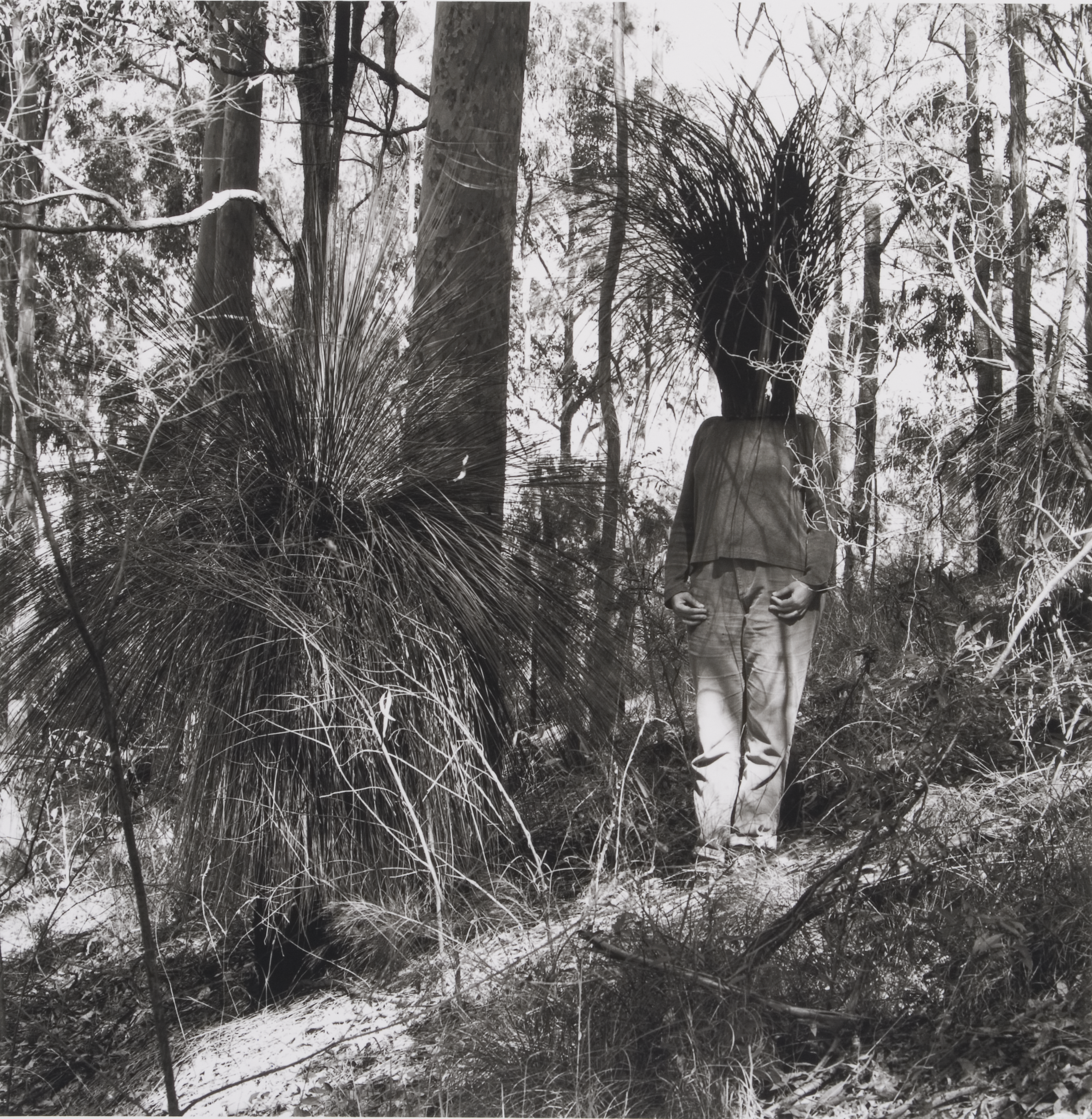
Simryn Gill, Vegetation 1999 Photograph: Jenni Carter

This is what she is in her 1999 Vegetation photos that she has printed in 2015… the reason for the delay is clear, they are moments of a life long journey, merging future, past and present, maybe stealing a story from the forest, and paying the penalty: colors are lost. Almost everything is secret in those images. The human head is lost as well, replaced by vegetation.

The mode of the person becomes the mode of the world,
For that person, and, sometimes, for the world itself.
The content of the mind becomes solid show
Or almost solid seen show—the way a fly bird
Fixes itself in its inevitable bush …
It follows that to change modes is to change the world. 

Wallace Stevens, from Conversation with three women of New England, Opus Posthumous, Vintage Books, 1990 ©1957 by Elsie Stevens and Holly Stevens

The mode of the artist becomes for me the mode of the world. The solid seen show of humans’ physical sensations:  an active exchange with the vegetation’s world, by contemplating or passing through.  

I wish I had had the same impulse Simryn had saving and printing branches from Maria’s Garden when the garden was destroyed to be replaced with a building.  One day the trees of the garden next door to my house, in Los Angeles, two enormous ficus and three pine trees have been killed, eliminated to build a wall. The shock I received was so strong that my mind stopped working properly and I ended up at the hospital, for suspected heart attack. It was not in my body, heart and brain were healthy. I couldn’t tell the same for  my spirit. My spirit had a heart attack. I still see them, but touch them I can not.

photos RA

TAKE THE DRAMA AWAY

Ulysses Jenkins’  “Sobriety” videotape 5.45′

to become “master of the world and of himself”

All the images are stills from video

THE WHOLE VIDEO IS PUBLISHED AT THE END OF THE TEXT WITH PERMISSION OF THE MAKERS

by Rosanna Albertini

The griot* is back. And his stories take off from the planet of facts fused into news and sculpted by useless words chasing a truth which is refused —by those who first of all need to believe. The planet is sad, violent, run across by feral humans. The same as always, since the beginning of writing that created history. 

The planet is where the griot lives. As if he were blind, the griot becomes a living echo. Bumping into the walls of the public insanity and returning to his body through waves of clarity and sobriety. Waiting for him are the phantoms of his mind: phantasmagorical images of water and air, desert and flowered land: the state of nature of his soul. 

Video images make his body an empty shell as if the griot in him had asked to turn into time, in the span of a dream. He can multiply because other smart humans have created special effects, and walk under water — a small person among enormous fish. Or, he can simply enjoy daily routines: that’s life! 

 The 5.45 minutes of Sobriety are not a parable. The artist escapes from daily brutality and stupidity. A morality final would stigmatize this piece as utilitarian, once more something to be used… enough. We have a piece of art.

The story brings the griot back to himself, identity isn’t “an inoffensive relationship to himself.”

It is it is and always was “to be chained to himself, and taking care of himself is a necessity.” (Emmanuel Levinas)

There is no infinity nor history that counts. Ulysses is present now, for real, that is not a dream.  But wearing the griot’s costume he can spread an impersonal speech and make it universal: don’t give up feeling.

Today Nobody dares to scream in the wind, “Your Intelligence will kill you,” like artist Jochen Gerz did more or less fifty years ago. 

Now Ulysses sings, and does it softly, whispering to our eyes keep being wide open, human among humans, what’s a joint compared to a rocket?  Worth laugh quietly, giving a chuckle. 

SOLITAIRE UNDER THE OAKS   

    by Wallace Stevens

In the oblivion of cards

One exists among pure principles.

Neither the cards nor the trees nor the air

Persist as facts. This is an escape

To principium, to meditation.

One knows at last what to think about.

And thinks about it without consciousness,

Under the oak tree, completely released.

ULYSSES JENKINS, Sobriety – videotape 5.45″, 2023

Bibliography and Notes

Wallace Stevens, Opus Posthumous, New York, Vintage Books 1990

Emmanuel Levinas, Le temps et l’autre, Fata Morgana, 1979, Quadrige/Puf 1983

Note by RA These two books never go away from my desk. Poetry and philosophy holding hands. They are my friends as I write, helping to keep my mind clear about human existence and experience. Levinas’ book was conceived in a German camp and written after his liberation. He thought me nuances and defaults of our understanding, and the lack of reality of idealistic abstractions. Time, being, existence merge into the fullness of life, and only the face to face with other humans allows us to exist. Wallace Stevens, on the other side of the ocean, dressed with poetic bodies very similar ideas. “A poem is a natural object,” “Poetry is great only as it exploit great ideas or what is often the same thing great feelings.” As I write about art and artists, I never feel alone.

*GRIOT from French, earlier guiriot, perhaps from Portuguese creado. Sometimes called ‘a bard.’ A member of a class of traveling poets, musicians, and storytellers who maintain a tradition of oral history in parts of West Africa. (On line Dictionary)

FRANK MASI : The Remote Life of Images

FRANK MASI : THE REMOTE LIFE OF IMAGES

after his recent journey to Japan


 Rosanna Albertini to Frank Masi — Los Angeles, December 2018

Dear Frank,

Your photographs of Japan are a dream of unreality. They are beautiful in an odd, almost disquieting way. I look at them and think, maybe Japan is not the point. The man I met many times in the past is a well organized, a practical person in love with the arts, and a very interesting collector of art. But these images that you grabbed and printed: the partial opacity of a window through which you saw the uncertainty of a blurred garden, and the frame of leaves tickling your curiosity; your oblique gaze through another window big this time that seems to protect from intrusion the peace of an inner space; the silent observation of manufactured clay cups waiting to dry – you call them ‘quiet’- these are works of a dreamer. A less mercantile term than the word artist.

Did you ever meet Fernando Pessoa?

 “In dealing with any object, the dreamer should try to feel the clear indifference that that object, taken as an object, inspires. The dreamer should know, with an immediate instinct, how to abstract from each object or event anything in it that is dreamable, leaving for dead in the Exterior World anything in it that is real — this is what the wise man should seek to achieve in himself.”  The Book of Disquiet

Still drying Kutani clay / quiet tools / no wind no fire / waiting

Haiku by Frank Masi

It seems to me that’s exactly what you do, whether the object of your attention is a river, a branch, a stone in a forest or an old wooden house falling apart, or a pair of pink gloves hung behind a glass door of a simple house, a daily routine sanctuary. Don’t mistake me, pulling the door of history shut behind you makes you free from the devils of History, objectivity and documentation.  But then, is Japan as a real country the center of your work? And, does it matter? Problem: the questions come from a limited experience that came to me via Japanese artists and friends in Los Angeles. My gardener Eto is my largest source of information. He was born near Hiroshima. He is reader of old poems whose language is today obsolete, forgotten.  He remembers trucks filled with corpses passing by his village, and stories of his life as an after war child, when he and his school friends worked in the countryside cutting vegetation with machetes. By accident, the head of one of them was cut along with the leaves. See, History is a bitch, a cutting weapon against art. 

Fact is, looking at your photographs I didn’t think of Japan, I mainly tried to unveil your perception while you captured moments that became images and in so doing mutated, moving from the surrounding reality to your instinct that hunted for silent meaning in a dreamed landscape. Photography is a surgical act, images are cut out from the body of reality. And yet it’s an act that guides me to your own sensations. Your images are the two faces of the same human reality: preservation of nature and urban variety of dignity and decay.

Forest shadow moss / mountain child rock / river clouds / sky somewhere

Haiku by Frank Masi

Visually omitted, the human presence is embedded in the scape of the land. And your eyes through the camera seem to rediscover fragments of a remote life in places and objects, a life that escapes time as well as control. Objects and landscapes are more foreign than national identities.  Maybe I felt something similar on a beach in Turkey, such a pristine and isolated site that I almost forgot about civilized life.  There was no sand, only red pebbles with round shapes sculpted by the waves. Not rocks, they were remains of pottery from ships sunk to the bottom of the ocean during ancient storms. I was walking on naked bones. 

“Nature is not mechanical to that extent for all its mornings and evenings, for all its inhabitants of China, or India or Russia, for all its waves, or its leaves, or its hands. Its prodigy is not identity but resemblance and its universe of reproduction is not an assembly line but an incessant creation. Because this is so in nature, it is so in metaphor.”  Wallace Stevens, The Necessary Angel 

“The true poem [or painting, or photograph] is not the work of the individual artist; it is the universe itself, the one work of art which is forever perfecting itself.” Ernst Cassirer,  An Essay On Man 

I must tell you, your photographs of Japan brought me into a cloud of nostalgia, reopening themes that never leave this blog, like termites attacking an old piece of wood. Nostalgia not for Japan, where I’ve never been, I’m thinking rather of an intellectual paradise with many comfortable chairs and humans sharing, comparing ideas, sometimes fighting to the death around the objects of their efforts, hoping to understand and to enjoy tremendously, face to face, the mysterious disconnection between images and words. How many times do we really feel the power of our voice, a sound which adds time and physicality to the bunch of words that we call ideas? Once more, writing eliminates sounds. Thoughts for eyes, strange as they are.

We are not far from Christmas, maybe the tail of The Kite will turn into a comet, and lift your images in a luminous constellation. 

I wish I had a kimono / and walked with others /wearing kimonos

Haiku by Frank Masi

BIBLIOGRAPHY

Fernando Pessoa, The Book of Disquiet, Translated by Alfred Mac Adam, Exact Change, Boston, 1998

Wallace Stevens, The Necessary Angel, Essays on Reality and Imagination, Vintage Books, New York, 1942-1951

Ernst Cassirer, An Essay On Man: An Introduction to a Philosophy of Human Culture, Yale & New Haven, 1944


AMERICAN ALLIGATORS IN MID-AIR


Paintings and drawings by STEVE GALLOWAY, Los Angeles

“I travel through time,” says a seven year old, “Which time? Ancient, a far past?”
asks the adult. “I come from yesterday night.”

A conversation reported by artist Giuliano Nannipieri, from Livorno (Italy)

STEVE GALLOWAY, Suppose 2011  14″ x 11″ Oil on canvas
Courtesy of the artist and Rose Gallery

STEVE GALLOWAY, Terrestrial Patterns 2007 15″x 11″ Charcoal and pastel on paper
Courtesy of the artist and Rose Gallery

MEMORY BEHIND THE EYES

by Rosanna Albertini

John Cage wrote that the means of thinking are exterior to the mind, and we might leave the mind ready to welcome divine influences. It is so hard to do. Maybe the handstand on the back of heron, giving our feet to the sky, would help if we could accept being displaced in an unfamiliar landscape. Steve Galloway places the heron on an alligator and the alligator in mid-air. This pathetic description, that says nothing about the art, only sends the art to hell.

You can only count on your eyes and look through charcoal and pastel until the imaginary land the artist found behind his eyes starts filling the paper. Along with him, we believe he saw it, he discovered it, he felt the power of images somehow as people did when they did not have books in their hands, and written language. “Tout faire parler,” let everything talk, representing the “large uniform flatland of words and things.” (Michel Foucault)

STEVE GALLOWAY, Floating 2008 52″ x 72″ Charcoal and pastel on paper
Courtesy of the artist and Rose Gallery

STEVE GALLOWAY, Moonflight 2015 20″ x 25″  Charcoal and pastel on paper
Courtesy of the artist and Rose gallery

Words, animals, and trees as figures of the world, limbs of the same body: neither too big nor too little, as they must be deep in a dream: feelings wearing the heaviness of matter: they are so dense and persistent that maybe only the alligator’s skin reveals their bumpy, obstinate proliferation. Now, as well as in the night of times, we know there is an infinite mystery we were born in. It doesn’t matter if computers try to visualize the back holes as if they were organs of the universe. How can we believe in what scientists say today, which is different from what they told yesterday night? At least in my countryside Italian legends we found and believed newborn babies were picked up from underneath a cabbage leaf. God’s eye, only one, inscribed in a triangle, was piercing the clouds to look at us, even listening to our thoughts. I don’t know about dreams. I suspect they were secret. He was not a god we children could love, his son was much closer to us, with his bloody cut in the chest and nails through his hands and feet. Children feared the father, not the son.

Sorry, I traveled back through time. It is what Steve Galloway’s images do to me: they bring my mind to a time before the order of grammars, to the time when I believed dreams were not distant from the frozen trees I was watching through the ice crystals on the window. Seeing was believing, although most of the images were made up. Nature couldn’t be copied. Books were the end of my era of belief.

STEVE GALLOWAY, Hibbies ol’ Place 20″ x 25″  Charcoal and pastel on paper
Courtesy of the artist and Rose Gallery

We live today in an age of disbelief. Let’s read Wallace Stevens:
“It is for the poet [and the visual artist] to supply the satisfaction of belief, in his measure and in his style….
To see the gods dispelled in mid-air and dissolve like clouds is one of the great human experiences. It is not as if they had gone over the horizon to disappear for a time; … it is simply that they came to nothing. Since we have always shared all things with them and have always had a part of their strength and, certainly, all of their knowledge, we shared likewise this experience of annihilation. It was their annihilation, not ours, and yet it left us feeling disposed and alone in a solitude, like children without parents, in a home that seemed deserted, in which the amical rooms and halls have taken on a look of hardness and emptiness. What was most extraordinary is that they left no momentous behind, no thrones, no mystic rings, no texts either of the soil or of the souls. It was if they had never inhabited the earth.”
WALLACE STEVENS, Two or three ideas.

STEVE GALLOWAY, Handstand 2011 50.8 x 63.5 cm Charcoal and pastel on paper    Courtesy of the artist

We had the Greek gods in mid-air, we had utopias, and later on in a similar vein Marx, Gramsci, Lenin and Che Guevara; now we have American alligators. They give us back impenetrable truths, and yet become our nautilus, the vehicle towards Galloway’s landscapes filled with irony and gentleness. It’s enough we “suppose” things that he doesn’t dare to entrust to words. We shouldn’t either. His image are not objects, they are “expressions of delight.”

STEVE GALLOWAY, Coyote Sky 2017, 30″ x 24″ oil on canvas
Courtesy of the artist and Rose Gallery

Bibliography

Wallace Stevens, “Two or three ideas”, in Opus Posthumous, edited by Milton J, Bates, Vintage Books, New York, 1990

John Cage, composition in retrospect, Exact Change Cambridge, 1993

Michel Foucault, Les mots et les choses, Une archeologie des sciences humaines, Gallimard, paris, 1966


JUDY FISKIN : Photography is a mental thing

“Imagination applied to the whole world is vapid in comparison to imagination applied to a detail.” Wallace Stevens

JUDY FISKIN, From New Architecture 1988 Plate 234 Courtesy of the artist

“The mind is the most terrible force in the world principally in this that it is the only force that can defend us against itself. The modern world is based on this pensée.” Wallace Stevens

JUDY FISKIN, From New Architecture 1988 Plate 242 Courtesy of the artist

UNTITLED  by Rosanna Albertini

Each little house is a song of solitude. A body opening limbs in a space where the distance between the sky and the ground has been reduced to zero: a flat, white empty space. They would float like islands. A scrawny bush, a pole, or little trees sometimes shaped by an odd haircut are ornaments in the wrong place, a complement to the odd shape of the houses.

“I am more interested in creating an experience than in summarizing experience.”JF
“The most interesting part is looking at this little universe of representation that I can make out of the world.” JF

It’s not the maternal opening of doors and windows of people’s homes that makes the artist happy. Each print gives the houses a face, the front of a building that seem to say the viewer: “True, things are people as they are.” Wallace Stevens, Like Fiskin, isn’t afraid of absurdity.
Am I ridiculous, with my single window and the bricks on my feet? You can say so, it doesn’t touch me. Oh, my forehead is too low, maybe two round eyes, of course closed, make me smarter looking. But I have three legs and two enormous garage doors (?)
Each house is a song of indifference, a self contained score only showing the mask of a secret, not immaculate conception.

JUDY FISKIN, From New Architecture 1988 Plate 233 Courtesy of the artist

JUDY FISKIN, From New Architecture 1988 Plate 235 Courtesy of the artist

jUDY FISKIN, From New Architecture 1988 Plate 240 Courtesy of the artist

“Impenetrable, opaque, obdurate: these are good terms to apply to the work. They all express something about what the world feels like to me.” JF

Through Judy Fiskin’s mind passes, maybe, the temptation to escape architectural codes and history of forms. Her 1988 eyes isolate each house from the landscape. Each house is a detail, almost a cut out, free from aesthetic rules or repetitions of architectural patterns.
See? My windows have curved eyebrows, and they stick out from the roof!
I am, instead, the reminiscence of a stilt house. And I grew like a barn with a vague Chinese flavor of a pagoda roof. I’m better than you, replies another house whose origins are uncertain: big ears and a city look under a hat low enough to evoke a pagoda, but centered in a way that makes more evident the asymmetrical face of the house.
Each house is a chant of styles speaking different languages in the same building.

“Idealized images from my mind.” JF

JUDY FISKIN, From New Architecture 1988 Plate 238 Courtesy of the artist

JUDY FISKIN, From New Architecture 1988 Plate 239 Courtesy of the artist

One house is the queen of flatland, another is so shy she hides behind a tree, the lateral side leaning on a tall chimney. Lady symmetry sits in the body of an urban figure waiting for cars, she has two garage doors. A pale, gray creature seems to be there by mistake, what a romantic mistake!
The high contrast prints reveal a flash of light not only erasing the context around these little houses, also removing all sign of memory, and comparisons to famous buildings. What’s wrong with common life? It’s mostly stifled by an eccessive closeness, to siblings and objects. Really, we need an artist to gently building a distance, and revealing its twisted, uncanny beauty.
Each house, a scream of silence.

OF MERE BEING

The palm at the end of the mind,
Beyond the last thought, rises
In the bronze decor,

A gold-feathered bird
Sings in the palm, without human meaning,
Without human feeling, a foreign song.

You know then that it is not the reason
That makes us happy or unhappy.
The bird sings. Its feathers shine.

The palm stands on the edge of space.
The wind move slowly in the branches.
The bird’s fire-fangled feathers dangle down.

— Wallace Stevens —

JUDY FISKIN, From New Architecture 1988 Plate 245 Courtesy of the artist

JUDY FISKIN, From New Architecture 1988 Plate 249 Courtesy of the artist

Bibliography:

Some Aesthetic Decisions, The Photographs of Judy Fiskin, The J. Paul Getty Museum, Los Angeles, 2011

Wallace Stevens, Opus Posthumous, Edited by Milton J. Bates, Vintage Books, A Division of Random House, Inc. New York, 1990


CANDY JERNIGAN : SONGS OF PAIN, LAUGHTER and CONTENTMENT

About influences, sharing and unexpected discoveries

by JUDY FISKIN, FIONA CONNOR and ROSANNA ALBERTINI

“Art should make life more interesting than art”
Robert Filliou, quoted by Annette Messager, quoted by Sheryl Conkelton and who knows from how many others


9512426_orig


Los Angeles. It was friendship that pushed us around Candy Jernigan at the same moment, and for the first time. Three women drinking her potion from a pink cup slightly twisted, offish. Pencils stand by not less reluctant to be touched. Their scrawny bodies curved by life, and their shadows, spread a sense of pain. Blue things cannot be on the same page: they would bring in liquid sparks of infinity as the sky and the water, the inner sensation that something larger, and intangible, goes around life but nobody can grab it. Candy’s images are small parenthesis in the big picture. The musical modes of her mood reflected by simple, quotidian object friends. Mostly, her name and art sit quietly on their parenthetic couch, waiting. Somebody might lift the plastic sheet.

A vague description floating in her memory, of an art piece from the Whitney collection that was on display at the New Whitney: made with something found, small papers with colored lines… Fiona Connor was chasing the artist’s name. She asked Judy Fiskin and me. Like a waltz by Gabriel Fauré, not too cheerful and not fast enough, the hunting started between the three of us, questioning, asking other people, getting lost. Soon Fiona found the name and sent it to us with a link to the anti-product web site: it was Candy Jernigan. She died in New York at age 39 in 1991, the same year I moved to Los Angeles. Eight images on the screen.


1404464_orig


2253542_orig


2449987_orig


3259623_orig


3516461_orig


7913593_orig


2318305_orig


Found online images. No captions, no dates. Yet, striking. I couldn’t stop looking at the artwork. Same reaction from Judy and Fiona. “Would you send me your response to Candy Jernigan’s work, for The Kite? I will add mine,” I asked both.

Judy Fiskin

Here is my response to Candy Jernigan’s leaves from Père Lachaise:

img_4315


Fiona Connor

I went up to the Laurel Doody’s last week to stay on her house boat and found this board. I have become obsessed with casting it in bronze. I love this chopping board – it is perfectly shaped by somebody, it has scars, it is hard to pin down.

I think I responded to Candy’s work because it is about mapping the world, being out there exploring as her modus operandi, choosing a single thing to help make sense of it. At this moment a practice that does not try and sum it up or say it how it is directly feels good. There are life lines in her work.

I ordered her book. I will hopefully show it to you on Sunday, Rosanna.

I am wondering about collecting and drawing works – will they always be deemed minor? Can they survive being brought into full view when they become something that an artist does, their thing? Do they require a sort of ‘childs eye’ or naivety on everyones part?

Is this important probably not. Some bile in our romanticism.

I forgot to take your book the other day Rosanna, I have been reaching for it.

Did another Newspaper Reading Club readings at the Getty courtyard this week with Billy Woodbury he read Le Monde it was very powerful.

Judy I love your photo and I am so so so excited for your iPhone film. Fuck.

A response, some news.

There is another artist I want to point you to Yuji Agematsu. He walked round New York for a year and filled the plastic sheaths that come off of cigarette packets with bits of rubbish from the city’s floor.

Love from,

Fiona

img_0317


My response, R. A.

She was not just a collector. She picked up and took care, gently, of pieces of garbage and discarded used objects that somebody’s fingers had touched and tossed. She attached her treasures to a thick paper or drew them with precision as if honoring their existence: nicely, in order. Wraps and prints and labels and matches and found dope from the city life, a blade of grass, a leaf in the country. She organized her relics in a space of quiet.

I’m attracted by her need of order. I wonder, was her imagination “pressing back against the pressure of reality?” (Wallace Stevens) No doubt as an artist she revealed her ‘nobility’ which is spiritual depth. “Nothing distorts itself and seeks disguise more quickly. There is a shame of disclosing it and in its definite presentations a horror of it. But there it is.” Nobility makes art possible, helping to feel each day as a gift, every thing as a custodian of vibrations, changes, expressions. Candy Jernigan’s cans of beans dance her homage to Goya.

Graphic order is the first thing I was taught in school: we drew little apples, or triangles, all around the page guided by a grid of squares. We weren’t yet able to read and write. We had to follow the grid, and be precise. To be literal was obligatory. (My school was a rural school in Northern Italy, with one teacher for two classes in the same room and countryside children using ink as a weapon from the tip of the nib.)

In the end we had made ‘una greca,’ a decorative frame recalling Greek borders. But Greek was only a word and we didn’t know what it meant. La greca was our decoration and nothing else. The forms we used though, reproducing flowers fruits or geometric signs, were part of the visual experience in our messy daily life, but these images were not as attractive as real pears or apples. We couldn’t eat them. I guess we discovered the images’ misery when they are not art. And in that time after World War II, we really were hungry.

Influence —I think it’s a sort of nourishment you take from other artists— it’s like the little sparrows, they are needy like that. When you’re young, you take in from a lot of sources; and afterwards, with all you’ve seen, you never know where it all comes from, where you stop and it begins.
—Annette Messager

Bibliography:

Wallace Stevens, The Necessary Angel, Essays on Reality and Imagination, New York, Vintage Book, 1942

Arthur Schnitzler, Relations et Solitudes, Aphorismes  Transl. from German by Pierre Deshusses, Paris, Rivage Poche, 1988

Annette Messager, Catalogue by Sheril Conkelton and Carol S. Eliel, Copyright © 1995 by The Museum of Modern Art, New York, and the Los Angeles County Museum of Art.


WAR IN THE EYES


Northern Italy 1943-45

Uncle and Niece: ROSANNA and ALBERTO ALBERTINI

HUMAN EYES AND THE EYE OF A CAMERA

A Panzer IV of the Waffen SS "Leibstandarte Adolf Hitler" division in Milan, Piazza del Duomo, immediately after the German occupation that followed the September 8, 1943 armistice

A Panzer IV of the Waffen SS “Leibstandarte Adolf Hitler” division in Milan, Piazza del Duomo, immediately after the German occupation that followed the September 8, 1943 armistice. (Wikipedia)

1325-PERSONE-EPOCA

Rosanna Albertini (niece) – I was born in the new days without war in an Italian village near Milano, and grew up with stories that nobody was able to forget so they were told over and over like an exorcism. For two years, before my living time began, the space between Milano and the Swiss border was a confused arena of bombing and killings. Large numbers of people were filling the streets, especially in Milan, manifesting collective feelings, raising their heads against military occupation and lack of jobs and food shortage.  To see the end of fascism in person was a way to become witnesses, to be sure there was an ending to bring home.

September 8, 1943, after the armistice, Milano was occupied by the German army.
April 25, 1944, under the directions of the partisan command of Northern Italy, Milan was liberated.
April 28,1945, Mussolini was arrested and killed. His collaborators had the same destiny.

I was an outcome of the war. By hope or by accident, I will never know. The doctor taking care of my mother’s pregnancy lived by the lake. Mother was eighteen. In no way our transportation could be safe: they still used horses and carts in December 1945: the horse was old, maybe the driver was drunk and the steep road toward the lake covered with ice. Despite the fact that details about the accident have been steadily hidden from me, I do know that I did do the first somersault of my life. I did not break from her body that day as the terrified members of my family expected. Christmas was approaching, I stayed warm where I was until the 28.

Alberto Albertini (my uncle) – In the early 1944, the dying regime tried to save little pockets of power. Placing blockades near the borders, for instance. Besano, our village, was four miles on a steep road up from Porto Ceresio, where the Swiss border starts, and the blockage was mid-way between the two villages. Because Besano’s city hall was in Porto Ceresio, to go to Porto we had to show a permit with identity photo. As I was the only one in the village doing photographs, I did portraits of everybody. I only saved a few of them. A curious thing: the blockage controllers were a special auxiliary police whose members, on April 25, merged into the partisan forces, as if such a decision were normal.
        The same happened with the customs officers. I was supposed to enlist with them exactly for this reason. I never did, the X hour struck. On the way home from Milan, I had to wait for the night to find a train. But I also wished for a lift from some truck. There was none. Not far from me, a bunch of young black shirts was hanging about. One of them was my age. I basically told him: ‘What a heck are you doing wearing a fascist uniform that is now against the law, when the war is lost and everything is falling apart? And the guy felt smart enough to tell me that his name was Felice Mascetti and he was happy (Felice) by name and by fact… when one has an idea! Comic and tragic facts followed. The guy was from Varese, he had tried to score with my girlfriend (I learned it when the news appeared) and died in a small fight against the partisans. The corps of fascism, already decayed, enlisted young and very young boys who might feel proud of themselves thanks to weapons and uniforms.

1320-PERSONE-EPOCAvarie epoca041-119


1319-PERSONE-EPOCA

1310-PERSONE-EPOCA

rev.GENTE 104104

1318-PERSONE-EPOCA

1322-PERSONE-EPOCA

1324-PERSONE-EPOCA

1327-PERSONE-EPOCA

1326-PERSONE-EPOCA 

1321-PERSONE-EPOCA

Technological war-craft: making the camera for portraits.

For lack of money and tools Alberto adapted 35mm film to a 6×9 camera, borrowing parts from a cheap Ferrania.

  1. he added a plate adaptor, as if the 6×9 camera were a plate camera.
  2. made a 35mm drive in the Ferrania and a piece of wood pressing on the film to keep it in the right position.
  3. Then he made by hand a small, indented wooden spool connected to a spring, so that at every perforation he could hear a ‘tac’ while rolling the film.

DSC_2421-21 DSC_2422-22 DSC_2425-25


Post scriptum by RA

It is difficult to read those eyes. They drank the war darkness and maybe kept looking at the bottom of their glass. What do they bring to me, to us, in 2016? Do I see their pain because they are my tribe, from the village where I was born? Is this the same pain of all those who survived years of war? In Palestine, in Africa, in Afghanistan? Is ours a completely different time? There is a layer of photographic or filmic splendor in the war images we share  today. Even a video recently made by a Palestinian girl about life in her refugee camp in Jordan is just beautiful. Images versus reality? The homeless’ eyes around me in Los Angeles are not as desperate as my people’s. I don’t have an answer. A vague sense of real things in my guts tells me that the war eyes are still like the ones in the identity portraits made by Alberto. We don’t see them in the newspapers. Maybe we like better not to see them, to keep them out of our walls. More than ever we need artists, hands showing the real thing, creating a new visual grammar, and new words, tearing off the lies of illusions. 

The greenness of night lies on the page and goes
Down deeply in the empty glass. . .

Look, realist, not knowing what you expect.
The green falls on you as you look,

Falls on and makes and gives, even a speech.
And you think that that is what you expect,

That elemental parent, the green night,
Teaching a husky alphabet.

WALLACE STEVENS, Phosphor Reading by his Own Light – From: Parts of a World, 1942-1951
in Wallace Stevens, The Collected Poems, New York, Vintage Books, 1990.

R. AA COORDINARE 017

Alberto Albertini using the camera he had built for the identity portraits.


PAPER WINGS and BRONZE DECOR

NAOTAKA HIRO 2012-2015 Los Angeles

HIRO.Rosen201516

“The bronze piece is titled, Red Olive. It is a life cast of my right arm from chin to fingers, holding a testicle.  The testicle is painted red.” (Red Olive, 2015, bronze and acrylic paint, 24″ x 14″ x 12″)

“I had a bald spot back of my head, about 1 1/2 inches in diameter, almost for a year.  It seems to have resulted from severe stress. Even though the spot was rather big, I didn’t notice it until a friend told me. In Japanese folklore there is a monster called futakuchi-onna: it is a woman with two mouths: one located on her face and the other on the back of the head, underneath her hair. Having her in mind I split open a face of my head-cast mask and cut a hole in the back. Then I stuck my head into the mask and breath through the hole.  I was interested in the shape, blackness of the pit, and, like a black hole, its unknowability and uncanny nature.” Naotaka Hiro.

NAOTAKA HIRO, Untitled, 2015 Pencil, watercolor, 17" x 14" Courtesy of the artist and Misako & Rosen, Tokyo

NAOTAKA HIRO, Untitled, 2015 Pencil, watercolor, 17″ x 14″ Courtesy of artist and Misako & Rosen, Tokyo

NAOTAKA HIRO, Untitled, 2015 Pen, watercolor, 17" x 14" Courtesy of the artist and Misako & Rosen, Tokyo

NAOTAKA HIRO, Untitled, 2015 Pen, watercolor, 17″ x 14″ Courtesy of the artist and Misako & Rosen, Tokyo

NAOTAKA HIRO, Untitled, 2012-2015 Graphite, pen, watercolor on paper, 9" x 12"

NAOTAKA HIRO, Untitled, 2012-2015  graphite, pen, watercolor on paper, 9″ x 12″

NAOTAKA HIRO, Untitled, 2012-2015, graphite, pen, watercolor on paper, 9" x 12"

NAOTAKA HIRO, Untitled, 2012-2015, graphite, pen, watercolor on paper, 9″ x 12″


“THERE MUST BE SOME WINGS ON WHICH TO FLY”* by Rosanna Albertini

Because humans do not have wings, and their minds are stuck in their bodies, they never cease questioning their own substance, the density of their thoughts like a fog over a buzzing busy hive of cells and organs, veins and pumps that we detect in biology books. Naotaka decided to dive into his own blindness, to visit images of the unknown carapace, of gestures, not to mention the invisible motion/emotion ejected through hands drawing without knowing, not really knowing what’s appearing in images a l’impromptu, and yet the artist doesn’t miss the spot he has found in some curves of his brain, creatures swimming or multiplying in chemical ponds. They are in him, not clear at all if they are him.


NAOTAKA HIRO, Untitled, 2012-2015, graphite, pen, watercolor on paper, 9" x 12"

NAOTAKA HIRO, Untitled, 2012-2015, graphite, pen, watercolor on paper, 9″ x 12″

NAOTAKA HIRO, Untitled, 2012-2015, graphite, pen, watercolor on paper

NAOTAKA HIRO, Untitled, 2012-2015, graphite, pen, watercolor on paper, 9″ x 12″

NAOTAKA HIRO, Untitled, 2012-2015, graphite, pen watercolor on paper

NAOTAKA HIRO, Untitled, 2012-2015, graphite, pen watercolor on paper, 9″ x 12″

Naotaka Hiro started to send out of his body from fifteen to twenty drawings a day five years ago, when his son was born. As if proliferation couldn’t stop? And every new born on paper is “his double” —he says. A supernatural disease? A human trying to capture the most fleeting, indefinite motions of his being. Sheets of paper are not mirrors. Light, light shadows, grab them before they melt, before they harden in ideas, visions, words. Movement is their natural birth, coming from any part of the body, wrapping forms recalling exterior limbs having the same delicacy of the interior skins but forms are not right, they look free from bones like new branches sprouting from a tree not yet aware they will have bark and leaves one day. Images of these drawings forget they had been conceived in an organism, a place of functional cooperation.  They show us the mysterious story of inner impulses asking to emerge and then feeling surprised there is inhuman space out there; “there must be some wings on which to fly.” Rebellious and gregarious at the same time.

NAOTAKA HIRO, Untitled, 2012-2015, graphite, pen, watercolor on paper, 6" x 8.5"

NAOTAKA HIRO, Untitled, 2012-2015, graphite, pen, watercolor on paper, 6″ x 8.5″

NAOTAKA HIRO, Untitled, 2012-2015, graphite, pen, watercolor on paper, 9" x 12"

NAOTAKA HIRO, Untitled, 2012-2015, graphite, pen, watercolor on paper, 9″ x 12″

NAOTAKA HIRO, Untitled, 2012-2015, graphite, pen, watercolor on paper, 9" x 12"

NAOTAKA HIRO, Untitled, 2012-2015, graphite, pen, watercolor on paper, 9″ x 12″

Those papers the artist covers with colors and water and delicacy extreme could be wings of desire floating in his mind. Sculpted and drawn hands look like an alien presence, four fingers, not five.

The hand is a bronze thief that holds a red fruit picked up from sexual organs. Something that might. Rigid, its power is lost.

On paper, creatures of water find a presence which is not supposed to last, the birth of an instant stabbing the artist with the force of an instinct, defenseless, already becoming something else.

The palm at the end of the mind,
Beyond the last thought, rises
In the bronze decor,

A gold-feathered bird
Sings in the palm, without human meaning,
Without man feeling, a foreign song.

You know then that it is not the reason
That makes us happy or unhappy,
The bird sings. Its feathers shine.

The palm stands on the edge of space.
The wind moves slowly in the branches,
The bird’s fire-fangled feathers dangle down.

WALLACE STEVENS, Of Mere Being, in Opus Posthumous, 1990

NAOTAKA HIRO, Untitled, 2012-2015, graphite, pen, watercolor on paper, 9" x 12"

NAOTAKA HIRO, Untitled, 2012-2015, graphite, pen, watercolor on paper, 9″ x 12″

* Wallace Stevens, Adagia, in Opus Posthumous, New York, Vintage Books, 1990.