PAUL WINSTANLEY, Walkway, 2026 oil on linen 72.44 x 90.55 inches Courtesy 1301 PE
1301PE Los Angeles March 2026
“The images, the paintings, are always extraordinary; the reality, even when similarities remain, bears almost no relationship tothem.“
From: Paul Winstanley, 59 PAINTINGS, London, Art/Books, 2018
Here I am, as the painter wrote, “the artists gets out of the way and leaves the viewer where once he stood.” I know Walkway is an image he reworked many times, each time a different painting in sync with a new state of his awareness of what he is doing. I use the present, as a sort of absolute time, separate from the fullness of things in which we loose the sense of our most intimate perception, and time steals our days. As I stand in front of the painting something from inside me is sucked in toward the silence of the white square at the end of the tunnel, so intense it is scary. The painting is, not the real physical place. Other humans have been there and marked their presence in graphic signs. The skin of the tunnel bears tattoos. Only in the painting they are indelible. But an un-human, vaguely pink-brown fog fights with the clarity of the white end. Forget reading. Only my soul can slide through the artist’s mental fog, and mine, maybe ours, in this damned 2026, where reason has lost her way. “life seeps in unintentionally, subliminally” (PW)
PAUL WINSTANLEY, House in the Mountains, 2025 oil on linen 87.01 x 60.24 inches Courtesy 1301 PE
‘Surface, translucency, light and space are all as one; they are indivisible. … a pure idea of the physicality and illusion of the painting.” (PW)
On the wall, in the gallery, “ the subject of the painting has ceased to be the walkway or the trees but was instead the painting’s own mediation of these things.” (PW)
What I write here makes sense when we are in front of the painting, the 87 x 60 inches of a window whose semitransparent curtain filters the outside scenery and remakes it intensified on the floor. My brain, at first, was seeing nuances of gray as the dominant colors. My eyes were mimicking the curtain, tricky as they are. I stayed still for a while, waiting: and colors come to me. As if the painting was waking from sleep. It was such a wonderful sensation that I liked to believe it was true for a second, a magical mutation. The one who was asleep was my brain, slowly making the colors out of the waves of light hitting the receptors at the door of my eyes. I am old, no surprise. You wrote it at page 94, dear artist, “ Self-irony, or knowingness, is always present as part of nostalgia, even when we are tempted to think it is not.”
The viewer needs it as much as you. I continue to see the light blue and the pink in the sky that gives to the painting a vaguely luminous area taking off from the top of the trees, as if the end of foliage was a landscape line. The profile of earthly creatures. I want to be a bird in that sky.
PAUL WINSTANLEY Stairwell 2, 2026 oil on linen 64.96 x 43.31 inches Courtesy 1301 PE
“My paintings consist of the color they need to be, for their own purposes.” (PW)
That’s a place that only exists in its painted form. Fabricated from photographs. Anonymous, enclosed inside a building, giving room for stairs or elevators, the place nobody pays attention to. Worse, the unidentified place in which humans are usually anxious, moving with haste, they can’t wait to reach some where else. The painting instead has erased all the unsettling feelings. It’s clean, almost soft. Green and pink diluted by light are the colors it needs to be. To be alive with hopes, expectations, angles and surfaces that bring to my mind an idea of transfiguration of architectural elements into a place filled with gentleness, silence, vertical breathing. Is it an organism? Really I don’t know why, the image of an unfolded body crossed my neurons.
PAUL WINSTANLEY, STASI, 2026 oil on panel 17.72 x 23.62 inches Courtesy 1301 PE
Smaller, surprising, in this almost romantic sequence of curtains in an oblique line, hiding more than revealing both the outside and the inside, the painting is a physical questioning, an oblique line of protection: dangers might be either inside or outside, please curtains, save us from harm. Veils are delicate, beautiful, seductive. Upper and lower space are two different dark browns, as if the earth was feeding them with strength. We can merge within the folds, and disappear.
“Focus on the mediation of experience rather than experience itself may, more properly, represent the world in which we now live.” (PW)
PAUL WINSTANLEY, Bathroom Mirror 2, 2026 oil on panel 17.72 x 23.62 inches Courtesy 1301
Desperate splendor of severed flowers and branches, before they fade and die. A quite penumbra, like in a house with the curtains closed in the afternoon, brushes petals and leaves giving them a mid color, temporary, and smooth. In the painted mirror the most unrealistic reflections recompose the scene, once more enchanting with colors. Images are pushed into the foreground by a steady barrier of brown and blue. Trompe l’oeil, it’s fun. Flowers and leaves recreate their own artificial environment. The artist reads their wishes and makes them happy.
“The painting is a picture of something, though of what is not entirely clear.” (PW)
Reading your The Bear in The Mirror for the second time
I stopped on page 77: Stories
in life
do not exist.
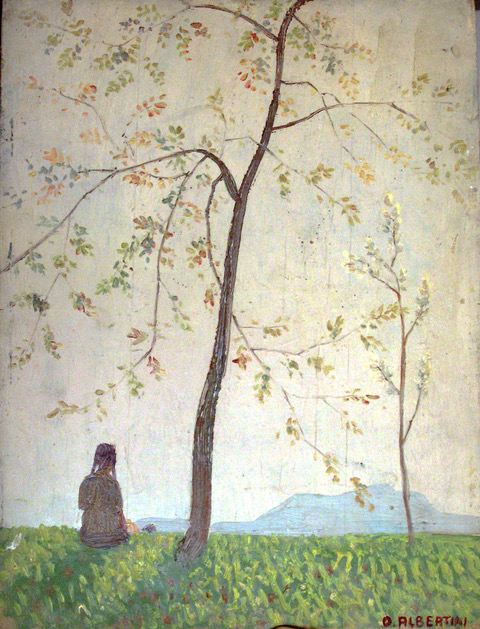
They need words to exist, people and places and pages, of course. But in that case, are they life or art? Let’s be ambiguous; for your birthday I send you again art from my family, by grandfather Oreste. I come from that garden, around it were fields and mountains beyond the lake, in Switzerland.
Grandfather painted me near the petunias. As I am made of time, strange intangible word, I moved out and far. Also, I never left the garden. These paintings keep me anchored.
Stories are told to my eyes by the light sweeping the small scene, almost burning the mountains’ tops during the sunset, and by each stroke of color. The act of painting for grandfather, and for me so very often making drawings next to him, were living moments grabbing an image from the passing time. To make an image out of love. Fighting, holding the power of changing not, and forever being. A strong circle connects me to these images as if my life could go back and forth jumping beyond obstacles.
I wish I could walk out of the painting and give you a petunia for your birthday.
Is white ok?
With love, Rosanna
Two paintings by Oreste Albertini, 1947 for the garden and unknown date for the landscape.
LA LOUVER Los Angeles – January 2026 Photos: Matt Emonson
I am a woman, my woman.
I am a girl, my girl.
I am woman, the woman.
I am girl, the girl.
I know how to work.
My feet work.
My hands know.
I am girl, my girl.
I am woman, my woman.
You made me woman.
You gave me woman.
Woman of the Flowers.
Mother of the Sky.
Woman of the Roses.
Girl of the Roses.
Flowery Woman of the Roses.
Daughter of the Rose in Bloom.
You gave me woman.
You gave me girl.
You took a girl out of me.
You took a woman out of me.
……..
You gave me my spirit.
You gave me my death.
You put my soul inside…
—Loxa Jiménez Lopez
Loxa Jiménez Lopez is Mayan woman from an untold time. The legend says that Anjel, “daughter of the Lord of the Caves, whispered in her ear and then, in dreams, showed her the Book with all the magic words to be learned.”***
I imagined Rebecca the painter was not just giving us portraits of flowers. She adds words for each painting, and titles sound like a ritual she started for herself, about herself: the flowery woman. A face surrounded by Gold Hair, wearing a mask of colors from the flowers hidden in her body, blooming from her hands.
Pink Punk Rose — A punk rose starting out like a kid starts out, inexperienced. A flower not yet knowing about her destiny, aggressively confused, spreading fullness and tension. The blue tries to contain the edges, before giving up, becoming lines from the sky.
Dahlia Uprising — The dahlia’s flower is a miracle of geometry. Soft with petals, a head full of hair. The artist brings an inconceivable disorder among the petals, a nervous uprising as if flowers were refusing the vase, trying to go away from the corolla, perhaps asking themselves “why” are they here. Why were they cut off.
Pink Heirloom — Who are they their name doesn’t matter. They are valuable forms. Heavy as if full of juices, ripe to death. So is the vase. The last wish of both flowers and vase was picked up by the artist who suspended disbelief: they float in the air.
Nasturtium Crown — They climb, or fall on the ground. Nasturtium hold all their energy in their colors, they do not raise vertical from stem to stern. As a painted crown, they float in the space missing a surface where to pose, and smile. Except the artist gives it to them, filling the wall with a fan of light that pushes the texture of stick strokes away from oneself, and encourages the flowers to be up, for a while, all they can have.
Blue Hydrangeas — I had them as a child in the back of the house, the shadowy side. Blue and round small umbrellas that stole their color from the sky. In this drawing they look particularly happy, luxuriating in a hat for the lady vase still like a stone, while they play with the light not knowing, maybe, how long.
Afton’s Abutilons — Red lanterns looking down, imperial, full of themselves as they can be. Although, they might shiver inside, and activate inaudible bells, warning about the yellow danger of the table, an alien flatness they cannot avoid.
Preppy Poppy — The starch in their look makes them rigid, or slightly perplexed. Red edges around the petals merge pain into their beauty.
Self Portrait in Green and Red — How vulnerable she makes herself! Yet, to use Eliot’s word “vulnerability was an opening – an ‘entrance.’ Where people were vulnerable was where they had once made room for other people.” Modern people struggled to find a language to “render what is unacceptable about themselves intelligible.” (Adam Phillips) Rebecca Campbell is an artist, feelings and desire are her stem. Images are her language. Not everything can be explained, nor understood. That’s why she lets herself unfold, until touching the ground. She apparently accepts her (our) fate: accepting things that cannot be ignored and cannot be understood. But in the end, green is resilience.
“I am woman, my woman”
REBECCA CAMPBELL
1. Self Portrait with Gold Hair, 2025oil pastel and UV varnish on paper, Image: 14 x 10 in.
2. Pink Punk Rose, 2025 oil stick on paperImage: 21 x 29 in.
3.Dahlia Uprising, 2025oil stick on paperImage: 74 x 49 in.
4. Pink Heirloom, 2025acrylic, oil pastel and UV varnish on paperImage: 19 3/4 x 28 in.
5. Nasturtium Crown, 2025 acrylic, oil pastel and UV varnish on paperImage: 27 1/2 x 19 1/4 in.
6. Blue Hydrangeas for Dot, 2025oil stick on paperImage: 29 x 21 in.
7. Afton’s Abutilons, 2025oil stick on paperImage: 21 x 29 in.
8. Preppy Poppy, 2025oil stick on paperImage: 74 x 49 in.
9. Self Portrait in Green and Red, 2025oil stick on paperImage: 74 x 49 in.
BIBLIOGRAPHY
Jerome Rothenberg, Technicians of the Sacred, University of California Press, 2017 pp. 369-372. For Loxa Himénez Lopez see Incantations: Songs, Spells and Images by Mayan Women, (El Paso, Cincos Puntos press, 2009) a Tzotzil/English version. “The fruit of the work of 150 people across thirty years, these are the first books written, illustrated and put together by Mayan people in nearly a thousand years.”
PORTRAIT OF ELLIOT ELGART made by his friend SAM AMATO
2 and 3
4
There is only one house between my house and Charlene’s, the wife widowed by the painter in 2014. She was about to sell Elliot’s studio and invited me to go with her and see her husband’s paintings before they were moved out.
An artist’s studio is a breathing space. The street and the building, with other studios one after the other, give the shoulders to urban life and face a wild garden. The place is silent, almost secret. I looked at Elliot Elgart’s art for the very first time; time disappeared. And a clear dialogue started between the images placed on canvas by his pupils and hands and my body visiting the painted world he had transformed, drawing and coloring a ‘biomorphic’ reality. Forms of the living can’t be prisoner of geometry nor reproduce the photographic blockage of only one instant. If one calls them ‘abstractions’ images start competing with realism, as if imaginary compositions had been cut out forever from things as we see them.
I don’t want to lock his art in any inappropriate cage. Art is a text escaping words; it’s itself a description, a mixture of perception, memory, feelings incessantly changed by passing time. Adam Phillips wrote that our relationship to change might “convert us to the beauty of the ephemera”. That’s what I saw in Elgart’s paintings. For the same reason I’m placing in this blog images of his work taken in his empty studio, “echoing and complementing each other in a context of spatial ambiguity”. Elgart’s words. Spatial ambiguity is inside most of his works.
Look at images as they live
Then, listen.
The true human dialogue, the one
of the hands, of the pupils,
is a silent dialogue.
Water melts me from words.
….
I talk of time out of time
I talk for yesterday and today;
about yesterday that is a lesson of life
about today that is a lesson of death.
Edmond Jabès, Le livre des questions
5
Images, words, neither are more solid than figments. It’s not the blue chair that is described, or a false facsimile.
“It is an artificial thing that exist,
In its own seeming, plainly visible,
Yet not too closely the double of our lives,
Intenser than any actual life could be…”Wallace Stevens, Description without place
In a room, in which objects and walls resist any reasonable position, the painted volumes become a small theater of displacements: angles are free from traditional perspective, walls become volumes rather than surfaces, and forms meet as colors want. Vase and flowers should fall from the table’s odd inclination but they don’t, and the chair can be seen as a surreal creature with two different seats; the white clothe is perched on both, is it a bird? Admirable complexity of an unusual painting. I couldn’t call it a still life.
6
Pink moon. The name I would give to a nocturnal combination of cut out parts. Abstraction? No. Maybe a collage of memories, to become a witty entity far from being satisfactory, familiar. And yet, it engages the viewer in a warm, friendly way, even funny, with the tiny figurine sitting on flatness and a pink animal neck resting on the line between white and green. It is a light, enchanting, capture of different forms without forcing them. Please, be together. Elgart seems to say.
In the morning I happened to have a humming bird flying in front of me within a hand’s breadth. Her flight was combining short movements in the air, vertical and horizontal, an irregular syntax of segments. This painting as I see it is the humming bird’s flight made tangible, and gentle.
7
Floating landscape. It seems to me a good example of the beauty of the ephemera. A combination of four horizontal landscapes? Lightness. Colors and lines do not hurt one another. They coexist in a floating movement of crossing flatness and depth; marks of human building are ghostlike, as if they had already been canceled by time. Only the foreground shows a certain depth, it could be the present, the rest is just feelings. It’s a landscape inside out, revealing a past that is not anymore.
Unfolding here a small part of his artworks, I bring back Elliot Elgart, a painter who left for the sky in 2014, and has been largely obliterated by the short span of attention that is typical of our time. So many artists had the same destiny. Inevitably, I would say. Elgart taught at UCLA for thirty two years, just before the flooding wave of conceptual art in which so many of us have been involved with passion and enthusiasm. During the short time I spent teaching at UCLA in the New Genre department, invited by Allan Ruppersberg and Paul McCarthy, I didn’t have any idea that completely different, interesting artists, had met the students in the same rooms.
After his retirement in 1991, a student sent to Elliot a painted card with a special thanks: “You are a true artist! ” – he wrote – “By this I mean you are passionate, open, and approach this world with a sense of wonder.”
Today, my sense of wonder helps me to keep my attachment to conceptual art, and to be open to so many different artworks hard to define in verbal frames. One by one, they can be a treasure trove.
8
9
10
Because I never met Elliot in person, I hope to keep a glimpse of his spirit reproducing a page he copied by hand and cherished. It is a text by Katsushika Hokusai, 1760 -1849, “the old man mad about drawing”.
From the age of six I had a mania for drawing the form of things. By the time I was fifty I had published an infinity of designs; but all I have produced before the age of seventy is not worth taking into account. At seventy three I have learned a little about the real structure of nature, of animals, plants, birds, fishes and insects. In consequence when I am eighty. I shall have made more progress, at ninety I shall penetrate the mystery of things, at a hundred shall certainly have reached a marvelous stage; and when I am a hundred and ten, everything I do, be it but a dot or a line, will be alive.
Written at the age of seventy five by me, once Hokusai, today Iwakio Rojin, the old man mad about drawing.
Very likely, Elliot felt in the same shoes as Hokusai. His entire life was dedicated to practice and teaching drawing and painting, following a special twist in his mind, hard to reveal in a verbal form. As I write my idea of his struggle for a personal, unique manner of painting, I stumble into the the dryness of words: as an artist, he was in search of the way to give life to the inside and outside of the the painted bodies. Trying to make the images capable to breathe, and produce energy. A simple drawing can be alive. His portrait of Chaz Garabedian is lively, as spare and essential as Giacometti’s portraits, with all the figurative details erased until the inner head survives, no different than anyone else. And, as beautiful.
11
When Elliot Elgart reached the marvelous age in which he could penetrate the mystery of things, his body was attacked by cancer. For him, a new country to explore: that hidden, inner body of his, only indirectly visible in medical abstractions. His paintings, for years, became an imaginary walk questioning the organs of his solid self, would they want to be fields of flowers? Flowers indeed that he is not allowed to pick up. One boot is enough, it must be blue.
12
13
“In death I disclose myself
I am a flower no one can pick up.
— You can’t breath it,
if you don’t know where it is.
Yet, you do know it exists.
That’s why you look for it.
You will die without finding
because it is your own death.”
Edmond Jabès, Le livre des questions
14
CAPTIONS
1 Elliot Elgart, no title, 1992, acrylic on paper 19 x 24 in
2 Elliot Elgart, no title, no year, acrylic on canvas, 24 x 30 in
3 Elliot Elgart, no title, 1992, acrylic on paper, 22 x 30 in
4 Elliot Elgart, no title, no year, acrylic on paper
5 Elliot Elgart, no title, no year, oil on canvas, 40 x 48 in
6 Elliot Elgart, no title, no year, oil on canvas, 60 x 50 in
7 Elliot Elgart, no title, no year, oil on canvas, 40 x 44 in
8 Elliot Elgart, {Self-portrait}, 1998, wash on paper, 22 x 30 in
9 Elliot Elgart, {birds} drawing on paper
10 Elliot Elgart, {profile}, drawing on paper
11 Elliot Elgart, {portrait of Chaz Garabedian} no year, 38 x 40 in
12 Elliot Elgart, no title, 1993 acrylic on canvas, 40 x 44 in
13 Elliot Elgart, no title, 1993, acrylic on canvas, 54 x 58 in
14 Elliot Elgart, no title, no year, drawing on paper, 17 x 14 in
BIBLIOGRAPHY
Wallace Stevens, The Collected Poems, Vintage Books Edition, 1990 Copyright renewed 1982 by Holly Stevens
Edmond Jabès, Le livre des questions, Paris, Editions Gallimard, 1963
FRED GRAHAM, Whiti Te Ra, The Sun Shines, 1966 Venice Biennale 2024
Fred & Brett Graham, father and son, about 1974
carving memories on the surface of time by Rosanna Albertini
History vanishes if no one writes stories, but even written deteriorates as much as the paper, never absorbed. The writer is not able to open history’s mouth like a midwife, and collect the whole body of dragons and ladders disguised under a double name: matters of fact. After decades spent writing, my illusionary attachment to the past disappeared: we accumulate stories in books not to preserve their truth, whose truth? Thucydides’? Mark Twain’s? Primo Levi’s? Shklovskij’s? All the Historians’? We mainly pack them in the closet and forget them. We like to be new, to look foreword. Only when the end of life approaches, we perceive what we don’t see.
“I was made of a changing substance, of mysterious time.
Maybe the source is in me.
Maybe be out of my shadow
the day arise, relentless and unreal.”
“We are our memory,
we are this chimerical museum of shifting forms,
this hip of broken mirrors.” Jorge Luis Borges
The printed age and the age of colonization cover the same volume of time. Fred Graham and his son Brett Graham are both Maori sculptors. Carvers of monuments in which Maori history resurrects from colonialist denial. Their art includes the inevitable integration – Brett’s mother is not a Maori – and yet their works, silent and powerful, let us face the indomitable energy of a living civilization. No isolationism, in either of them.
After the war, Fred Graham found himself in between traditional Maori art and what he calls “the modern movement of forms toward a new order reshaped by human mind.” Leaning towards the echoes of Modernism — the chaotic, idealistic response to the worst face humans showed to each other in a half century of wars — Maori artists tried to hold together personal vision ( implying freedom about tools, language and materials) and attachment to the spirit of the old, without which they would have lost the unique character of their culture: a chain of love, fight, and trust.
FRED GRAHAM, Tinirau and the Whale, 1971 Venice Biennale 2024
FRED GRAHAM, Maui Steals the Sun, 1971 Venice Biennale 2024
FRED GRAHAM, Tamariki a Tangaroa, 1970 Venice Biennale 2024
Grace, Hetet, To Kanawa, Rare, Harrison, Tukaokao, Matchitt, Nin, Graham, Wilson, Muru, Hotere, Tuwhare were pioneer artists seeking more than survival or local recognition. For a short while, they shared the New Zealand Maori Artists and Writers Society, founded in 1973. They were river, and island, as in a poem by Hone Tuwhare: The River Is an Island.
FRED GRAHAM, Kaitiaki, 2004, in the Auckland Domain in Auckland, The 11.8-metre-tall (39 ft) piece depicts a kāhu pōkere (harrier hawk), a bird that features as a guardian in Ngāti Whātua and Tainui oral histories. (Wikipedia)
FRED GRAHAM, Washbowl of Sorrow, 2004 stainless steel, kauri, totara, and customwood 734 x 55 x 82mm Waikato Raupatu Lands Trust Visual Arts Waikato museum.
FRED GRAHAM, Waka Maumahare, 2022, stainless steel, 16 m. high, it weighs 5 tons. Photo Waka Kotahi (Inspired by the story of the Tainui waka – a canoe carved from a tree that was planted on the grave of Tainui, the son of a chief Tinirau and his wife Hinerau in Hawaiki. One of the first canoes to reach the New Zealand shore, according to the legend.)
The artist on his way to bless the art piecePhoto: Waka Kotahi
Birds are a constant presence in Fred Graham’s vertical, tall and elegant monuments for more than half century. They stand on the land, and look as if wanting to fly toward the sky. Birds were the only animals in New Zealand in a pre-historic time, before Maoris arrived; how closer to creation not even the myth can say. Fred never broke the chain, he is the prince of Aotearoa’s Maori artists. A living ancestor whose moral authority will never disappear. Brett says that his own closeness to his father’s art was not transferred by words. He calls it sort of ‘osmosis.’ How lucky Fred is as a father! Not only Brett did not break the chain, he added his own vision. He carves the Maori stories in wood. Mallet and chisel are his pen. His pieces often cross the ocean. They are astonishing.
In 2024, Fred and Brett’s artworks were together in the same space of the Corderie dell’Arsenale, at the Venice Biennale. The first time for Fred, not for Brett, whose Aniwaniwa had been installed in Venice in 2007.
Maoris don’t have books. Past and present, since the first canoe from Polynesia reached the shore of New Zealand —it was about the thirteen century— are only one thing: generations passing on memories from mouth to mouth. Easy to say… Let’s change mode, from history to personal stories. I have been in Aotearoa. Brett Graham was my guide in his Maori tribe. Journalist, I was trying to learn as much as possible about contemporary art of every kind and origin in New Zealand, to convince Flash Art it was worth writing about it. My intellectual baggage? “That’s not reality, not for us,” Brett told me. After my pitch, Flash Art told me: too far away, why bother? Not their reality, neither. I worked for myself and wrote a book.
Facts are like boxes in which reality dries up, and dies of artificial stillness. But beforehand, there are coincidences, chances, wishes, delusions along with rare, unexpected moments in which you are certain that your inner freedom has found where to be, in a tangible form. Life in the marae, the Maori communal house, pulled me out of many boxes.
2008Pohara. Church starts before sunrise. At 7 a.m. the whole tribe stands outdoors under a spotless sky. A flag is the only religious symbol, lifted on the top of a pole: a flying field of images assembled by an artist for people who still read the face of the day. Frosted vapor has made the grass a carpet of needles. In spite of the low temperature — and a strange sensation of endurance and sublime self-effacement — everyone stands still until the singing starts, and hands and arms sway like waves through the fullness of feelings, and vapor spreads from the flock of humans. Buon giorno, Good morning, Kia Ora, Bonjour. While the sun rises in front of us, overcoming a curtain of trees, singing birds join the humans for the most vibrant orchestra, as crispy as the air. Who am I? For an instant, it doesn’t matter.
Such illusion is only mine; mythology and history for a Maori person melt into a collective preservation of memory. Roots and rituals climb like vines around care for family, friends, animals and the land. A single identity doesn’t have contour without fathers, mothers, queens and kings, ancestors. For an Italian woman like me, born to a Southern mother, mythology is no more than a fantasy unless my eyes touch it, on the curves of my mother’s shoulders just the same as the sculpted forms in the Greek statues. Personal genealogy is lost, becomes archeology.
Dinner at Fred and Norma Graham house. I couldn’t take my eyes off his hands. They seemed to me bigger than they should be, strong hands softened by work, hands finding a visual language for Maori stories since the very first: Rangi and Papa separated by their seven offsprings. “In the beginning Ranginui (the sky father) and Papatūānuku (the mother earth) were joined together in an eternal hug, and their children were born between them in darkness. The children decided to separate their parents, to allow light to come into the world as we see it now.” (Wikipedia)
After dinner, I couldn’t wait to ask him, “Is the myth of creation to you something more than a vague fantasy lost in time?” “It’s a beginning carved in each contemporary story,” he answers, “a beginning oddly reminding the sons and daughters of time that their life, their stories, are inscribed into a natural universe. The carver brings them out, as if they were already existing inside the wood, only needing to be revealed, and be born.” The dog snores in the corner of a quiet studio by the dining room. Fred Graham and I enjoy the warm solitude one feels when the house has family in the next room resting, talking, cleaning the table. His fingers leafing through images of his early sculptures, those recently migrated to Venice, the same his son Brett remembers as sounds in the evening, when his father was sculpting in his studio after a day spent teaching. Brett remembers them big, he was seven at the time. I found online a recent speech of Fred’s, telling that Brett’s recent sculptures seem to him so big! “Flesh and wood – Fred told me that evening – they are both bodies of the living. Death is only displacement. We Maori believe that when we die we become stars. I often looked at them as a child, wondering which one was grandfather.”
Brett Graham
Brett drives back to Auckland along the Waikato River’s curves. He resists my wish to talk about his artworks. See, he says, this is the way the land is forced to accept corrections. The Maori cemetery, steep on the hillside, was separated from the riverbed by the flux of cars. His grandparents, three Maori kings and their people rest there. This time too, as in many other trips, his car stops on the road when the cemetery appears. For a while, a magic silence. It’s church, inner quiet amid an outbreak of noise and billboards.
Brett was angry at colonialism, young, and anxious to introduce the foreign person I was to the Maori’s real life and culture. We became friends. Although he still doesn’t know, I suspect, how deeply was I changed by meeting his people. Talk about art, analyze and dissect? He gave me much more.
His recent pieces create symbolic places where fragments of Maori life —stigmatized as historical — cannot be corrected, appropriated, in the end destroyed. Celebratory monuments that give a magnificent body to past feelings forced to withdraw under the pressure of wars in name of civilization.
Wetlands dried up by the British conquerors to improve agriculture, had been a mine of gold for Maoris, full of eels. Wet and eels disappeared. Brett overloads with sculpted eels the room in which precious things were stored, put it on wheels and adds two long arms to the treasure trove. Nine months of work. Wetland. The two arms are a desperate prayer merging past and future, asking for simple understanding and respect, offering the strength of real stories. When I grew up, they told me words are stones, as if meanings could be separated by people who care about them. I am now the opposite: afraid to force real lives into the page and crush them like dry leaves. Maybe, can you tell? Maybe words forgetting self-realization, ignoring the judgment to come, maybe they can be written and fly, happy to forget universal truths or solipsistic illusions. Brett’s artworks, at my eyes, fly in the same way. Caring is their secret core.
BRETT GRAHAM, O’ Pioneer, 2020 Wood and plaster, 3 x 4m Photo: Mark Tantrum (Modeled on the gun turrets of ship Pioneer, an armed steam-drip built by the British New Zealand government, that invaded Waikato in 1863)
BRETT GRAHAM, The Great Replacement, 2022 12m wide. Yellow cedar 12 x 5.3 x 2.7m. Photo: John Collie. (It is an inverted ship’s hull. The materials recall Christchurch’s colonial architecture. The title connects to the white-suprematist manifesto of the terrorist who attacked Christchurch’s mosque in 2019.)
Kia ora Fred and Brett,
back to Los Angeles after the third trip to Aotearoa, on October 15, 2009, I tried to make the point with myself, who was I after my journey through the Maori land, and I ended up bickering with my new self. I send the botta e risposta now, in 2025, as it was the beginning of a new direction in my work that is still moving on with the same spirit. Rewriting, I made it new.
“I can hardly believe you went to the end of the world to the Southern hemisphere, to feel again in your bones the same chilly sensation you had in your childhood, in houses with no heating.”
Please, let me stop you. We can play with doubts and uncertainties. I knew for sure I could not plan my movements. At the same time, I did not feel deceived.
“What a sentimentalist.”
Not at all. Reality can reveal itself.
“That’s why shivering and smelling mold was important?”
Perhaps a Demon made me dull. The main intention was not to repeat colonialist mistakes, with candies of truth in my pockets. Questioning my story, my own perception, was inevitable. Words can approach a feeling of absurd freedom. Remember W. B. Yeats? The poet who listened to the friendly silences of the moon? “It is not permitted to a woman who takes up pen and chisel, to seek originality, for passion is her only business.” I turned his words into a feminine mode.
“You want to write about nothing, just the clouds of your own soul.”’
Exactly. Would you prefer a detailed description of the Auckland Museum?
“You don’t care about facts.”
Precisely. Press, Internet, radio, TV, track them down. It’s more than enough.
“You are so old-fashioned!”
Even romantic. I like graveyards. Besides, if you take fashion away, you will have a fact.
“How does art fit into the picture?”
Art is a short term, personal deviation, commitment, investment, you decide.
“So you were short-sighted in Aotearoa?”
Undeniably.
“Why such an absurd report?”
If I don’t, who would? — Not worth a damn, André Gide already wrote it. We believe our ideas are smart, and belong to us, because we have not read enough. The best thoughts have already been written.
“So, why do you persist?”
My feelings are truly mine; thoughts are common domain.
“What counts then?”
Relations: with any thing or any person. Not what you think about them, what they really are. History is a spiderweb lacerated by fingers to make holes for the present.
“Great. And by doing that you are not yourself?”
If identity is the point, I would put chains around myself. Where does freedom go if physicality becomes a burden, so much so that my mind burns out the heaviness, and I must vanish in the air like the spirit from Aladdin’s lamp? But if my muscles instead, calves and heart, along with arteries, skin, bones and hair, give me my sense of myself at every second — a human clock sculpted by time — I feel as a tree, filling a living time that changes and expands with the body, fed by sparkles of chemistry the same as rocks, sticks, fish, leaves and grasshoppers. Solitude goes away, time fondles me.
“Consciousness?”
Do you mean the sense of guilt, endlessly pricking the liver like Prometeus’ eagle? I can roast it and eat it.
“Do you give up with intelligence?”
No, I use it. It is a tool, not a goal.
Fred Graham
Thinking of you both Fred and Brett, from the distance of space as well of time, I see the Maori myth of creation once more releasing it’s meaning in your family story: Rangi and Papa giving birth to Brett but, this time, his life is instantly in the light as soon as he takes the first breath. Kia ora, Rosanna
BRETT GRAHAM, Cease Tide of the Wrong-Doing, 2020. 9.6m tall 3m wide, kauri and metal Photo: Vanessa Laurie/Stuff Permanently at the Govett-Brewster collection. (Ka pari te Tai Moana Ka timu te Tai Tangata – When the Ocean tide rises, the Human tide recedes. Memorial in the form of a niu, a Pai Mārire ritual practice. In memory of the Maori resources expropriated by the British settlers.)
photos RA (visual notes highly improved by my husband Peter Kirby)
One step inside, and the Stendhal syndrome alters my mental clarity. Confusion, dizziness: art fairs are not the place for celestial sensations. They are not the best place to encounter art at all. Personal sensations are overflowed by a loud orchestra of colors and forms, and shrunk by the effort of reading microscopic labels. Very few doing that.
I’m too curious to give up. To keep my sanity I think of David Hockney’s flowers, and follow the flowers, if there are any. My visit turns out to be surprising, it takes a long time. Yet, I’m not writing a review. I was in an odd space, parallel to the commercial effort at the origin of this big show, that’s why I don’t mention galleries. I keep myself there. Looking for art of today, wanting to savor something new.
The first painting that stops me is familiar and unexpected: Piero D’Orazio geometric abstraction Light Colors, 1962. Those colors are a musical space weaving the spirit of flowers so tiny and delicate they hardly last a day; they just open the eyes and sleep, protected by a grid that doesn’t hurt them. Of course, they are mental. And the mind perceive them more than the eyes. World War II is around the corner, I am seventeen, I buy a newspaper for the first time, get lost. In Italy we are all survivors. Light colors are hope and a sense of flutter in the stomach.
William Kentridge – Black & white flowers in a vase, as tall as a human. Art of now. Really, they are two drawings emotionally clinging one to the other. The small on the ground is a contemporary Goya, soldiers shooting at people. Life and death crept into the flowers sucking out every color. The eyes’ sensors transfer this feeling in my brain, blindness not allowed.
“I want to know how it feels to be them.” Words by Chantal Joffe. She means the people she portrays; her flowers share with them the same powerful manner of her painting. Stems and leaves are forced in an undesirable place, cornered. The vase as well isn’t comfortable. I keep seeing the two round sides of the vase as if they were stems folding down. Not reasonable, I know. Believe me, these painted flowers are pushing themselves out of the canvas. (Cornflowers, 2020) Let’s praise this artist, without nostalgia for Van Gogh.
Ana Mendieta – Flower person, 1975. She convinces me. Real flowers for the body and a stick as a pillow, with fake flowers. Nothing’s heavy. Her soul is dressed white and pink, as is her body. For a moment flesh and blood are forgotten. I forget her death. I had a similar vision when I was nine, on a hot afternoon, while covering my body with tiny white flowers just before a hemorrhage started from my nose, that no one was able to stop.
Yoshitomo Nara, Under the Hazy Sky, 2012 Like a piece of music, bringing all the vibrations of the empty space around a little person completely absorbed into the mystery of thinking: what are those minuscule double leaves? Did I killed them picking them up? They didn’t cry. They smell a little, must be alive.
Michal Rovner – Pragim (Poppies) 1 2023 LCD Screen. A sculptor of time in video forms, Michal makes visible the uninterrupted movement of people and things. Her effort is to reveal the truth of their movement. It can be a human population or leaves or flowers. The universe plays in their lives more than we imagine. Poppies float in a restricted space; withered petals are subdued into gray, brown, or white colors. The physical soul of the stems remains thin, tall, extremely fragile. Is the artist giving a vegetable look to the endless battle between Israeli leaders and Palestinian? An image of exhaustion?
Paul McCarthy – Silicone 2020-2023 Painted silver, it is not silver. The three stereotypes of Disney’s characters are caricatures: a loquacious duck is for Snow White. Comedy replaces drama & dreams, vive Stendhal. OMG Paul, this is so sad! You know? Even more because those flowers, to me, are thick and round, like money. This little sculpture is a mournful monument to the end of an empire, also the end of so many people dreams. My father would have been one of them. One day he appeared in the garden, where I used to spend the whole day as a child, waving a sheet of paper. “He answered!” he told me barely containing his excitement, “This is Walt Disney’s Picture and his signature!” He had sent to California an advertisement offer from the Italian version of Topolino, Micky cartoons, pretending he did it for me. To his dismay, I couldn’t care less and did’nt open my mouth.
Jean-Marie Appriou – Cherry blossoms 2022 Painted bronze. A French sculptor. From the on-line display I see he made many of these pieces, to express peculiar feelings. It’s a beautiful, strange piece, a stranger in the show. It brings me to remember similar decorative sculptures in Italian cemeteries. (The place where Lucio Fontana came from, working with his father). Today, in Los Angeles, it seems like a gentle alien from another time, I liked the surprise it gave me, still I am touched.
Jeff Koons Puppy, 1998 Porcelain vase, Edition of 3000. A dog 3000 times humiliated to hold flowers. I have sympathy for him.
Doron Langberg – Sunflowers 2, 2022 A young painter from Israel who lives in Brooklyn happily sharing ideas and experiences with a small community of artist friends. It sounds new to me, as new as Gertrude Stein Picasso and others in Paris in the 20s. One reads about them, hoping it happens again. One hundred years after. Doron declares his connection to Bonnard or Van Gogh in a simple way. Right. His artworks are completely new, original and inspired, incorporating hints from the past. I would never be tired watching these sensual, hard-living and dying sunflowers. I thank him.
Giorgio Morandi – Surprised, in my quest for flowers, I can’t avoid an act of devotion to Morandi’s still life. Flowers were in the vases, now empty. Their cycle ended, the whole painting holds onto the idea of tender colors, inorganic bodies reflecting pink.
Laura Owens – Untitled 2023 But I see flowers. Don’t mistake me. The real flower in this piece is the act of painting: thickness and flatness without conflict; delicate small details between spots of color that seem to come directly from the tube; a vine with leaves is the background of a red and blue dance of large commas with no text; it’s an earthly painting that includes the sky and the sea in a luminous window, superposes day and night. There are no clock hands turning these colors off and on. Only a marvelous crack in the artist’s mind. No photograph can render such work.
John Chamberlain, Untitled 1962 Painted copper. Isolated in a corner, the 15x21cm sculpture fell from the sky of unreasonable objects, wishing the market will find a place for her. It was an outgrowth from the artist’s hands. I see a bud with 2 geometrical pistils expanding in search of pollen, a desiccated flower magically turned into copper, whose colors never fade.
Pae White, Cyan I am 104.5 x 10⁵ in A big tapestry, extraordinary. Once more, not for photos. Forgive the images’ imperfection. Based on colors: cyan is dominant and yet yellow and pink are a massive presence. Flowers, maybe, or and fireflies? Not the point. The visual impact is powerful and gentle at the same time. Not that far from D’Orazio texture of light colors. As a portrait of a natural fable it makes you forget the urban scene in which you move. It makes you want to stay, and lie down in the grass and look at the fireflies at the end of the day. You also become Cyan.
A marathon of writing. After all, I crossed Frieze like a knife on a couple of legs, and this post is my own Fontana cut through the art I saw. Fontana must be mentioned by necessity: his works were the largest presence in the whole exhibition. Among many honest and often interesting artworks, perhaps burdened by absorbing the immense amount of perceptions and data, natural and artificial, and by struggling to find a personal focus —the ‘domestic heart’ in our garden of dramas and contentment— I feel grateful. Grata, we Italians say. We are particles in the sand of history.
The present is the only reality we belong to. Some of the last words by Marcel Duchamp say the Art of today is the only one we understand. What about the past? (Future is in question) I would say Art made before is a visual vocabulary enlarging our experience. No copy, no appropriation by young artists. Just available information like words we speak and melodies we sing. Some contemporary composers remake in their own spirit classic pieces they love. It isn’t stealing. It’s digesting. Visual artists do the same with impressionism, cubism, ancient art and are completely themselves. Nothing is hidden.
The artist as a hero was a myth. Fontana in the middle of all that is a good reminder: the foliage of the world gives us a home, but we still have to cut the surface to the core, if we want our existence to move on.
Origins are sweet, though. The following image is a painting by Oreste Albertini, my grandfather, and the girl is me. A fantasy landscape. I only have a B&W photo.
In the middle of June Things Mother Used to Make had its first online presentation in the evening, like a regular movie, or a performance. Brought directly into my home,I was excited. Dawn has few equals: she is her art. Over the last twenty years I saw her performances like wind in my brain. To tell the TRUTH? A way of speaking…not for Dawn Kasper. She branded the five letters one by one in the inner part of her right arm. On the left arm she bears the word LOVE, also branded.
DAWN KASPER, Uncle Jimmy or TRUTH branding, 2008 1 hour site specific performance installation. Anna Helwing Gallery, Los Angeles. photo: Micol Hebron
Her thinking is movement through the whole body. For years shespent hours exposing her body as if she had been killed, every time a different character, a new situation,and preparing for the performance by drawing in detail all the components of the crime scene. We used to talk in my kitchen while, a knife in my hands, I was peeling potatoes and chopping vegetables. Dawn still remembers the wooden handle of my knife. I was all ears. Especially to the intensity of her respiration.
“Yes, but my pieces are not about wanting or being prepared to die, they are about feeling life more. I become more myself through the work. Is it bad to admit it?”
Short-circuit for my brain; I had the sense that a mysterious monster was petrifying Dawn temporarily for reasons unknown.
“As I said in the kitchen earlier, I am consumed by curiosity in finding the meaning of life. But, I am dwelling so much on horrific imagery, asking myself why I am so attracted by this aspect of my existence. Perhaps I am already dead, I don’t know when or why.”
DAWN KASPER, Evil Series #12 ‘the Pond’ 2003. 3 hour live site specific performance installation. Mount Washington, CA Photo: Mark Golamco
One day she stopped dying. New performances were sometimes dangerous, other times delightfully absurd: like painting on white paper with clear water and telling stories of daily life during the work. Always around her there was a palpable emotional field, a physical tension stronger than intellectual description.Coming out of the performing effort she was at times bruised, wounded, the very portrait of failure. And yet, she had made visible something that words express in a different way, with a rigidity we must force and penetrate to grab the movement of thoughts, or poetic visions.
With Dawn, we face the power of a struggle with no guidelines, no safe edges, no idealism, for the soul is lonely, so desperately deserted in front of the task of living, that humor steams out of her body, while laughter and tears bring the spectators into the same tragicomic disorder.Art making disintegrates in her hands as does consequential thinking: if an action is planned, Dawn’s body makes it — her mind doesn’t know how emotions will play until the action starts. What comes out is a collage of circumstances, observations, reactions to place and people and the mood of the day Objects are simple tools, her body language the powerful center.
DAWN KASPER, Clues to the Meaning of Life part 6 (first time) 2008 1-hour site specific life performance, Echo Park, CA photo: Christopher Kreiling
A friend of her took his life and the artist had the strange privilege of being the first to find him. “The blue rope was strung through the rafters over two different points in the ceiling. Then came down and met David around his neck.” I’m wondering now, after so much time, if in her terror and despair facing this real death she had a tender wish hidden in her mind, like to give her dead friend a teddy bear. A few days after she made herself a bear, covered by mask and skin, and told David’s story reading a sheet of paper she had written on. Curiously, death goes with words: no more change.
…
History repeats itself.
The movement exposed.
Turn into another.
And into another.
And another.
Over & over again.
Observing.
…
These are words from the online piece. Twenty years after my first shock in front of her performances, Dawn Kasper keeps dealing with the tragicomic quality of the living. Things Mother Used to Make is a presentation of ingredients for the art piece. Spectators must put the pieces through their paces, discover and absorb their scent before the immersion into the peculiar flavor of the whole piece. The ingredients are:
— A long musical piece, sounds of the “recording of a recording”
— A group of words
— Animations or old film images and sounds turning into another composition over and over during the collage performed by Dawn’s fingers
— The title comes from the title of a 1922 cookbook
I would add that Mother’s ghost hovers on the whole pile.And, like any good food, the piece needs to be eaten to exist; art pieces are not different from food. Except, senses here are stimulated without physical objects. Like Pessoa, Dawn Kasper leaves their real bodies for dead and instinctively picks up their souls, merged with her dreams and ours. Ronawave defeated by art.
Two hours after viewing the piece I wrote an e-mail to Dawn:
Cara Alba, (Italian for Dawn)
I liked your piece: it was puzzling in an interesting way, music bringing an inward lack of expectations and high pitch listening of the same inside.
Probably helped by the sequence of subjects you had listed separately, insisting in separating words from images and sounds, you made me think ofyour mind and mine and everybody else’s revisiting what mother used to make through her own life, and yours, and mine, and others’.
In this way the piece was a moment of separation from the constant violent mess around or mental confusion. It was a clean time of light feelings, and cartoon like memories, they flatten, don’t they?
I’m probably dreaming, as usual, but I felt your beating heart in your fingers making the visual collage. Another experience I already had with you in person, when you made the little books at my house. You think through your body.
Rosanna
DAWN KASPER, Collage on paper 2007, in the hand-made booklet Dawn Kasper life and death, Circus Gallery Los Angeles.
Bibliography
Dawn Kasper life and death, essay by Rosanna Albertini, booklet Circus gallery, Los Angeles, 2007
Rosanna Albertini, Life Piercing Art, a book of portraits and self-portraits, Oreste & Co. Publishers, Los Angeles, 2013
Fernando Pessoa, The Selected Prose of Fernando Pessoa, Edited and translated by Richard Zenith, Grove Press/New York, 2001
Lidia Maria Gurney, Things Mother Used to Make, Macmillan Publishing 1922
KIM ABELES6 Self-Portraits with Files1995 Los Angeles
The interior life is often stupid. Its egotism blinds it and deafens it; its imagination spins out ignorant tales, fascinated. … A mind risks real ignorance for the sometimes paltry prize of an imagination enriched. The trick of reason is to get the imagination to seize the actual world — if only from time to time. (Annie Dillard)
( oxen )
KIM ABELES, Self-Portrait with Files, 1995, Courtesy of the artist
trying to GRAB the ACTUAL WORLD
by Rosanna Albertini
Leaves do not fall on the floor for a reason, a reason we can’t read or measure —secret dance of nature —and the eyes look about the yellow ripples searching for an order that isn’t there, it is only within us, mostly lost in a life we don’t understand and moderately control. Birth and death the ultimate truth.
I bring back these self-portraits by Kim Abeles today for a special reason: they depict a woman in action, but they are stills. The woman engages all the energy of her body holding, pulling, birthing a package of files that are nothing but life, but once more truly still: documents, memories, flat monuments of some living things.
The photographs are not about her SELF, they translate into paper images our stubborn conflict within a reality threatening us every day like the big mouth of a crocodile. Oh the teeth! They seem able to crumble every trace of humanity and especially like to chew the remains of freedom. Eventually the crocodile will go back to the swamp. It happened many times in the past. In the meantime our brain is scoured by the news. They are the semblance of life. They wrap themselves around the hours scanning time more than the old clock. See? all of this paragraph is a mental thing, as any thing else which is written.
Kim, the artist, opens a different chapter: her body deals with the flattened life as another body. We see the weight of saving pieces of life on paper, heavy phantoms of the living, if phantoms can be heavy.
( pulley I )
KIM ABELES, Self-Portrait with Files, 1995 Courtesy of the artist
( pulley 2 )
KIM ABELES, Self-Portrait with Files, 1995 Courtesy of the artist
( pulleygut )
KIM ABELES, Self-Portrait with Files, 1995 Courtesy of the artist
And we perceive her permanent struggle in preserving movement, the physical connection to something that was living and now is flat and black and white andpackaged. Each photograph is condemned to the same destiny. So you as an artist, Kim, you become a figure on the pile, maybe trying to stop flatness from growing, maybe adding your own?
“Multiple emotions. Not just one life in one isolated body; make your soul the host of several bodies. Feel it vibrate to the emotions of others as well as to your own and it will forget its own griefs when it ceases to think only of itself. The outer life is not violent enough; more poignant tremors result from inner surges of rapture.”André Gide, The White Notebook
( birthing )
KIM ABELES, Self-Portrait with Files, 1995 , Courtesy of the artist
Online dictionary: e-motion: a natural instinctive state of mind deriving from one’s circumstances, mood, or relationships with others… moving from, mid 16th century.
The artist’s actions are literally e-motions. Her soul, invisible, is the engine of her actions, silencing her mind.
Levitation: reality, the pile of files, looks pregnant with her.
Birthing: she gives birth to the pile of files, just a physical need.
André Gide again: “I was then a child. I did not understand that the mind is nothing and passes away while the soul still remains after death. … What is the soul?
The soul is our will to love.”
levitation )
KIM ABELES, Self-Portrait with Files, 1995, Courtesy of the artist
LENZ GEERK, Untitled 2019, Acrylic on canvas, 100 x 70 cm Courtesy of the artist and Roberts Projects, Los Angeles CA
LENZ GEERK, Croissant 2019, Acrylic on canvas, 24 x 18 cm Courtesy of the artist and Roberts ProjectsLos Angeles CA
YELLOW MOON
by Rosanna Albertini
No, says the child, the moon is white. That is not the moon, it’s a croissant.
I am not in the mood for fighting, words assume they are right, so does the child.
I keep seeing the moon wearing a puffy dress, looking kindly at the people of the house.
They look at her or keep her in their mindsin an uncanny way, even when the moon-croissant, the crescent moon, is off stage, or he looks as if he is wondering where she is,the man about to pick up his briefcase or maybe only passing by through the corridor. His thoughts, heavier than the bag, make him greenish. Hemight be a tree man growing out of the bag like a Houdini. It’s a painted reality, at the mercy of the marketplace.
But the artist knows that and he is conscious at the same time, deeply conscious, that he makes people and rooms and objects in his paintings “the only way that he is able to get the picture to exist.” Therefore the story doesn’t have to be necessary,“it has to exist but it doesn’t have to be necessary …. because the minute it is necessary it has in it no possibility of going on.”
LENZ GEERK, Pearl Painting and Pearl Necklace 2019, Acrylic on canvas, 49 x 35 cm Courtesy of the artist and Roberts Projects,Los Angeles CA
Gertrude, you are welcome. Did you notice the woman adjusting the necklace underneath her hair, she only has a portion of an arm, maybe she is a statue. Her pearl is so powerful that turns into a giant pearl, a mother pearl? floating between painted wavesin another painting. Mystery grows, for the two figures, the woman statue and the painting, float in the dark emerging from the canvas like Venus from the ocean. The painter, I wonder, maybe the painter is realizing he doesn’t have the soft, absorbing surface of felt underneath anymore, he is painting on canvas, not so easy, not so welcoming. He stops remembering the felt. He chops the arm, acts anew and lets the brush make the job.
Pirandello would call the figures six characters in search of their author, so lost in their own nature that they barely deal with the density of the living. Geerk’s painted creatures are not even completely human. They stand rigid, or slightly folded on themselves like leaves, or fall down in a strange angle as flowers do in a vase when the water has soaked the stem and petals dry up.Impossible to imagine themin a less empty space, less anonymous. A man leans toward the crescent moon on the table, can’t reach her. Hiswoman companion on the chair seems suspicious, keeps her distance.
LENZ GEERK, The Croissant 2019, Acrylic on canvas 80 x 115 cm Courtesy of the artist and Roberts Projects, Los Angeles CA
Another woman in a small gray painting looks at the yellow presence from afar, half hidden behind the doorway. That is the epilogue of the mystery story, the same that unfolds in five views of the same place: one of the two corners of the moon has been eaten, or stolen. It’s a croissant, not a moon anymore. Exactly as in an old Inuit tale: the house was flying, people inside asked the house to stop, they were cold. The house stopped and the people put some light snow in their lamps, the snow burned and gave them light. Someone from the street went in and said, “the snow is burning!”And the flame disappeared.
In our story the flame remained lit in the painter.
An interesting closeness to Morandi’s palette, and to the soft edges of his painted cups and pitchers, goes along with the quiet intensity of the figures locked in themselves and unrevealed dreams. If the crescent moon is their dream, it’s obviously unreachable. But the painter ate it.
LENZ GEERK, Untitled 2019, Acrylic on canvas, 150 x 200 cm Courtesy of the artist and Roberts Projects, Los Angeles CA
BIBLIOGRAPHY
GERTRUDE STEIN, Look at Me Now and here I Am, Writings and Lectures 1909-1945, Penguin Books, 1967
Inuit stories in Jerome Rothenberg, Technicians of the Sacred, Third edition, University of California press, 2017
MORANDI, Catalogue of Giorgio Morandi, San Francisco Museum of Modern Art, 1981. The catalogue I consulted belongs to Lucas Reiner, painter. He lent it to me with trepidation because it was one of his mother’s favorite books. Thank you Lucas, both the book and myself hope to see you soon.
A R T I S T S’ T A L E S — G U T S Y S T O R I E S
N.1
with the participation of ERIN COSGROVE (Los Angeles), SYLVIA SALAZAR SIMPSON (Los Angeles), GUILLERMO KUITCA (Buenos Aires, Argentina), ROSANNA ALBERTINI
(Sylvia Salazar Simpson’s foot has free access to this page. A wax creature, the foot pretends to be invisible and moves from the sidewalk to my studio in the most silent way. Photos: Hannah Kirby)
I go first only because this blog is my house. I must open the door. Also because history and unanswerable questions around the mutant forms of her body, transformed into strange alphabetic flooding of signs on tablets or pages, has been my research island when I was a scholar, for twenty years. My head must have been bigger than my whole body at that time. Now I am a woman who writes with the tips of her fingers, and thinks better when her feet move on the outdoor pavement, without studying, waiting for words coming by themselves. Laughing, they sometimes come with one of my old aunt’s expressions: “ego et ego,” that I mutter watching the garbage spread on the street. Little aunt never studied Latin, but mess was egoetego. A word as inscrutable as the birds’ songs hidden in the lilac in front of her window. The meaning was clear to me before I knew about languages or dictionaries.
The other women I knew in my family look back at me from the mirror: my mother’s shoulders, grandmother’s Rosa jaws, my southern grandmother Giuseppina’s mole in my clavicular left cavity, and god knows how many other spots of heritage from older branches I never met. My body is history! My voice is a concert: every single word I utter or write are history pebbles, their conglomeration is monumental, like an enormous midden.
And it is for me the most exhilarating discovery to see that from the Papua in New Guinea to the northern Netsilik Inuit to my old friend from the Eighteenth century, Rousseau Jean-Jacques, the mind resides somewhere in the larynx, the memory in the belly, and the force of magic “does not reside in things; it resides within man and can escape only through his voice.”* “Songs are thoughts, sung out with the breath when people are moved by great forces & ordinary speech no longer suffices. Man is moved just like the ice floe sailing here and there in the current.”**
When words shoot up of themselves, there is a new song, a new song from my porous bones. It might have holes of undefined shapes. It might rise like fog around human monuments, it’s only words. “Confusion will be my epitaph,” and that was Jim Shaw. I think he made a nest in my liver.RA
HISTORY — historical origin of the word: it comes from wit, old English witan from Indo-European root shared by Sanskrit “Veda” (knowledge) and latin “videre” see. The passage from wit to Hist is clearly phonetic. It belongs to the spoken more than to the written language.
THE MARCH OF HISTORY by Erin Cosgrove
ERIN COSGROVE, The March of History 2012. Live action video 15′ 17”
Before you enjoy watching the whole video, let me pay a few words of introduction; please listen to them with your ears. I’m the mocking bird who repeats all the possible sounds, who can sing some snoring out of your window. My song simply repeats some of Cosgrove’s words. The March of History is an art piece, spoken words go with the actor’s body language. Like me, he also walks, like history we all float through horizontal currents … of time? of air? mainly keeping our feet on the ground. But our mind is disrupted by disturbances: questions, centuries of conjectures and ideal constructions, interpretations, philosophical frames: which are histories, maybe rather stories, with people trying to give their present lives the proper ancestry from recent and ancient past stories rewritten and manipulated ad hoc. An endless work, worthy of Sisyphus. If there are truths making history’s rock too heavy, too painful to absorb, a new revisionist version will be entrusted to the words. Voilà! A march of lies. Erin Cosgrove is a conceptual artist who tears to threads any scholastic disguise. She is not immune from sarcasm and allegoric representations. Her art melts stories into romance, drawings, tapestry and animated films.
Here she deals directly with the big monster of History, a creature as fragile as Polyphemus who is one more symbol of single vision, the railroad of unidirectional thinking. She throws her pole into his unique eye, HISTORY’s single name, although hélas, not without pain for her. As in Camus’s Sisyphus descending the cleavage to recuperate the rock and push it back to the top of the mountain, an infinite sadness appears at the end of the story.Erin knows too well that lady History, altered and imperfect as she is in her verbal dresses, is our inevitable backbone, no less mysterious than each of her conscious and unconscious performers. Losing History, no doubt, we would lose our shadow. Come to the march!
Some of Erin Cosgrove’s words, moved around by me in a cloud of thoughts:
The past refuses to die
even if there is a past, history is falsified by everyone
let’s face it; memory is malleable, even in personal history
plausibility?
is history different from fiction?
Abba Eban: “History teaches us that men and nations behave wisely only once they have exhausted all other alternatives.”
It is part of the very warp and woof of life that the poor do not appear in history. As the African proverb goes, until lions have their historians, tales of the hunt shall always glorify the hunter. Is it so very surprising then that a brilliant few will be valorized over the many? We cannot undo the past. To think you can demonstrates a fragility of mind. The very price of understanding history is an impotence to do anything about it.
SYLVIA’S FOOT
(One of 20 feet exhibited in the water of a big pond at Barnsdall Park, Los Angeles, CA, 1978. An installation for The Great American Foot Show, Junior Visual Arts Center.)
Here Sylvia’s foot meets one of Erin Cosgrove’s paintings on wood:
It’s a foot, it’s a candle. The replica of the artist’s foot cut off below the ankle was born in 1978, 41 years old. Nineteen identical siblings didn’t survive the fire of Sylvia’s house.
It is a base without pillar, maybe he forgot the body he came from. It has become a mental thing in my mind, abandoned by name and personal history. The foot belongs to the realm of death secretly swallowed into the silence of wax, colors also were lost. Only for one day the foot floated in a pond of water at Barnsdall Park in Los Angeles. Children were allowed to grab the feet as if they were fish. “Oh, sea,what fish is this / so tender and so sweet? / -asked Gregory Corso, his boyish soul-—Thy mother’s feet.”
Words are absent minded. They often abandon us mid-way.
Wrongly or rightly, reb Souassi drew the logical conclusion that death was nothing but a coarse distraction of life. Hélas! It was fatal to us.
It is far from the shore that books have a shipwreck, like improvised boats knocked down by the storm.
Whiteness, by distraction, found herself without color. Unless it was the color that, suddenly, discreetly, found its whiteness again.
EDMOND JABÈS
Jamais le sang ne connaitra la blancheur Blood will never know whiteness
GUILLERMO KUITCA, one part of Missing Pages 2018, Oil on canvas 285 x 380 cm 18 parts, 95 x 63 cm each. From the catalogue published by Hauser & Wirth Los Angeles for the Kuitca’s exhibition 18 march-11 August 2019
BIBLIOGRAPHY
Guillermo Kuitca, Hauser & Wirth Los Angeles 2019
Albert Camus, Le mythe de Sisyphe, Paris, Gallimard, 1942
Gregory Corso, Mindfield, @ 1989 Gregory Corso, New York, Thunder’s Mouth Press
Edmond Jabès, L’ineffaçable L’inaperçu, Paris, Gallimard, 1980 (transl. of the quote by RA)
*Statement by Trobriands, Papua Nuova Guinea, in Jerome Rothenberg, Technicians of the Sacred, University of California press, 2017
**Statement by Orpingalik, Netsilik Inuit, in Jerome Rothenberg, Technicians of the Sacred, University of California press, 2017
You must be logged in to post a comment.