SIMRYN GILL

when finger tips try to see and eyes try to caress, far from words’ noise

Simryn Gill, Fall Then at  1301PE Los Angeles March 2024

She is Malaysian and lives in Australia, I am Italian and live in Los Angeles. Geographic and cultural distance. But, what if distance can approach the most remote parts of what is visible and discernible, the ungraspable emotions moving our mind through the myriad of sensory data, always contained between physical edges, until we disconnect from  the immediate perception as if it was lost, and “acquire the gift of giving a more durable form to real things vanishing around us.” As life moves on, language, in exchange, does everything she can to erase herself  “to open a space to the pure vision, starting an intuition completely forgetful of the words’ noise.” We flow through time. We flow hoping to keep alive the feeling of change; we take some notes, avoid stopping for too long. 

The world flows into the self, or mingles with it or bears it, and the like. One participates in things (understand the language). In this condition understanding is not impersonal (objective), but extremely personal, like an agreement  between subject and object.” 

I’m serious in what I’m doing here: in two paragraphs I have sucked in, translated, and recombined some thoughts from my beloved Robert Musil, Jean Starobinski, and Johann Wolfgang von Goethe —an unrequested inheritance. I made a parody of myself as an old scholar who can’t give up the beauty of thinking and accepts the strange fusion in the mind. Fact is, Simryn Gill practices these same ideas in her journey as an artist.  Reading her Passing Through  I could follow step by step the formation of an art piece she produced starting from the exploration of a real thing,  a derelict mid-century seaside motel in Malaysia, now liberated from the perfect modernist combination of squares after the attack of  roots, leaves, trees, animals and the human devastation of the walls in search of copper wires or pipes.  

I could read her mind looking for structures and decorations in detail, and follow her hands, the tip of her fingers asking the stones and floors to tell her their “internal porosity and openness…a kind of self referential, self-contained vulnerability.” “I had been – Simryn says– crawling on the floors and stroking walls in a ritual of appeasement. My cousins and I weren’t allowed to come here when the motel was in its full flight and we were in our teens, because it would have exerted a bad influence on our impressionable minds.”

Simryn  wanted to graphically render the patterns as archeologists used to do. Her words:  “In my version, I applied ink directly onto the patterns and details, and took the impression by rubbing the paper onto the stained surface with the back of a metal spoon.”

“I ran a bush studio out of the boot of my car: a folding table to hold a thick pane of glass for rolling the inks on, and the inks themselves, in tins; in a cardboard box under the table, my cleaning materials, cloths and solvents; on the back seat of the car, rolls of buttery Japanese paper, which is so deceptive in its fragility, so sympathetic to the heavy treatment of being beaten and rubbed.”

I wish I had seen the motel prints. Instead, I saw the bush prints at Brian Butler’s gallery, the exhibition title is Fall Then.  Same kind of technique described above. Same “dexterous hands and serene intentions.” 

A ritual, again. Dead branches, grasses and vines, destined to die in their new, aerial situation, are restored to life as if each of them had impressed a silent, visual speech on vertical papers. A last word, a unique symphony of forms. Tempos are visible, between each sheet and layers and superpositions behind. Light vibrations appear in transparent shadows. The forest, or the garden, aren’t in the gallery, so we only find well dressed ghosts. They maintain the freshness of the living and, let’s be clear, the artist’s tenderness, her attachment to the entire natural story as if she were a substantial component. Not an observer. Not only an observer. A wanderer, a passing bird. 
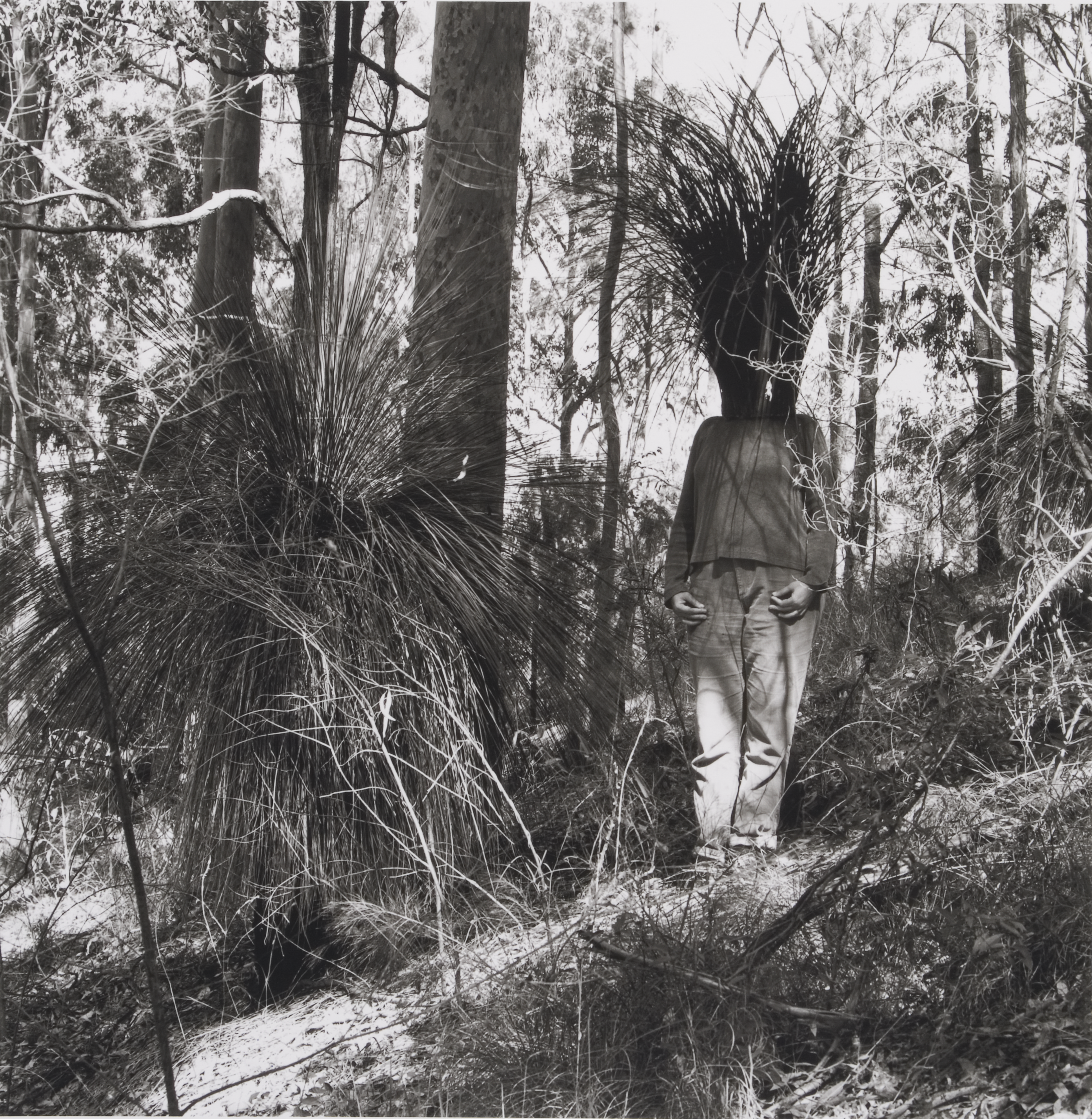
Simryn Gill, Vegetation 1999 Photograph: Jenni Carter

This is what she is in her 1999 Vegetation photos that she has printed in 2015… the reason for the delay is clear, they are moments of a life long journey, merging future, past and present, maybe stealing a story from the forest, and paying the penalty: colors are lost. Almost everything is secret in those images. The human head is lost as well, replaced by vegetation.

The mode of the person becomes the mode of the world,
For that person, and, sometimes, for the world itself.
The content of the mind becomes solid show
Or almost solid seen show—the way a fly bird
Fixes itself in its inevitable bush …
It follows that to change modes is to change the world. 

Wallace Stevens, from Conversation with three women of New England, Opus Posthumous, Vintage Books, 1990 ©1957 by Elsie Stevens and Holly Stevens

The mode of the artist becomes for me the mode of the world. The solid seen show of humans’ physical sensations:  an active exchange with the vegetation’s world, by contemplating or passing through.  

I wish I had had the same impulse Simryn had saving and printing branches from Maria’s Garden when the garden was destroyed to be replaced with a building.  One day the trees of the garden next door to my house, in Los Angeles, two enormous ficus and three pine trees have been killed, eliminated to build a wall. The shock I received was so strong that my mind stopped working properly and I ended up at the hospital, for suspected heart attack. It was not in my body, heart and brain were healthy. I couldn’t tell the same for  my spirit. My spirit had a heart attack. I still see them, but touch them I can not.

photos RA

THIS IS MY ITALY: A RADIANT, ABANDONED GREEN LAND

by Edgar Honetschläger and Rosanna Albertini

Conversation between an Austrian wanderer from Vienna and an Italian native who lives in Los Angeles

PHOTOS OF ITALY by Edgar Honetschläger

IMG_7966

IMG_7956

EH      This is my Italy. You might see it like a dream world, but this is the Italy my eyes see. Japan was dreamland too for me: Tokyo, or the breathtaking countryside, never appeared real to me. Ghosts and spirits everywhere, and people who believed in them. I guess the two cultures are strong enough to allow it.

The beauty I encountered was almost unfathomable: the intact landscape, the colors. Flowers blooming all over, butterflies, birds everywhere. At Bolsena lake the water played all the blues of the scale, then the rain came and the isola Bisentina vanished within minutes. For a while the lake looked like the sea, with no end to it.

IMG_7950

RA      Not the usual images of Italy. They are thick and secret, a texture of vegetable history intertwined with ruins, fountains, grottos that are for ghosts, figments of our mind. Impenetrable walls of plants: one can play with them in a reversed metamorphosis: unraveling our body through branches and leaves that are as hungry as the three-headed dog the Romans called Cerberus. Lost in Central Italy’s greenness, I was never able to separate mythological images, or the Etruscan smile, from valleys looking as if time hadn’t passed and ancient eyes could look at me from open caves pierced into the mountains.
But, it’s real landscape, not a dream.

IMG_7926

IMG_7927

IMG_7932

EH      To me it is a dreamland: I’ve always seen Italy exactly as in these photos since 1999; I went down to Italy regularly. I guess I make it that way as I do not like reality. I am simply not willing to live in a purely empiric, rational, only driven-by-science world. That’s my privilege as an artist. I embrace all things that cannot be seen: the birds that twitter their hearts out, the spirits in trees, the ANIMA, the animistic that is only to be felt, the alchemia of a seemingly untouched landscape that mankind has formed over milleniums with respect for all creatures so desperately needed to keep a natural equilibrum.

People I met there are outstanding individuals, the landscapes pure and virgin like churches and medieval houses positioned as if Leonardo da Vinci was looking at them, no change.  People more courteous than in most European countries: for me Italy is the last refuge in Europe, Italians are simply more humane.
Therefore your reaction shows me that one only gets to see and experience what one wants to see…

RA      I’m so distant from you: old stones and medieval churches are paradoxical sites to me: elegant, calm and harmonious, often shiny with gold and painted decorations. I’m only grateful that the rain of time washed away all the blood spread by centuries of violence. Italy has been invaded more than any country in the world. Clearly, I try to justify our misfortunes. That’s why we are kind, but with sparkles under the ashes. Your images, therefore, are true to the place more than you believe. They are the wild, secret face of Italy. My Italy for sure.
My dear friend, this is morning rumbling of my brain. Tell me please: how do you think in German language? Is it visual thinking?
See, when I think in Italian, Americans say it’s poetic language, and I laugh, for I do know we think and speak in a strange Italian way: animistic, metaphors are instinctive, idiomatic. It’s a primitive manner to feel like an ant among ants, a tree among trees, human animals among all the animals of the world. Think of Francesco’s Cantico delle creature, sister moon and the stars, brother wind and the air. And, if you can, follow me through idiomatic expressions in which I see the deep irony of an agricultural country forgotten and abandoned in these days. Yet, it is stuck in our words and sculpted in our minds.

Piove sul bagnato
Ha mangiato la foglia!
Che cosa aspetta / Forse di candire?
Ci resto di sasso
Ammazzo il tempo
Cercando il pelo nell’uovo

It rains on the wet
She ate the leaf!
What is she waiting for / To dry up like a candy?
I react like a stone
And I kill time
Looking for a hair in the egg

IMG_7951

IMG_7961

IMG_7953

IMG_7952

EH      Oh, German is a philosophical language and a very political one. No other language I know can pin down a fact so well.
Japanese is fuzzy, it is like the food. There is no center in Asian food many small dishes, no climax, like their stories: you have space to think and make up your mind.
German language is not very visual.
There is quite a difference whether you grew up with HÄNSCHEN KLEIN or HUMPTY DUMPTY, the surreal element is missing. I grew up with the latter.
For German speakers Italy is the land of dreams: Goethe [Johann Wolfgang von Goethe] gave us something to look for: while doing research in Sicily for my movie Il mare e la torta, [The Sea and the Cake] I realized that Goethe had visited Taormina and had painted the Greek theater in a watercolor (the same theater is in one of Woody Allen’s movies). Looking into tourism catalogues from the German speaking world, it’s impossible not to notice that the photos taken are exactly the same angle —more or less replicas of Goethe.
In other cultures, promotion about Taormina looks different. Leoluca Orlando [ Mayor of Palermo] once told me: “Goethe did good and bad for us at the same time; he brings us tourists still today, but they come with a preconception.”

IMG_7990

RA      But Goethe*, humane as he was, understood the modern world in its early beginnings and still enlarges our perception of it. Look at this, he could have joined John Cage: (please forgive my lack of chronological faith, I learned it in the eighteenth century.)
“We find that in observing objects our attention takes on a definite direction, that scattered data can be learned and retained more easily by comparison, and that in art we can in the end rival nature only when we have learned, at least in part, her method of procedure in the creation of her works.”
John Cage used to call it “her manner of operation.” And his own manner was not far at all from some of Goethe’s wishes:
“Everything is subject to constant change, and when things cannot coexist, they thrust each other aside. The same goes for knowledge, for practical training, for modes of representation and for precepts. Man’s objectives always remain very much the same; men still wish, as they always did, to be good artists and good poets. But the means by which these objectives are to be attained are not apparent at all, and there is no denying that nothing could be more agreeable than achieving something important without really trying.”
Isn’t it what you did with your photos?

IMG_0450
Johann Wolfgang von Goethe, Introduction to the Propyläen, 1798 in Goethe on Art, edited by John Gage, University of California Press, 1980

IMG_7974