LENZ GEERK : WHEN COLORS MOVED OUT

Lenz Geerk, Pears, 2024 Acrylic on paper, 84 x 200 cm

Lenz Geerk, Vampire, 2024 Acrylic on canvas, 180 x 130 cm

Lenz Geerk, Table-Tennis Player, 2024 Acrylic on paper, 41 x 30 cm – Lenz Geerk, Bird, 2024 Acrylic on paper, 41 x 30 cm

Lenz Geerk – Schwarzweiß – 2025

at Roberts Projects, Los Angeles, January-March 2025

  “A thing must talk. Sometimes it’s very hard to find the reason why a thing to whom one has dedicated work for so long doesn’t talk.” Joseph Beuys

There is a time out of dates, from which facts have been erased and places forgot their names, populated by living beings, animals and objects mute like stones. Their features have been refused any expression. They are what they do. Of course, this has been written already, about a hundred years ago: “We should stop thinking that this creature does what it is: rather it becomes, for God knows what reasons, what it does. Man makes his own clothes, but clothes make the man too.” Robert Musil 1922. 

Here we are, in 2025, with an artist who paints the clothes hung on the handles of a wardrobe, Joseph Beuys style, adding  a matching pair of shoes, and a vase with flowers. No human in view, pants and jacket are silent. A small figure appears wearing a crown, a king? If it is, he is perfectly dressed, a boy floating on paper. Waiting. So does the bird not really flying, he seems to be sitting on a spot of air. A touch of magic pervades each painted scene if one reads what’s happening, without questions. A naked man walks between mountains in a sort of trance, following a branch of flowers that tickles his nose and loses petals. Fragrance is the living strength of the scene. 

Lenz Geerk, Untitled, 2024 Acrylic on paper, 41 x 30 cm

We rather keep quiet our temptation of putting meaning over everything we see forgetting the silence, the intensity of feelings that refuse to be squeezed in words. They bounce back against us like the small ping pong ball against the naked chest of a player. More and more when one imagines to be one of the standing figures holding the night sky with two hands, as if it was a blanket, or a tablecloth: feelings merge with mythological mirages, turning into a state of wonder. Yet the standing figure, her/his/its face in Gerz’s painting is deprived of expression. It happened, she don’t know what it is. The naked feet are big and steady on the ground.

Lenz Geerk, Woman Holding the Night Sky, 2024 Acrylic on paper, 118 x 101 cm

Feet: are they the steady balance in this colorless landscape? In this painted comedy of errors? Pointless to invent another name: Geerk recalls the vampire, a big figure dressed in black that glides in the blackness of an unknown space. It could be the place where colors were sucked in, and annihilated. Maybe the blood as well. Surrounding fears heavy on every minute of our existence disappear, turning into a nightmare: “a mountain of facts growing larger by the hour, knowledge won, life lost — a failure of the soul.” Let’s turn inside out like a glove our inner, invisible life and Geerk’s paintings will become the images we discover in ourselves if we recuperate “the open-eared attentiveness of the child: expanses; solitude; being led; letting reason growing out of thing and into man.” And women and children…

Lenz Geerk, Woman and Moth, 2024 Acrylic on paper, 41 x 30 cm

Lenz Geerk, Shakespearean Actor, 2024 Acrylic on paper, 41 x 30 cm

Lenz Geerk, Scent, 2024 Acrylic on paper, 87 x 28 cm

Lenz Geerk, Holiday Ceramic Course, 2024 Acrylic on paper, 133 x 82 cm

Lenz Geerk, Painter and Model, 2024 Acrylic on paper, 41 x 30 cm

Lenz Geerk, Untitled, 2024 Acrylic on paper, 41 x 30 cm

Nonsense is not excluded. A painter keeps the model behind her. It is the model who looks at her. The Holiday Ceramic Course is a school en plein air, three people undressed, lost in themselves, as the hands on the ceramics don’t care what they are doing. Impossible not to laugh. Oh the moth! Ugly, fat, big like a butterfly but missing the grace of the far cousin. In European popular culture, butterflies are the open wings of the feminine sex. It’s quite funny to see them replaced by a gigantic moth. No title for the man and the woman so strongly embraced, seemingly forever. They become a painted sculpture: the double stem of a flower, it blooms in their heads. 

After so much inside out between the painter’s mind, mine, and these paintings’, the major feeling I will send through my words remains the same I found in the first sentence, a time without dates. Not arbitrary at all, incorporate in the present as it was in many past situations for centuries, when not so many facts were hovering, written words were spare, most of the visual art lost or unknown. I can be wrong, delusional. Unable to find my way like an ant on the white tablecloth, a painting that strangely represents the classic power of center with a plate full of pears. Be it. Così sia. I eat a pear and read: 

With flowers You write,

O Giver of Life:

with songs You give color,

with songs You shade

those who must live on the earth.

Later You will destroy eagles and ocelots:

we live only in Your book of paintings,

here, on the earth.’

With black ink You will blot out

all that was friendship,

brotherhood, nobility.

You give shading

to those who must live on the earth.

We live only in Your book of paintings,

here on the earth.

I comprehend the secret, the hidden:

O my lords!

Thus we are, 

we are mortal, 

men through and through,

we all will have to go away,

we all will have to die on earth.

Like a painting,

we will be erased. 

Like a flower, 

we will dry up

here on earth.

The Painted Book, after NEZAHUALCOYOTL

A few years ago, Lenz Geerk shrunk his message to the viewers in painted stamps on a monochrome envelope with no address. Today he discloses a song of silence; “ombra mai fu di vegetabile cara ed amabile soave, never was a shade of any plant, more cherished, pleasant and gentle.” (G.F.Handel, opening aria from Xerses)

The painter’s shades, the darkness, are sheltering the cracks in the rational habits, replacing certainties with gentleness, bringing painted flowers already dry, but never dead. With flowers he writes, his Painted Book.

Lenz Geerk, Untitled, 2024 Acrylic on paper, 41 x 30 cm

All the quotes in this text are from Robert Musil, Precision and the Soul

All the images reproduced in this post are by Courtesy of the artist and Roberts Project, Los Angeles, California.

Photos by Paul Salveson

Bibliography

ROBERT MUSIL, Precision and Soul, vols 8 and 9 of Musil’s Gesammelte Werke, Hamburg 1978 The University of Chicago Press, 1990, Paperback edition 1994 Edited and translated by Burton Pike and David S, Luft.

Technicians of the Sacred, Edited with commentaries by JEROME ROTHENBERG, University of California Press, 2017 “Pre-conquest poets and books in Mesoamerica : a written tradition that reenforces and expands the spoken one. … Nezahualcoyotl (1402-1472) author of more than thirty surviving compositions & chief of Texcoco for over forty years. Books were “made of animal skins or of the amate-tree bark, …and the writing itself took the form of pictographs , ideograms & some limited forms of phonetic transcriptions” (Leon-Portilla, Native Mesoamerican Spirituality) p.543.

CHAOS

C H A O S   

BY ROSANNA ALBERTINI

 Thick like a rock, the mountain of smoke was surging from the horizon in front of my house. The sky, a luminous stripe of light blue, was squeezed between the new soft, dark mountains and the umbrella of gray interrupting the usual sense of infinity. Fire was underneath all that, invisible. 

The beginning of something new. A few days ago a sudden disaster exploded in the city of angels, building walls of fire among the hills, pushing flames down the hills to the line of the ocean, jumping like hungry dragons devouring houses and trees. I avoid the political litany of complaints. News have been accurate, brave, sometimes more than news, personal stories impossible to watch without tears. Thank you Katy Tur! As I’m reading The city and its uncertain walls by Haruki Murakami, I’m tempted to compare the wild surging of fires like red walls, appearing at the same time in distant part of the city, to the walls in the book, that move and follow people who live there, to block them from getting out. In the literary dream humans can go through the wall only closing their eyes and giving up fears. You can say reality is different… not really. Beyond the physical destruction opens up a large buffer space, the emotional arena.  

So many left outside, standing in the chaos, deprived of the space where their whole life had been contained. An undefinable sense of disillusion, fears bigger than this disaster, turn on the way to darkness and tameness, deeply invading brain and body of those as well who did not meet the flames in person.

I can’t speak for others, I was facing for the first time the natural power of fire and wind in full force, a primordial work hard to defeat. I was not really prepared. And even less was I expecting that wind and fire would have sucked out from my chest most of the vague terrors, painful memories and illusions -a cumulative weight growing along my whole life- that I had kept quietly invisible inside, as if my reason could regulate life despite them. The personal color of all of that faded. Their weight deflated. 

Roughly grabbed out, the personal inner chaos was materialized in front of me, reduced to ashes, broken down, meaningless. When it’s hidden god knows where in my body, do the cells reserve a corner to such spidery connections? In fact, connections change over the years, flashes of memory change every time I put words on them, I see myself at five painting my face with the rotten husk of the walnuts fallen from the tree, darker than ink. 

Do the birds fly holding a small chaos inside, or are they completely programmed, or else they are both, with inner conflicts like us? They memorize. 

Day 9   For the first time various bird voices jump from one to another tree, seasons keep happening, and little by little we rebuild everything like spiders, also the inner chaos.

JEAN-LOUIS GARNELL, Man facing the chaos, 2025

As I was boiling in my brain these fragments of thoughts, I received from  Jean-Louis Garnell, a French artist whose voice becomes very powerful the more it is filtered by solitude and questioning, the image of a drawing. Man Facing the Chaos, 2025.  The state of mind he depicts comes from France, and yet is the same we share in California through the series of disasters happening in these days. No edges, no protections, each human is part of a formless transformation of matter and ideas, that are only sparkles of matter.

No distance between inside and outside. Fluid, undefined, we become marks on paper beyond words, boux de ficelle, blades of grass, dry flowers, cotton treads.  I know, it’s absurd to write about shapeless things using names of things. That’s how reality is pinned down. A drawing, Garnell’s drawing, reveals fragility as well as persistence. We are absurd, we don’t give up. 

Day 2. When I was born, burned and broken walls in Milan after the bombs of WW2 were still smoking. Probably my cells more than my mind have a precise memory of me. I could start now a new life, as it happened then, once more not by my decision. I am a dresser opening drawers here and there with no chronological order, no order at all.

A landscape of ruins has transformed big parts of Los Angeles into a B&W crumbling drawing. I try to feel like my friends who lost the comfortable, friendly objects, the furniture of their lives. Maybe inside them too the fire burned down fears and resentments. I believe they will do the same my friend John Pule did, building inside a trunk of wood, “a statue carved by the effort of finding solitude and voice beyond survival.”

 So many of them are artists. I wish their voices will sit in the air after the end of smoke, inspiring everybody else’s efforts. It is not Artificial Intelligence that will help resilience. A deep sense of equality as humans, just human intelligence, that would be enough. 

Our questions should evolve like everything else in life. A city, especially Los Angeles so rich with languages, habits, food from all of the world, is not different from a country. Who decides the edges? Who decides whose country the country is? The will of the few? The will of the many?  A country is a dinner at the same table, as large as the fish can be.  Not one person is better than another, actions are not precisely measurable. Agreements are questionable and there is no evil in arguments, only differences.  We share “a secret rising and ebbing of our being with that of things and of other people.” (Robert Musil)

Instead of “whose country” I would like to ask: “Who is coming for dinner?” 

JEAN-LOUIS GARNELL, My tools, 2025

BIBLIOGRAPHY

Rosanna Albertini, New Zealand with an Italian Accent, Oreste & Co. Publishers, Los Angeles, 2010

Robert Musil, Precision and Soul, The University of Chicago Press, 1990

Haruki Murakami, The City and its Uncertain Walls, 2024

FIONA CONNOR prova d’orchestra – an orchestra rehearsal

FIONA CONNOR, Drawing something under itself —2023— Düsseldorf, Germany

prova d’orchestra – text: rosanna albertini

photo credits: Cedric Mussano

Which one is the perfect verbal dress for Fiona Connor’ art pieces is almost impossible to say. I stick to my experience. She recently installed at the Kunstverein für die Rheinlande und Westfalen, Düsseldorf, five bodies of work. On February 20th she presented the whole project in a lecture at Art Center, Los Angeles. The event was memorable for unexpected reasons: her words could be counted, che le parole tue sian conte, we say in ancient Italian to avoid long explanations that spread from the lips like broth spilled on the tablecloth, sbrodolate. That evening, Fiona Connor counted her words, surprisingly and wittingly, wissentlich. The wittiest art speech possible. 

Intermittently, she threw little fistful of words in the air, projected plenty of photographic images and the video images of the Continuous Sidewalk, (her previous piece in Los Angeles). Pausing the show four times like a music conductor, she asked some students to read the words of apprentices from a German school of construction in Düsseldorf, those who had built the five unfinished squared constructions that seem to grow from the Kunstverein’s floor like ideas frozen in geometry. 

To call them unfinished is arbitrary. Maybe they are what they must be: a designed ridge, a landscape of the mind? Along with the hooks on the wall and the shoes on the floor (cast metal painted black, too rigid to walk away) the brick open cubes do not move. I’m comparing them to Giacometti’s heavy feet, the only part of the human body bringing safety and balance to his sculptures. The only one that is not gradually destroyed. Would the open cubes be the physical figure of the major, steady ridge in Connor’s mind? 

Hung on the hooks, invisible underneath her jacket, hides the story of Fiona’s father going to Germany in the mid 70’s to compare European to New Zealand modes of construction, especially how to organize the various elements of making buildings. True enough, the artist is obsessed by materials and process details no less than her father. I saw his eyes in a photo of that time: an intent look lit from inside, a contained  interior smile I observed many times in Fiona’s eyes when conceiving a project.  But honestly, to unveil such sparkle would risk to push the viewers toward a cause-effect logic: she made the ridge because… I would be the first screaming NOOOOO. This is history, art is something else.

An absolute Truth is in each art piece. And yet, unlike a flower we pick up breaking the stem, Truth, “like Beauty itself, floats elusive, obscure, half submerged, in the silent still waters of mystery.’ JOSEPH CONRAD, Lord Jim.

One should sit on them and think. Both on the words and on the bricks.  It goes with the title of Connor’s piece: Drawing something under itself, 2023. 

The most movable component of the Düsseldorf Installation is the artist herself: she spent the whole time of the exhibition going every morning into the lofty room, alone, looking at the ceiling that opens in stripes to the sky, moving the chairs around, then sitting on one or more than one and drawing small imperfections of the wooden boxes, other chairs, details, whatever her eyes wanted to pause on. Consequence: the frenzy and unrest in her own mind, helped by skilled hands, changed every day the sculptural configuration of the show. The installation is many views, and a mixture of different, implicit moments or decisions. Fiona seems to question her own process at every day. My impression, or something odd she said in her lecture (—her words from my notes on paper): “the metal chairs belong to the Kunstverein, they were available. Which is a failure, obviously.” “The fonts of the new alphabeth with a different style for each character were one of the five bodies of work. The public used the ink blocks to make posters. They were successful, another failure.” 

The artist covered with a nervous little laugh her secret irritation in front of the most obvious usage of her piece. Silent still clouds her mind obnubilating a simple contentment. 

In my view Fiona Connor made in Düsseldorf the most important piece of her journey as an artist. I tried to look at the whole process simultaneously in my mind, so I could see the images all together at the same time, not one after the other. A beautiful carousel appeared where the center is displaced horizontally —and why not, non-Euclidean geometries have existed since the 19th century—, the chairs are skinny horses incapable to trot having the four legs blocked in their industrial shape. They are meubles, mobili, furnitures made to be moved by somebody. And the artist does it in many ways: transporting them, sitting on them and drawing them. The drawings, afterwards, sit as well on the chairs and stay. Lighter, black and white, they can pretend to be butterflies, or graphic scores of a silent music.

 ‘Drawing’ is the first word of the title. I wonder: was the artist playing the conceptual symphony to the point she felt expropriated, as a person looking down at the implacable order of inanimate object, lifeless? To the point she needs to put her hands at work, the black and white papers become more and more convinced, rubbed, full of de-signs, as if “massaged” (her word) by the graphite.

Here, forgive me, I must distinguish ‘concept’ from ‘thinking.’ To think is to let the world flow into our self, and respond by uncertainty, feeling the borders between self and non-self as a buffer zone. Both influencing each other. (Forget quantum mechanics, let’s stay in the art world). Concept is grabbing, appropriation. Here the artist lets the presence of the damned chairs influence her hands. The act of drawing might be the buffer zone. I’m not attributing to the artist this idea, which is only a vague impression, a questioning totally mine.

“Hang ideas!  —always Joseph tormenting me— They are tramps, vagabonds,  knocking at the back of your mind, each taking a little of your substance,  each carrying away some crumbs of that belief in a few simple notions you must cling to if you want to live decently and would like to die easy.” (Lord Jim)

Therefore Fiona Connor set on her own art piece. 

In 2017 she wrote about an artist she admires that she was “mapping the world, being out there exploring at her modus operandi, choosing a little thing  to help make sense of it.” Could these words be the present top of her awareness?  Like a forefinger pointing at the 2023 Drawing something under itself. Hard work, today, to map a world technologically altered, produced and reproduced as if the easy way was universal. Not so in this case. The crime is personal, the absence of the last word is beautiful.   

Allan Kaprow would praise this piece as lifelike art, not just intellectually, as a moment of experience only accidentally in a Kunstverein. 1979, more than forty years ago. Fiona Connor, today, has been brave enough to expose the low and high ebb of her intent in the questionable lack of a final definition for her piece.

Art is not a perfect myth anymore, nor a symbol. These reassuring words, just words, only verbal emissions would replace with a caricature the complexity of the living. Art can be unaccomplished and cracked and beautiful like the secret life of each human. 

A hundred years ago, a blur in Robert Musil’s notebooks: “…apparently a world in itself, the world of beauty is nonetheless incomplete, marked off, and secretly negative.” … “Nonetheless, art as a form is probably a special limiting and grouping of her contents of ordinary life, but remains within its compass.”

z

SIMRYN GILL

when finger tips try to see and eyes try to caress, far from words’ noise

Simryn Gill, Fall Then at  1301PE Los Angeles March 2024

She is Malaysian and lives in Australia, I am Italian and live in Los Angeles. Geographic and cultural distance. But, what if distance can approach the most remote parts of what is visible and discernible, the ungraspable emotions moving our mind through the myriad of sensory data, always contained between physical edges, until we disconnect from  the immediate perception as if it was lost, and “acquire the gift of giving a more durable form to real things vanishing around us.” As life moves on, language, in exchange, does everything she can to erase herself  “to open a space to the pure vision, starting an intuition completely forgetful of the words’ noise.” We flow through time. We flow hoping to keep alive the feeling of change; we take some notes, avoid stopping for too long. 

‘The world flows into the self, or mingles with it or bears it, and the like. One participates in things (understand the language). In this condition understanding is not impersonal (objective), but extremely personal, like an agreement  between subject and object.” 

I’m serious in what I’m doing here: in two paragraphs I have sucked in, translated, and recombined some thoughts from my beloved Robert Musil, Jean Starobinski, and Johann Wolfgang von Goethe —an unrequested inheritance. I made a parody of myself as an old scholar who can’t give up the beauty of thinking and accepts the strange fusion in the mind. Fact is, Simryn Gill practices these same ideas in her journey as an artist.  Reading her Passing Through  I could follow step by step the formation of an art piece she produced starting from the exploration of a real thing,  a derelict mid-century seaside motel in Malaysia, now liberated from the perfect modernist combination of squares after the attack of  roots, leaves, trees, animals and the human devastation of the walls in search of copper wires or pipes.  

I could read her mind looking for structures and decorations in detail, and follow her hands, the tip of her fingers asking the stones and floors to tell her their “internal porosity and openness…a kind of self referential, self-contained vulnerability.” “I had been – Simryn says– crawling on the floors and stroking walls in a ritual of appeasement. My cousins and I weren’t allowed to come here when the motel was in its full flight and we were in our teens, because it would have exerted a bad influence on our impressionable minds.”

Simryn  wanted to graphically render the patterns as archeologists used to do. Her words:  “In my version, I applied ink directly onto the patterns and details, and took the impression by rubbing the paper onto the stained surface with the back of a metal spoon.”

“I ran a bush studio out of the boot of my car: a folding table to hold a thick pane of glass for rolling the inks on, and the inks themselves, in tins; in a cardboard box under the table, my cleaning materials, cloths and solvents; on the back seat of the car, rolls of buttery Japanese paper, which is so deceptive in its fragility, so sympathetic to the heavy treatment of being beaten and rubbed.”

I wish I had seen the motel prints. Instead, I saw the bush prints at Brian Butler’s gallery, the exhibition title is Fall Then.  Same kind of technique described above. Same “dexterous hands and serene intentions.” 

A ritual, again. Dead branches, grasses and vines, destined to die in their new, aerial situation, are restored to life as if each of them had impressed a silent, visual speech on vertical papers. A last word, a unique symphony of forms. Tempos are visible, between each sheet and layers and superpositions behind. Light vibrations appear in transparent shadows. The forest, or the garden, aren’t in the gallery, so we only find well dressed ghosts. They maintain the freshness of the living and, let’s be clear, the artist’s tenderness, her attachment to the entire natural story as if she were a substantial component. Not an observer. Not only an observer. A wanderer, a passing bird. 

Simryn Gill, Vegetation 1999 Photograph: Jenni Carter

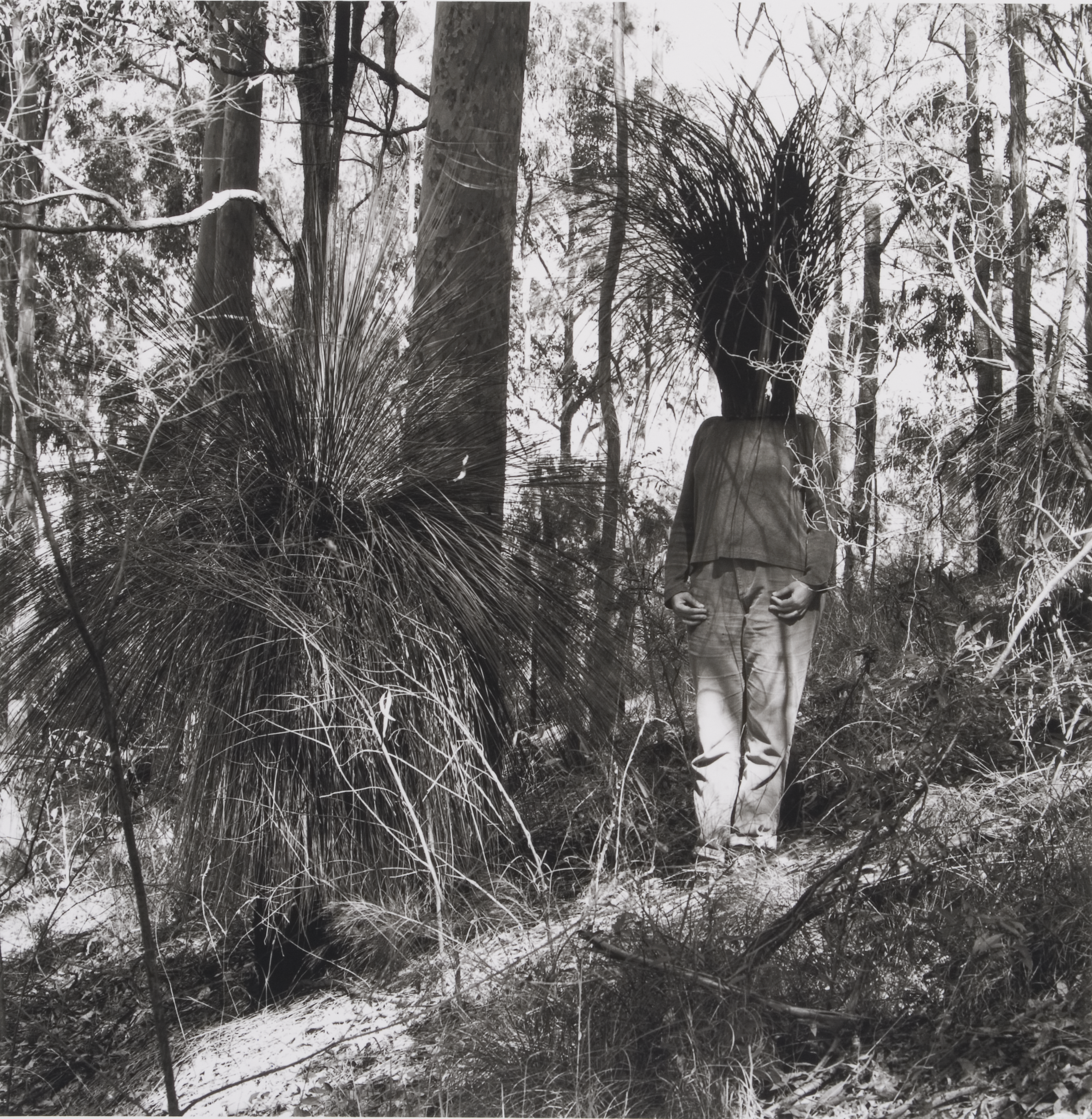
This is what she is in her 1999 Vegetation photos that she has printed in 2015… the reason for the delay is clear, they are moments of a life long journey, merging future, past and present, maybe stealing a story from the forest, and paying the penalty: colors are lost. Almost everything is secret in those images. The human head is lost as well, replaced by vegetation.

The mode of the person becomes the mode of the world,
For that person, and, sometimes, for the world itself.
The content of the mind becomes solid show
Or almost solid seen show—the way a fly bird
Fixes itself in its inevitable bush …
It follows that to change modes is to change the world. 

Wallace Stevens, from Conversation with three women of New England, Opus Posthumous, Vintage Books, 1990 ©1957 by Elsie Stevens and Holly Stevens

The mode of the artist becomes for me the mode of the world. The solid seen show of humans’ physical sensations:  an active exchange with the vegetation’s world, by contemplating or passing through.  

I wish I had had the same impulse Simryn had saving and printing branches from Maria’s Garden when the garden was destroyed to be replaced with a building.  One day the trees of the garden next door to my house, in Los Angeles, two enormous ficus and three pine trees have been killed, eliminated to build a wall. The shock I received was so strong that my mind stopped working properly and I ended up at the hospital, for suspected heart attack. It was not in my body, heart and brain were healthy. I couldn’t tell the same for  my spirit. My spirit had a heart attack. I still see them, but touch them I can not.

photos RA

BELLINI and MANTEGNA : FAMILY LIFE

having derives from another’s possession
…
Transformation, where true possession takes place,
…
Transformation, all transformations, man’s furnace,
crucible of patience,
I say all waiting is pure patience
If these words be spoken at the crossroads of space!
(The voice of the Karaw,  African praise poem)

ANDREA MANTEGNA, Presentazione di Gesù al Tempio, c. 1453, tempera su tela, egg tempera on linen, 77.1 x 94.4 cm  Gemäldegalerie – Staatliche Museen zu Berlin
   © Gemäldegalerie – Staatliche Museen zu Berlin

GIOVANNI BELLINI,  Presentazione di Gesù al Tempio, 1470, olio su tavola, oil on wood panel, 82 x 106 cm
Fondazione Querini Stampalia di Venezia   © Fondazione Querini Stampalia Onlus – Venezia

HAND OF THE FUTURE

by Rosanna Albertini

Pure patience in me had evaporated. It was early June and Venice was as hot as Africa. Yet I was cooking patience in my crucible as if my love for Venice were floating on the laguna, waiting to reach at least one place, one image calming my senses. Eventually I found two. Right now Venice is a theater for lost souls, a market of cheap, repetitive masks and glass beads to feed the savages, a park of shaggy grass surfaces, Chinese Cafes and bridges and floors trodden by a million feet. My self was an empty basket quickly filled with nausea from lack of space between humans, and disgust in front of German kids filling their mouth with water and spitting it brutally on the pigeons. The charming place where I had lived in the early 70s was gone.

“One participates in things (understands their language). In this condition understanding is not impersonal (objective), but extremely personal, like an agreement between subject and object. In this condition one really knows everything in advance, and the things merely confirm it. Knowing is reknowing.” ROBERT MUSIL

“You have been here already, haven’t you, you know where to go, right?” I crossed the entire third floor of the Querini Stampalia palace, the art gallery, as fast as possible, attracted by a magnetic force toward two paintings, or the same painting made twice, the first by Andrea Mantegna, the second about twenty years after by his brother in law Giovanni Bellini. Noticing I was spellbound, the museum guard, an old Venetian, couldn’t wait to tell me the story.


PREMISE: The two versions of the Presentation of Jesus at the Temple were painted when Venice was at the peak of its power and splendor: 1453 and 1470. Venice was the second biggest European city after Paris and the richest. Jacopo Bellini, Giovanni’s father and an artist himself, who was the head of the most interesting and successful “bottega” in Venice, will be my principal narrator. His slightly strabic, dark and piercing eyes, look at us from center of the paintings. He is a grumbling man, for good reasons.

The two paintings are family portraits. Bellini enlarged the group with two figures. From the right: Giovanni Bellini and Andrea Mantegna are the young men (self portraits), Simeon the priest not identified, Jacopo Bellini the father, Jesus is the baby boy born from Mantegna and Jacopo’s daughter, the Madonna a symbolic figure with no name, at her left Nicolosia, Jacopo’s daughter and Mantegna’s wife, the last woman at the left is Giovanni’s wife. 

Because both these paintings underwent five centuries of transformations in the restorers’ hands – Mantegna’s background was probably blue, hard to imagine now – I will avoid conjectures already deployed by art historians and experts of technology, often contradicting one another. I will stick to the story. Not long ago Venice was still permeated by whispers and talks in Venetian, flying around like a wisp of wings. We are in Bellini’s bottega.


Jacopo (father)          Would you close the curtain please? I saw the usual shadow coming up from campo Santa Margherita. Yes, I know you like him he is a good artist, but I don’t want Nicolosia to see him and besides, I do not want to scuffle with her.

Giovanni           Cossa vusto, father? What do you want?  Antonello da Messina gave us access to the oil color making he learned from the Flemish, so we learned to make more luminous works, almost sparkling. He is charming, has curly hair and big eyes. Think of the business. 

Jacopo          I do, but, Nicolosia is my daughter, she just gave me a boy to adore, Mantegna’s sun. Maybe a son of ambition rather than love, with marriage Andrea bought his freedom from his adoptive father Squarcione and got his own studio in Padua. It’s true the family painting he just gave me as a thank you present is still mat, quite sculpted on linen with perfect proportions —he always loved the colors of ancient sculptures, and the stones’sensuality. He is so good he doesn’t need oil paint. The other guy from the south instead uses every kind of trick. Tempera, you know, is still my favorite. He likes pretty much to slip under the skirts…That’s why he came to Venice, our putee (unmarried girls) are wonderful. Oh, the boy painted by Mantegna is a mummy, a cocoon. Antonello could give me another grandchild… can I be a collector of grandchildren from the most talented painters of these days?

Giovanni           True enough, Mantegna is the master. Perspective! You are good father, and have been innovative, but he is like anybody else. Too much work in Mantua. Nicolosia is young and lonely. Did you notice his self-portrait in the right corner? A tired face. He is so meticulous. Admirable, no stencils, no cartoon. I keep learning from him. Who knows if in a far away future people will understand the emotional depth of each detail, his ability to make lively figures out of lines and brush strokes, almost revealing their souls’ precision with egg tempera!

Gertrude Stein          I am thinking of attacking being not as an earthly kind of substance but as a pulpy not dust not dirt but a more mixed up substance, it can be slimy, gelatinous,  gluey, white opaquy kind of thing and it can be white and vibrant, and clear and heated.

Jacopo       Whose voice is this? It makes me nervous. I’m talking about men and women. Not my language. 

Gertrude Stein           I begin again with telling it, the way I feel resisting being in men and women. It is like a substance and in some it is as I was saying solid and sensitive all through it to stimulation, in some almost wooden, in some muddy and engulfing, in some thin almost like gruel, in some solid in some parts and in other parts liquid, in some with holes like air-holes in it, in some hardened and cracked all through it, in some double layers of it with no connections between the layers of it.

Jacopo           Who is she? Stein? Never heard of her; familiar though, she sounds like a painter. We were saying of master Mantegna that each of his painted characters is locked into an invisible hole, inside. Six bodies together, in the family portrait, and the bottom of them is somewhere else. 

Giovanni          Starting with you, father, What were you thinking? 

Jacopo          Oh, I was jealous, I wanted to kill him for being so young.

Giovanni             For the same reason would you kill me and my brother Gentile, like Chronos did with his children? I’m for sure your son, although I heard rumors about my real mother. I don’t blame you, and I love Gentile, we often put our brushes on the same painting. Did you call him Gentile because of your apprenticeship with Gentile da Fabriano?

Jacopo           We all share the same passion. First I want to see what you are able to paint. Maybe I will save you for the business.

1470 – Seventeen years later

As the former baby is already searching a mate, Giovanni remakes the family portrait adding himself and his wife to the scene. Same structure, same figures, not at all the same imaging: this family is not sacred anymore, halos around the heads have disappeared. Mary and Simeone look at each other, Mantegna sends an oblique gaze toward his wife, Giovanni looks obliquely out of the painting, his wife and Nicolosia seem to share a secret, pensively. Jacopo looks directly at us, is he thinking of his death, that will happen one year after? And the baby is the only one speechless, probably hoping to reach his mother’s breast. 

Dresses are more simple, and colors are dominated by a light bouncing on them from the outside world. Not anymore contained in each figure like the mystery of life. “The image of each [painted] object becomes a wordless experience; and the description of the symbolic face of things and their awakening in the stillness of image belong without doubt in this context.” (ROBERT MUSIL) Then undeniably symbols move out of the hands, like the growing baby, in a world of conflicts, of doubts and uncertainties. As if by accident, or accepting fate, the painter had left the invisible hand of future modernity posed on the painting, transforming its message.

Willem De Kooning           When I used the newspapers in the paintings, it was just an accident. When I took it off, I saw the backprint of the papers, and I thought it was nice. That’s about all.

Bellini                         Mantegna


A legacy by Giovanni Bellini: the most remarkable students of his studio were Giorgione and Titian.

BIBLIOGRAPHY

Bellini Mantegna – Masterpieces face to face – The Presentation Of jesus to the Temple, Milano, SilvanaEditoriale, 2018  and Fondazione Querini Stampalia, Venezia (Italy)

Gertrude Stein, The Making of Americans Being a History of a Family’s Progress, 1906-1908.  Something Else Press, Inc., 1966

Robert Musil, Precision and the Soul, Edited and translated by Burrton Pike and David S. Luft, The University of Chicago press, 1990

The African praise poem from Technicians of the Sacred, edited by Jerome Rothenberg, University of California Press, third edition, 2017

Giorgio Vasari, The Lives of the Artists, Oxford University Press, 1991

Emile De Antonio and Mitch Tuchman, Painters Painting – A candid history of the modern art scene, 1940 – 1970  New York, Abbeville Press, 1984


Between The Lines : AIMEE GARCIA

CUBA – AIMEE GARCIA’s SUPREMATIST SPEECH – LOS ANGELES

 Couturier Gallery

AIMEE GARCIA, Cuerdas, 2016, Inkjet print, newspaper, thread on canvas. Courtesy of the artist and Couturier Gallery

AIMEE GARCIA, Cuerdas, 2016, Inkjet print, newspaper, thread on canvas, 22″ x 33″
Courtesy of the artist and Couturier Gallery

cuerdas, lectura, alas – strings, reading, wings

By Rosanna Albertini

Put the title in your mouth. Strings, reading, wings : a bird screeching, in anger or pain. The wind is stronger, faster than his flight. The bird doesn’t stop, resting doesn’t fit his American temper. Try the Spanish mouth. Cuerdas, lectura, alas. Words that bring a feeling of  whiteness, calm. A large page with no resistance waits for history to be forgotten.

Aimee, the artist’s name, melts the two sounds into one. In my Italian mouth, Aimee is a silent moan that doesn’t slip into the throat. It doesn’t need voice.

In her Cuban isolation, Aimee Garcia has transformed in art flowers of intelligence, never complaining. I could see myself in her collages, or any of the humans living on earth. We are all shredded by the same storm. Really the past could teach? As languages, politics, internet, financial games, advertisements tie our lives into the same bundle of voices fighting for primacy, believing takes the place of the dirty window we look through. We don’t know what we really know.

So I thank Aimee for her suprematist speech which is a portrait of us all like flies tangled in the news’ spiderweb. But her images also are, strongly and gracefully, the portrait of a possible flight out, a non-objective getting away from the written reality toward secret, inner transformations. Between the lines, the artist. Very much like Simone Forti who reads the news only noticing and remembering them as they slip into emotions, digging ponds in her heart.
(See Flag in The Water, https://albertini2014.blog/2016/02/09/flag-in-the-water/)

AIMEE GARCIA, Lectura 2016, Inkjet print, newspaper, thread on canvas Courtesy of the artist and Couturier Gallery

AIMEE GARCIA, Lectura, 2016, Inkjet print, newspaper, thread on canvas, 31″ x 24″
Courtesy of the artist and Couturier Gallery

Aimee’s speech is made with colors and embroidered into the paper. She is threading herself, and looking at us from behind the cuerdas : her hand works like a cursor: ploughing into words, while sowing that “primacy of pure feelings” that Kasimir Malevich called SUPREMATISM about one hundred years ago. “The visual phenomena of the objective world are, in themselves, meaningless; the significant thing is feeling; as such, quite apart from the environment in which it is called forth.” (KM) When she reads, Aimee visits her own mental field that is not necessarily the same as Cubans’ or, as far as I don’t know, a simple acceptance of a theory married to Russian revolution as if both, ideas and political upheavals, were a block sculpted by time instead of myriads of crumbs and broken steps.

AIMEE GARCIA, Suprematist Speech, 2015, laminated collaged newspapers, threads Courtesy of the artist and Couturier Gallery

AIMEE GARCIA, Suprematist Speech, 2015, Laminated collaged newspapers, thread 15″ x 12″
Courtesy of the artist and Couturier Gallery

And yet, I believe that Aimee recalling the old suprematist credo right now, the old regime facing the last days, finds a personal way of telling that a past life is in her hair, her skin, her face and in her mind. Up to us to read the change, to try her wings.

“Life doesn’t disappear mutating in nothing. Automation devours objects, suits, furnitures, the wife and the fear of war.
If the very complex life of many goes away and we are not conscious it is gone, then it’s like if it had never existed.
Here we are, in order to bring back the meaning of life, to “feel” the objects, to see that a stone is stony, we have what we call ART. … a way to feel how the object becomes something else. The already done doesn’t matter.”
VIKTOR SHKLOVSKY*

AIMEE GARCIA, Resistencia I, 2019, oil on canvas, 24" x 28" Courtesy of the artist and Couturier Gallery

AIMEE GARCIA, Resistencia I, 2009, oil on canvas, 24″ x 28″
Courtesy of the artist and Couturier Gallery

This is a flower painted by Aimee Garcia : Resistencia I, 2009. It is the last moment of beauty before the petals wither. Natural beings are lucky, they fall apart, molecules. Ever heard of a ghost flower? History takes a longer time to disappear, but in the end it does, ghost and monuments, forever. Art is for now.
If the object survives, the same doesn’t happen to its meanings : meanings are parasites of the living.

“…just this way just this one time. Incidentally, we human beings also belong in part to this class of unique events.”
ROBERT MUSIL**

AIMEE GARCIA, Alas, 2015 Inkjet print, newspaper, thread on canvas Courtesy of the artist and Couturier Gallery

AIMEE GARCIA, Alas, 2015 Inkjet print, newspaper, thread on canvas, 22″ x 33″
Courtesy of the artist and Couturier Gallery

*Viktor Shklovsky, Theory of Prose, 1929, English translation 1990 by Benjamin Sher. Dalkey Archive Press, Illinois State University, 1991.

** Robert Musil, Precision and  Soul, originally in Gesammelte Werke edited by Adolph Frisé, 1978. Edited and translated by by Burton Pike and David S. Luft, The University of Chicago Press, 1990.


THE OTHER SIDE OF TIME

 Rosanna Albertini about KORAKRIT ARUNANONDCHAI’s installation

Letters to Chantri #1: The lady at the door/The gift that keeps on giving

At THE MISTAKE ROOM, 2014

_1100112

 U-topia? Non-space? Not at all. Korakrit is from Bangkok, now he lives in New York. He is as young as a heron, he found the way to survive and make art in the marsh, the unsteady ground stamped by the hallmark of our uncharitable lack of moral strength or hope for a future. The price he pays, is a “peculiar sense of contingency” and a fragile sense of beauty threatened from every side, first of all from the visitors’ frequent, almost inevitable misunderstandings: “What a wonderful experience!” “That’s a simple metaphor, a ritual of purification.” No blame on anybody, for these are reasonable reactions of humans attached to reasonable expectations.

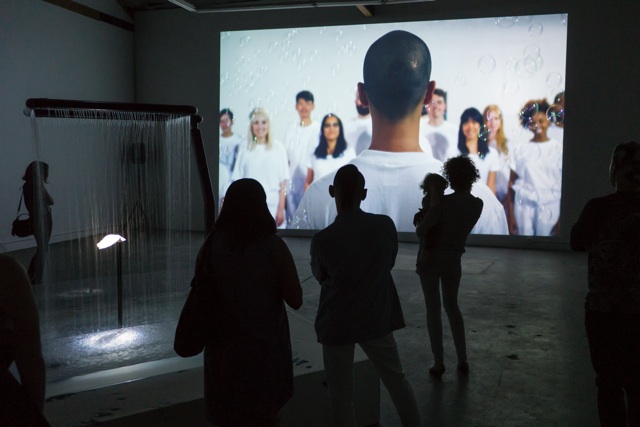
The strength of this art piece is emotional and symbolic. My heart bumped when I entered the first time and again when I reentered the Mistake Room space. A pleasure fed by fear. It was like standing on a tree pulled up by the roots, no ground, no sky. A fountain, hands offering a bar of soap, transparent, translucent. A collection of hybrids: mirrors that are changeable paintings, a passage between two groups of mannequins all alike: a patrol of white statues, and projections that are reflections of a personal journey from confusion-isolation to clarity to social smile and applause. The mare of the night was galloping in my ears.

_1100148

_1100317

Disquieting space. Darkness is the poetic touch. We all become shadows to one another as we look at our backs, because we all turn when instructions are given and still we see the back silhouettes of those who are walking out. The only magic light is on hands offering the soap. Yes, it sounds banal. Who’s afraid of banality? Watching TV, reading papers, phones, screens, we multiply illusionary thoughts: seeing is not understanding. History we live in is invisible. The past is out of reach. Therefore we really see nothing. I’m sure the artist found in himself some winding existential feelings to build his goal of cleaning his own soul as a message for other humans.

Is there the “white elephant” behind his obsession with white? In Thailand white elephants, chang phueak, are sacred animals, they can’t be used for work, they are also called chang samkhan, “auspicious elephants.”

So he replaced the arrogance of tradition and intellectual foundations with “the open-eared attentiveness of the child: expanses; solitude; being led; letting reason grow out of things and into man; a more universal, more conciliatory, but less precise mode of thought in place of ethical-activist brusqueness.”*

_1100151

_1100280

_1100227

 KORAKRIT ARUNANONDCHAI (feat. boychild)

Letters to Chantri #1: The lady at the door/The gift that keeps on giving

The Mistake Room, Los Angeles, CA 2014

Photos: Peter Kirby

The moment we enter his territory we can’t avoid cringing. With the best intentions, Korakrit has made his message as messages are made today by the long hand of the market: formally perfect images of eternal youth. Apparently they correspond so perfectly to the rules and meanings that different societies, in the east and the west, have already accepted and digested, that one doesn’t even feel the need to think about them. They are a ‘natural representation’ good for everyone. Except, they are exactly what the mercantile wisdom has discovered and spread beyond control. Here the artist walks on a shaky bridge: he embraces the aesthetic of “a special form of violence shockingly flexible, highly developed, and creative in many respects,”** the aesthetic of capitalism. But he also offers the gift that keeps on giving, to expand his desire of simple, clean human connections.

It might be the other side of time, a chapel maybe, or a raft in the ocean. I like better to think of Korakrit riding a white elephant, while adjusting the glasses on his nose. On this side of time, I would be grateful for his auspices.

*and ** ROBERT MUSIL, Essays, 1918-1933