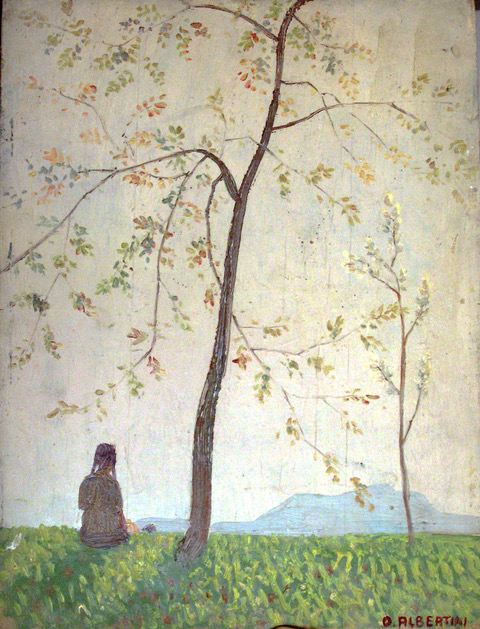
Photographs and texts by Alberto Albertini – Milano, Italy

LIFE AT 98
My contract with the manager of eternity is about to expire, no, not the contract itself, just the earthly clause which, due to its material nature, is objectively a nuisance. Eternity, because time doesn’t exist, doesn’t exist either. I feel cheated out of my legitimate future!
Now I’ve accumulated so many years that I can no longer go back without stumbling, and I realize that through experiences, mistakes, and enthusiasms, many personalities have followed one another like layers glued on top of each other. I’m trying to peel them off, like an adhesive label sealing a box of strawberries from the supermarket.
Among the many projects I have in mind to keep myself busy in the future, there’s also the one of studying Mahler. I’ve already made some attempts, but without the necessary conviction. There must be something more, beyond the first impression, even the second one; it can’t be that simple and therefore disappointing, despite the substantial size of the orchestra.

Alberto Albertini, Photomontage, 2025
The impression I get is that he’s a professor who knows his subject very well but doesn’t enrich it with musical ideas, at least that’s how it seems to me. I could be wrong: perhaps this is the music he wants: serene walks along paths through green valleys, visions of luminous Alps on a clear morning, the glaciers and the scent of larch resin, the tinkling of cowbells. Serenity, lightness, an almost heavenly boredom, with Heidegger hovering in Bavarian costume.
I can hear the First Symphony from the other room; I have the impression that a film is playing on television, with the symphony serving as the musical commentary: the charge of our heroes arriving, the clash and the battle, the truce, the vast prairies of the West, Monument Valley… Visconti used the Fourth Symphony to accompany the opening credits of Death in Venice, credits superimposed on a long tracking shot of the sea, thus confirming the descriptive nature of Mahler’s music. Hence, film music. A scene can completely change its meaning depending on the musical commentary, provided that the musical discourse is not valid without the scene to which it is associated, as it could distract the viewer. Will a scene always be necessary to support Mahler, or will it be sufficient to listen to him in the other room?
The room is silent, the objects surround me affectionately, the control is mine. I could turn on the radio and fill the room with music, but the atmosphere would change immediately, and the control would pass to it. I wouldn’t mind, but I don’t do it. Why? I don’t know. Is it always a delicate balance? Two worlds separated by a thin line of indecision.

When I told myself that I loved women so much that I would accept them even as just friends, I was lying. The pleasure I felt in conversation wasn’t just friendship; it was a controlled intrigue, a subtle thread stretched between two brains that were weaving a dialogue hidden from both of us. I’m sure the conversation was more pleasant and flowing because the two opposite poles were circulating the fluid, the electric current. The conversations were longer, more relaxed, and more fulfilling, and now I feel calmer.
To keep his brain responsive to the social and political present moment in Italy, AA writes regularly his observations and sends them to a Milanese Daily Newspaper: DOMANI (TOMORROW) Most of the time they are published. Here one of most recent: RA
DOMANI, November 10, 2025 What if human intelligence were in charge of governing us? I booked an appointment through the National Health Service at the Monzino Cardiology Center. I arrived at the appointment early. Ten minutes before the scheduled time I was called in for a preliminary examination, and at the exact time of my appointment I was taken in for the consultation. Before I left, the doctor advised me to keep in touch for any event or need, and I was given a phone number to book my next appointment. A (human) person answered the phone and scheduled my next appointment.
Due to a mistake in the email address, I sent a message to customer service, and the next day I called. At extension number 6, a person (always a real human being!) answered and told me that they had read the message and forwarded it to the person in charge! So it is possible! I think that even within the intricate web of bureaucracy, much can still be done to improve the quality of life. The lingering question remains: what will become of human intelligence? The ancient masters built palaces and cathedrals that we don’t fully understand how they constructed, how they took measurements and performed calculations. Today, a surveyor no longer carries a tape measure in their pocket, but a laser, and without walking back and forth, the laser instantly takes the measurements and performs the calculations. Why shouldn’t they use it? Thanks to it, they could have more free time, but instead, they use it to work even more.
The situation can be summarized as follows: an ever-deepening chasm splits our society: on one side, increasingly specialized scientific excellence with remarkable achievements in research and invention; on the other, the broader society that embraces and uses scientific progress to avoid thinking, leading to cultural decline. Between these two sides of the chasm lies a new political class detached from both, incapable of understanding them and seeking to consolidate an ephemeral power by manipulating democracy before the next elections. Perhaps this is the great project that is missing: how to heal the wound. AA


You must be logged in to post a comment.