THE KITE : TEN YEARS IN A PINK BOX 2014-2023 – rosanna albertini

Dear readers,

ten years of this blog found a new home on paper, 17 volumes, in a wooden box entirely covered with Italian terracotta. A quiet life on paper. The books have been hand-made by the same person who gave life to the blog. Simply me, an Italian writer who built in a blog her own museum of innocence, a home for her favorite artists. My fingers sewing as my mind dreams in words.

Images and words are the blood vessel of the most personal and disputable way of understanding. The infinite variety of art and life might change site, and instrument, and yet still brings up the same quest of meaning.

This month brings a memorable date, at least for me: the box filled with volumes will be one of the artworks at THE BOX gallery, Los Angeles, dressed with a new name: Pink Cloud. Robert Zin Stark’s invitation to Phallus : Fascinum : Fascism turns for me into a heartfelt thanks to him and to artists, galleries and museums giving me collaboration, kindness and feedback. My deep gratitude goes to my husband Peter Kirby who is the gardener of the blog, trimming and polishing each post. To Hannah Kirby, the smiling fun artist who keeps me warm, and last but not least to Alberto Albertini who enriched the blog with so many stories about art and life in our family, and photographs he made in his ninety-eight years of life. To me he gives the precious gift of his friendship.

It is not the end of The Kite. The blog will continue to exist as far as my body allows me. No change with the motto, neither: always about

THINKING as the art of DESIRE, and ART as the desire of THINKING FRESH.

Rosanna Albertini, Nov. 30, 2025

Phallus : Fascinum : Fascism will open at THE BOX Los Angeles

November 15 to January 17, 2026

Project Drawing by Robert Einfrank, 2025

THE KITE 2014-2023


TEN YEARS OF BLOG IN 17 HAND-MADE VOLUMES edition of 10


I was an Eighteenth-century philosophy scholar who turned into a journalist, a blogger and a maker of hand-sewn books. My hands give the books a body as the secluded princesses of the old tales, making their lovers’ body with flour and water. I was and am a grown up Italian country-girl who grew up through gray days in front of windows often covered with ice. Naked the trees, and black. My cat walking with me on the way to school. But fireflies in May were flying diamonds among the piles of hay.

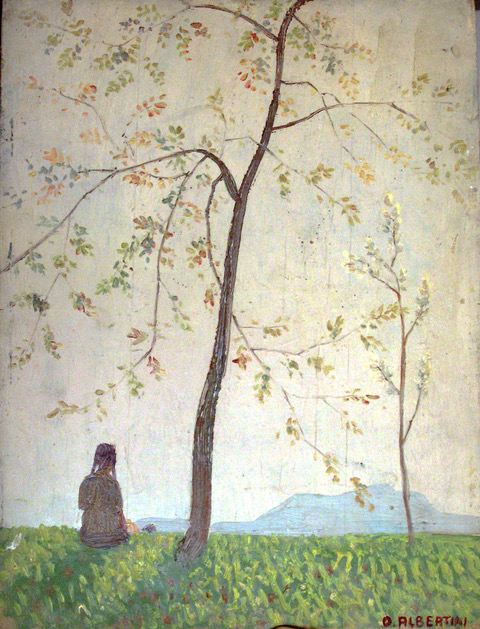
My grandfather Oreste, painter, was my guide in the mysterious labyrinth of real and imaginary journeys, when there is no distance between art and life. And his son Alberto my companion in THE KITE, connecting the blog to our family history.

There is no beginning nor ending in these blog/books. No rules, no patterns, no separation between images, art, documents, texts, and lives. There is, feeling. 

A long time, and a lot of work learning how to abandon the idea that ‘evaluation’ or ‘judgment’ are the right approach to writing about artists. Such a mechanical device. Which the brain is not. THE BLOG:  as usual, I was attracted by things I did not understand. Over the years, patiently, they started to make sense. I became skeptical of aesthetic theories. I need to meet the artist, to crush objectivity like Fluxus artist used to do, using an axe to destroy the piano. Emptying as much as possible my closet filled with intellectual devices. Every time I am in front of interesting artworks an inner fire lights on.

Never alone, nor isolated. Old and new friends among Los Angeles artists, and others beyond the oceans, gave form to the pleasure of thinking together despite geographical distances.

THE KITE has become, in ten years, the place of friendly collaboration I imagined at the beginning; a fragile carpet supporting the texture of stories that words cannot perfectly translate, and images cannot reproduce. 

What makes artists’ lives and work an irredeemable outer world, unreachable at times, is also what allows such a fragile land to hover over everybody’s lives without touching them, just showing some where else: humans alterations in reality. 

Never cease feeling, don’t give up hoping. Even when reality is painted black, blogging in common with my open tribe of people gave me, and continues to give me the treasure of Joy. That’s the language of these books, a pink spot in the clouds.


ROSANNA ALBERTINI  writer, editor, designer, hand-maker of each volume, publisher

BASED IN LOS ANGELES

THE PINK BOXES edition of 6 are a collaborative result of many hands & brains

Rosanna Albertini – multitasking 

Neil Doshi – designer

Michael C. McMillen – artist 

Robert Einfrank – artist carpenter

Peter Kirby – multitasking

Post Scriptum:

Books are an edition of 10 for each volume, the boxes are an edition of 6. Very few volumes remain out of the boxes. Each volume contains the posts of a year. You can see in the blog what’s in each year of the blog. The layout is obviously different. Trying to transfer to the books the dynamic character of the blog, for every year I changed color and fonts of the cover. Each volume starts with the dedication to an artist, and 6 pages of a small exhibition. This is only in the books; the artists are: Jean-Louis Garnell, Julie Shafer, Bianca Sforni, Mitchell Syrop, Simone Forti, Eileen Cowin, Yves Tremorin, Judy Fiskin, Philippa Blair, Peter Kirby, Dominique Moody, Edgard Honetshläger, Francesca Lalanne, Michael C. McMillen, Kim Abeles, Fiona Connor.

Frankly, I dislike advertisements. If, for some special reason, any of you is interested in purchasing one of the 2 or 3 copies I have for each volume, please send me an e-mail:

rosanna@albertini.ws Thank you.

E’wao Kagoshima: WHITE AUTUMN and other visual stories

E’ WAO KAGOSHIMA

at THE BOX, Los Angeles, June-August 2018

After his exhibition, the artist started a mail art communication with the gallery and Mara McCarthy. 

E’wao Kagoshima, White Autumn 2016. Acrylic, pastel, ink, and collage on paper, 15″ 1/2 x 18″3/4 (framed dimensions)  Courtesy of the artist and The Box Gallery


BODY BOX BINDING 

— about E’wao Kagoshima’s world of physical language —

By Rosanna Albertini

Maybe the autumn wants to be white. A flood of summery red brightness fills his memory, he can’t get rid of it. Dryness is drifting across his eyes. The place is real and inscrutable. Shrunk to the bones or happily swimming in water, fish pull my hair and push my brain into an unfamiliar space, as if “rejecting the idea that everything is in its right place; there isn’t any.” (Robert Rauschenberg) A tree grows from a bone and a pink branch from a woman. There is no land or sky, we see an abstract space of transformation. The artist’s duty is to an absolute living, out of time or common sense.

Let’s pretend the alphabet starts with B. Art, area, affection, affliction, adoption, adulthood would disappear from language. Same kind of displacement wrings the world of physical language, E’wao Kagoshima’s pictorial world, out of any expected grammar. Every thing, and each form, have a mind of their own. Humans along with butterflies, toys, birds, plants and words communicate with the living landscape they are in as they like it, as they dream, without rules or restrictions. The same happens to humans, animals, objects or undefined figures.

Everyone is right. Things become true as soon as someone believes in them. Reality is within us; our mind creates its truths. And the best truth will not be the one sanctioned by reason.”  

André Gide, The White Notebook

Kagoshima’s colors might be the prevailing message, they fade or intensify like the daily mood. The artist has absorbed the natural beauty and sends it back as luminous islands from his brain: sometimes dry, often wet images, can he feel his brain is wet, as neurobiologists have discovered? They didn’t see red fish though, with smiling lips after swallowing dreams of government (John Kennedy), a cat, now part of their aquatic body — red fish looking after a red human baby.  But E’wao did. 

E’Wao Kagoshima, Parallel Case 2012. Pastel, colored pencil, ink, graphite, and collage on paper, 10″ 3/4 x 13″ 3/4 (framed dimensions)  Courtesy of the artist and The Box Gallery  

E’wao Kagoshima, Breathing Skin 2012. Pastel, colored pencil, acrylic, ink, and collage on paper, 10″ 3/4 x 13″ 3/4 (framed dimensions)   Courtesy of the artist and The Box Gallery

It’s a space beyond limits where some artists like to be. John Baldessari taught a plant the alphabet in 1972. He showed the plant the letters with patience, repeating their sound to make sure that the plant’s brain could grasp and memorize. And Nico Muhly composed I drink the air before me in 2010. Sounds and atmosphere of the living environment enter his entire body, not only filtered by the ears. Steve Galloway placed American alligators walking on the clouds in mid-air. Many other artists can probably be added, but these I know well, as well as Haruki Murakami’s books in English translation.  

E’wao Kagoshima, Saving Diaspora 2016. Pastel and colored pencil on paper, 15″ 5/8 x 18″ 3/4 (framed dimensions)  Courtesy of the artist and The Box Gallery

But in the end, I see what I see, missing Japanese language and Japanese life experience. I don’t understand Kagoshima’s images, like a blind woman talks of colors never having seen them. Simply, I love them. There is a stark naked reality in his painting and drawings: a spellbound territory, completely personal, that seems to me distant from either Japan or New York, where E’wao  moved  in 1976. My illusion? Could be. I hoped to learn from Japanese literature, only to realize that many characters and situations of Murakami’s books also belong to the Western tradition; they circulated all around the world in fables and stories for centuries. As I would like to pick out some Japanese evidence in Kagoshima’s images of Saving Diaspora, I could cry like his blue mouse, my mind lost and taken by the transparent lines of a butterfly, almost invisible, which to me is the feminine organ — as my grandmother called it since I was able to understand language. Of course I loved to detect the butterfly in such a claustrophobic room where a face cries blood and memories are petrified on her forehead.

 Storytelling is a universal art, each artwork by Kagoshima is a visual story. A woman slips out from the elephant’s trunk, maybe the cats dancing around her came from the elephant’s nostrils. The elephant seems happy to throw a shower on her and the cats. There is no separation between the three different species.   They bear the same light colors of nakedness and celebrate their closeness.

E’wao Kagoshima, Distortion One 2015. Acrlic on paper and pencils, 24″ x 19″ 1/4 Courtesy of the artist and The Box Gallery

E’wao Kagoshima, Nose and Tails 2018. Acrylic on canvas, 80″ x 60″ 1/2 Courtesy of the artist and The Box Gallery

Breathing Skin opens an incongruous series of dialogues: a fish with a crab, a bird to a fox, a woman to another identical woman, an undefined human creature bubbles water in a tank that could be a head. An exquisite gentleness permeates the drawing, lines are smoothed by water. It could be mist, or a layer of air flattened on paper.

Kagoshima’s life wasn’t easy at times, his art congealed feelings into poetry of distortion, and open-eye dreams. In his personal new world fish are bigger than the Statue of Liberty, and Sleeping Beauty floats in a miraculous clarity in the middle of an intestinal maze. The forest around the castle grows in green spots so powerful they cannot be contained, and spread on the frame. Happy birthday E’wao, it’s so good to meet your dreams. 

E’wao Kagoshima, Sleeping Beauty 2017. Mixed media on canvas, 24″ x 20″ Courtesy of the artist and The Box Gallery

“It’s all a question of imagination. Our responsibility begins with the power to imagine. 

It’s just like Yeats said: in dreams begin responsibilities.

Flip this around and you could say that where there’s no power to imagine, no responsibility can arise.

Just like we see with Eichmann.”         Haruki Murakami, Kafka on the Shore                  

Kagoshima was born in 1945 in Niigata, one of the 4 cities destined to become a target for The Atomic Bomb in Japan. The town was spared in favor of Nagasaki.  We are both children of the war sprouting from the same year, new leaves in a time obscured by lack of imagination. Only one Italian scientist around Enrico Fermi in his laboratory imagined the scientific monster they were pursuing. He was a Neapolitan dreamer. He quit, and disappeared. To write it now, it sounds like a fairy tale. Our little brains born then did not know anything and yet kept growing as if their souls had been wrinkled by the fears and destructions around. To these days, any personal deception is linked to a primeval spot of darkness in human hearts. As an art student, one afternoon with friends E’wao was enchanted by the sunlight going through the beer falling from the pitcher into the glass. He had the idea of two metal sculptures that made him one of the few pop artists in Japan.

At the Box I saw his artwork for the first time during the summer, a one person exhibition. Immediately after, E’wao’s mail art to Mara started, almost weekly, from New York to Los Angeles, sending little by little fragments of his life to a place of trust, of friendly reception, a sort of harbor.