Photographs and texts by Alberto Albertini – Milano, Italy
LIFE AT 98
My contract with the manager of eternity is about to expire, no, not the contract itself, just the earthly clause which, due to its material nature, is objectively a nuisance. Eternity, because time doesn’t exist, doesn’t exist either. I feel cheated out of my legitimate future!
Now I’ve accumulated so many years that I can no longer go back without stumbling, and I realize that through experiences, mistakes, and enthusiasms, many personalities have followed one another like layers glued on top of each other. I’m trying to peel them off, like an adhesive label sealing a box of strawberries from the supermarket.
Among the many projects I have in mind to keep myself busy in the future, there’s also the one of studying Mahler. I’ve already made some attempts, but without the necessary conviction. There must be something more, beyond the first impression, even the second one; it can’t be that simple and therefore disappointing, despite the substantial size of the orchestra.
Alberto Albertini, Photomontage, 2025
The impression I get is that he’s a professor who knows his subject very well but doesn’t enrich it with musical ideas, at least that’s how it seems to me. I could be wrong: perhaps this is the music he wants: serene walks along paths through green valleys, visions of luminous Alps on a clear morning, the glaciers and the scent of larch resin, the tinkling of cowbells. Serenity, lightness, an almost heavenly boredom, with Heidegger hovering in Bavarian costume.
I can hear the First Symphony from the other room; I have the impression that a film is playing on television, with the symphony serving as the musical commentary: the charge of our heroes arriving, the clash and the battle, the truce, the vast prairies of the West, Monument Valley… Visconti used the Fourth Symphony to accompany the opening credits of Death in Venice, credits superimposed on a long tracking shot of the sea, thus confirming the descriptive nature of Mahler’s music. Hence, film music. A scene can completely change its meaning depending on the musical commentary, provided that the musical discourse is not valid without the scene to which it is associated, as it could distract the viewer. Will a scene always be necessary to support Mahler, or will it be sufficient to listen to him in the other room?
The room is silent, the objects surround me affectionately, the control is mine. I could turn on the radio and fill the room with music, but the atmosphere would change immediately, and the control would pass to it. I wouldn’t mind, but I don’t do it. Why? I don’t know. Is it always a delicate balance? Two worlds separated by a thin line of indecision.
When I told myself that I loved women so much that I would accept them even as just friends, I was lying. The pleasure I felt in conversation wasn’t just friendship; it was a controlled intrigue, a subtle thread stretched between two brains that were weaving a dialogue hidden from both of us. I’m sure the conversation was more pleasant and flowing because the two opposite poles were circulating the fluid, the electric current. The conversations were longer, more relaxed, and more fulfilling, and now I feel calmer.
To keep his brain responsive to the social and political present moment in Italy, AA writes regularly his observations and sends them to a Milanese Daily Newspaper: DOMANI (TOMORROW)Most of the time they are published. Here one of most recent: RA
DOMANI, November 10, 2025 What if human intelligence were in charge of governing us? I booked an appointment through the National Health Service at the Monzino Cardiology Center. I arrived at the appointment early. Ten minutes before the scheduled time I was called in for a preliminary examination, and at the exact time of my appointment I was taken in for the consultation. Before I left, the doctor advised me to keep in touch for any event or need, and I was given a phone number to book my next appointment. A (human) person answered the phone and scheduled my next appointment.
Due to a mistake in the email address, I sent a message to customer service, and the next day I called. At extension number 6, a person (always a real human being!) answered and told me that they had read the message and forwarded it to the person in charge! So it is possible! I think that even within the intricate web of bureaucracy, much can still be done to improve the quality of life. The lingering question remains: what will become of human intelligence? The ancient masters built palaces and cathedrals that we don’t fully understand how they constructed, how they took measurements and performed calculations. Today, a surveyor no longer carries a tape measure in their pocket, but a laser, and without walking back and forth, the laser instantly takes the measurements and performs the calculations. Why shouldn’t they use it? Thanks to it, they could have more free time, but instead, they use it to work even more.
The situation can be summarized as follows: an ever-deepening chasm splits our society: on one side, increasingly specialized scientific excellence with remarkable achievements in research and invention; on the other, the broader society that embraces and uses scientific progress to avoid thinking, leading to cultural decline. Between these two sides of the chasm lies a new political class detached from both, incapable of understanding them and seeking to consolidate an ephemeral power by manipulating democracy before the next elections. Perhaps this is the great project that is missing: how to heal the wound. AA
Nativity is in my mind for all beings on earth, not only human.
I like the creche more than the tree.
The lyric I found
quoted by William Carlos Williams poet in a rumination
about language labored “with speech and history”
turned on surprising reaction in the readers
unimaginable to me I am Italian
my husband Peter read it with the rhythm of a song
Dominique Moody told me when she was young
during the winter those lyrics were used to advertise Campbell Soup,
a company where her father used to work.
Yet, it was the freshness of the caring words
I cherished, people we love they belong to us.
You belong to me only a little bit, dear readers,
for the time you spend grazing my words
and whipping art images to peel off a meaning.
To all of you my goodwill, not yet contaminated by thinking.
The lyrics of Button Up Your Overcoatwere written by B.G.De Silva and Lew Brown. The music was written by Ray Handerson. The song was published in 1928.
Penso alla natività per tutti i viventi, non solo umani.
Il presepe mi piace più dell’albero.
La lirica che ho trovato come citazione
in una pagina di William Carlos Williams poeta
che ruminava le parole pregne di lingua e di storia
ha acceso nei primi lettori
una reazione sorprendente per me italiana.
Peter il mio consorte ha letto la lirica con un ritmo di canzone a lui ben nota.
Dominique Moody mi dice che quando era giovane
queste liriche d’inverno erano in uso
come pubblicità delle Campbell Soups, la ditta dove suo padre lavorava.
Quanto a me invece, ero presa dalla freschezza
di parole tenere, accostate per unire le persone care
all’idea che stranamente ci appartengono.
Caro lettore anche tu mi appartieni per un momento,
nel tempo che passi a brucare le parole
e a frustare le immagini delle opere per svelarne il senso.
A tutti la mia volontà buona, incontaminata dal pensiero.
The artwork gives a body to an intellectual drama. Our thinking gives up with prestige accepting to be nothing more than intelligence making appearances visible and covering them with images that don’t have reason to be. If the world was clear, art would not exist.
Expression begins where thinking stops.
ALBERT CAMUS. From Le mythe de Sisyphe, 1942
Dis-like, dis-quiet, dis-member, dis-traction, D I S, the 3 (greek) letters that have lived hundreds years and found a place in many languages of today, give the words a strange uncertainty: DIS ARM for instance, it’s an arm and it is not. Fiona Banner decided it is the arm of a clock. Time is gently held inside the hand, it’s human time. As the arm moves around invisible hours the human touch replaces certainty. Time is not written. Movement, inner timing, the unpredictable, surprising clock in our body hosts an infinite shrinking, or enlarging time, the son of emotions. Silent and invisible. Not a hero.
We all are, including the artist, prisoners of languages that we love and dislike.
They are a constant challenge. Words are the most tricky. On paper they slip away fast. If we stop on them more than a few seconds each word becomes a deep hole, understanding goes to hell. Paul Valéry showed me that. But placed on the floor cast in industrial fonts — using melted aluminum that was once the wing of a jet attack aircraft originally used by the British Royal Air Force and the French Air Force — the surviving word, V U L V A, becomes heaviness, sculpted mixture of meanings; an object, an absurd object in our face.
As I look down between my legs, I feel my vulva — the delicate architecture of the porch to my sexual life: a soft, flexible, humid and warm system of lips — falling down to be transformed into a metallic word. What language does. The common usage of it. In her countryside wisdom my grandmother used to say, bathing the child me, that my butterfly needed care and constant cleanliness, because it was my second face. Another usage of language.
V U L V A : Fiona Banner exposes the hard core of this word : there is no way out. She is right. And I thank her, because feeling the vulva pulsing in me I do know it’s an unwritten fairy tale. The artist also must have felt the harshness of the metal. She added her own feelings in graphite on paper with soft, nuanced images. VULVA is barely readable, absorbed into a cloud of gray.
But my mind surprises me. She starts dancing, my camera moves around the still word on the floor: yes, upside down, diagonal, with Brian’ s feet, without, how much time is congealed in it, devoured by language. Not a hero.
Camus wrote that the artwork comes from intelligence giving up: art is “the triumph of the carnal. Clear thinking gives rise to it, yet in so doing abandons its claims.”
The whole exhibition dances around me, pieces of body painted, or thrown in the air for a video. The scene is completely separate from the earth, only clouds and the blue of the sky. Real pieces of a plastic mannequin dance among the clouds apparently having a lot of fun. No AI, no 3D computer graphics. Feet, hands, head, hair, and a bust with only one leg, don’t seem destined to come back to the ground. A headless, painted feminine bust floats on the canvas upside down. ORCHESTRA is written over the breasts.
We are so imperfect that we can’t even be always unhappy, wrote an old French guy. Art makes no exception.
I walked out of the gallery thinking of writing as a crazy dance picking ideas from everywhere, and moving them in a smiling, displaced, imaginary conversation with the artist. I can’t avoid thinking that in music, and rhythm, time is a hero.
Rosanna Albertini
Fiona Banner, time, the anti-hero, 2025, Mixed media, mannequin arm, paint, clock mechanism, electrical components, 57″ diameter
Fiona Banner, VULVA VOLVO (2021 now), 2025, Aluminum from Sepecat Jaguar XZ118, 63 v 6 x 4″
Fiona Banner, Vulva Volvo (2004-2012), 2025, Graphite on paper, aluminum from Tornado ZE728, glass, 16.5 x 31.5″
Fiona Banner, Obsolete, 2025, oil on canvas, 7 x 5″
Fiona Banner, Recto, Verso, 2025, Oil on canvas, 7 x 5″
Fiona Banner, Orchestra, 2025, Oil on canvas, 7 x 5″
She doesn’t need to split off from the fullness of life. She swims in it, stitching together private stories — her mother’s voice about her life before Roe — with images of American stories far from our present or we believe they are far, as we ignore they existed. Their film version was mainly ignored, but the effects of legal/political decisions on giving birth, having the freedom or the medical necessity of not to do it, are and were visible to everybody.
Time is endlessly dark, hiding the edges of things. So this artist works on the edges: sewing into geometrical figures fragments of 35mm polyester film with polyester thread, and painting colored ink on sections of film. Kept in their regular sequence the photograms stretch the most simple gesture into a long geometrical time. Madame’s Cravings, a 1906 b&w film, becomes a dismembered story in film-quilts. The same happens to a 1934 documentary showing doctors and midwives on horseback in the snow riding to deliver home care in rural Appalachia.
Imagine a pond with all these quilts like floating flowers… Yes they are vertical on the walls, and yet… In each of them the limited time of the original films disappears, and the layout is playful; the translation of moving images in a still system makes me think of a new birth helped by the artist’s hands, by her smiling mind. They float in my mind.
The Forgotten Frontier (Kentucky Star), 2025 35 mm polyester b/w film, polyester thread, LEDs 27 3/8 x 27 1/8 x 3 inches
Madame’s Cravings (Absinthe), 2025 35 mm polyester b/w film, polyester thread, etching ink, LEDs 19 3/4 x 20 x 3 inches
Madame’s Cravings: Sweet, Bitter, Smoky,, 2025 35 mm film, polyester thread, etching ink, LEDs 19 x 19 x 3 inches
Reality remains, an unfriendly swing that seems to escape from human measure, feelings and physical risks. Legal, illegal, what? What’s humanly convenient? What’s a decision? An executioner’s sword chopping a previous decision? A glimpse into the past tastes like a bitter medicine, and yet it helps to perceive what’s really real: reality moves and changes. Timing is not geological. Things happen at human measure. No one more than an artist knows it. Each art piece comes out of the struggle between the single, personal effort to be in the world with an eye on its infinite possibilities, and a castle of facts all around that only look able to be here always, trying to obliterate any contrast, any “other condition.” ( Robert Musil) It can happen that the castle crumbles before the goal is reached.
“Therefore there is the universe.
Because it is flying around.
It is interesting.
Anything that is flying around is interesting.
Human nature government propaganda is not flying around adventure is not flying around, it is flying to or from therefore it is not interesting.
And romance and the human mind.
….
The human mind is interesting and the universe.
About romance well supposing we just like it like that but not by definition.”
That’s a different story, The Geographical History of America by Gertrude Stein, 1936.
Sabrina Gschwandtner’s as well as Gertrude’s art make me happy. In the film-quilts beginning and end disappear. Movements appear and turn and bring us in, and we don’t disappear. In Gertrude’s pages we get mad at our own impatience, stumble over the words that are often jewels, we do not get lost.
“One participates in things (understands their language). In this condition understanding is not impersonal (objective), but extremely personal, like an agreement between subject and object.
In this condition one really knows everything in advance, and the things merely confirm it. (Knowing is re-knowing.)”
Robert Musil not afraid of subjectivity.
That’s why the film-quilts are flowers. I’m trying to bring Sabrina’s art out of art formalisms. Back into the big world she has embraced with humor and intelligence. Nothing could be better than the subversive idea she had picking a story where the pregnant mother smokes a cigar, steals candies, drinks absinthe and in the end, quite naturally, squats down on a cabbage. The baby is born. A nativity? Why not?
We are in “the art of the every day.”
1984 Allen Ruppersberg, Fifty helpful hints on the art of the every day:
I pick five of them:
“Art should be familiar and enigmatic, as are human beings.
“Use everything.
“Art should make use of common methods and materials so there is little difference between the talk and the the talked about.
“There is a quotidian sense of loss and tragedy.
“The individual search for the secret of life and death. That is the inspiration and the key.”
Madame’s Cravings (B/W),, 2025 35 mm b/w polyester film, polyester thread, LEDs 72 x 48 inches
BIBLIOGRAPHY and FILMOGRAPHY
Alice Guy-Blaché, Madame’s Cravings, B7W 35 mm. film, 1906
Marvin Breckinridge, Chronicles from the Frontier Nursing Service, documentary film, 1931
(after the 1934 Hays Code, childbirth and abortion disappeared from American cinema for decades)
Robert Musil, Precision and the Soul, edited and translated by Burton Pike and S. Luft. The University of Chicago Press, Chicago & London, 1990. Paperback edition, 1994
Gertrude Stein, The Geographical History of America, Copyright 1936 by Random House, Inc. The John Hopkins University Press, Baltimore & London, 1995. The John Hopkins paperback edition, 1995, was published by arrangement with Random House, Inc.
Allen Ruppersberg, The Secret of Life and Death, The Museum of Contemporary Art Los Angeles, Black Sparrow Press, February 1985. Published in occasion of Allen Ruppersberg’s retrospective exhibition at The Museum of Contemporary Art, Los Angeles.
ten years of this blog found a new home on paper, 17 volumes, in a wooden box entirely covered with Italian terracotta. A quiet life on paper. The books have been hand-made by the same person who gave life to the blog. Simply me, an Italian writer who built in a blog her own museum of innocence, a home for her favorite artists. My fingers sewing as my mind dreams in words.
Images and words are the blood vessel of the most personal and disputable way of understanding. The infinite variety of art and life might change site, and instrument, and yet still brings up the same quest of meaning.
This month brings a memorable date, at least for me: the box filled with volumes will be one of the artworks at THE BOX gallery, Los Angeles, dressed with a new name: Pink Cloud. Robert Zin Stark’s invitation to Phallus : Fascinum : Fascism turns for me into a heartfelt thanks to him and to artists, galleries and museums giving me collaboration, kindness and feedback. My deep gratitude goes to my husband Peter Kirby who is the gardener of the blog, trimming and polishing each post. To Hannah Kirby, the smiling fun artist who keeps me warm, and last but not least to Alberto Albertini who enriched the blog with so many stories about art and life in our family, and photographs he made in his ninety-eight years of life. To me he gives the precious gift of his friendship.
It is not the end of The Kite. The blog will continue to exist as far as my body allows me. No change with the motto, neither: always about
THINKING as the art of DESIRE, and ART as the desire of THINKING FRESH.
Rosanna Albertini, Nov. 30, 2025
Phallus : Fascinum : Fascismwill open at THE BOX Los Angeles
November 15 to January 17, 2026
Project Drawing by Robert Einfrank, 2025
THE KITE2014-2023
TEN YEARS OF BLOG IN 17 HAND-MADE VOLUMESedition of 10
Iwas an Eighteenth-century philosophy scholar who turned into a journalist, a blogger and a maker of hand-sewn books. My hands give the books a body as the secluded princesses of the old tales, making their lovers’ body with flour and water. I was and am a grown up Italian country-girl who grew up through gray days in front of windows often covered with ice. Naked the trees, and black. My cat walking with me on the way to school. But fireflies in May were flying diamonds among the piles of hay.
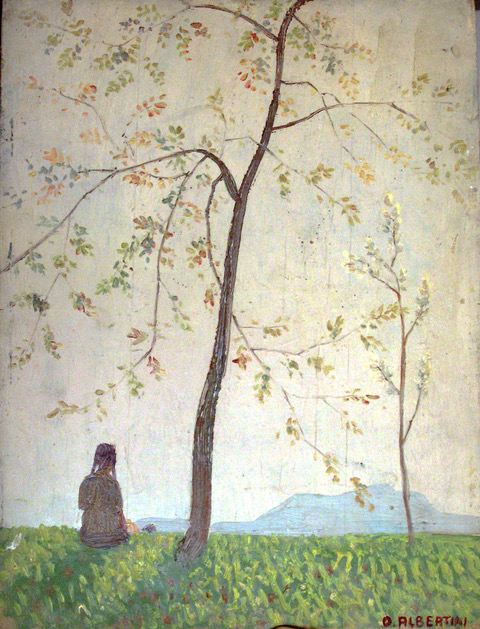
My grandfather Oreste, painter, was my guide in the mysterious labyrinth of real and imaginary journeys, when there is no distance between art and life. And his son Alberto my companion in THE KITE, connecting the blog to our family history.
There is no beginning nor ending in these blog/books. No rules, no patterns, no separation between images, art, documents, texts, and lives. There is, feeling.
A long time, and a lot of work learning how to abandon the idea that ‘evaluation’ or ‘judgment’ are the right approach to writing about artists. Such a mechanical device. Which the brain is not.THE BLOG: as usual, I was attracted by things I did not understand. Over the years, patiently, they started to make sense. I became skeptical of aesthetic theories. I need to meet the artist, to crush objectivity like Fluxus artist used to do, using an axe to destroy the piano. Emptying as much as possible my closet filled with intellectual devices. Every time I am in front of interesting artworks an inner fire lights on.
Never alone, nor isolated. Old and new friends among Los Angeles artists, and others beyond the oceans, gave form to the pleasure of thinking together despite geographical distances.
THE KITE has become, in ten years, the place of friendly collaboration I imagined at the beginning; a fragile carpet supporting the texture of stories that words cannot perfectly translate, and images cannot reproduce.
What makes artists’ lives and work an irredeemable outer world, unreachable at times, is also what allows such a fragile land to hover over everybody’s lives without touching them, just showing some where else: humans alterations in reality.
Never cease feeling, don’t give up hoping. Even when reality is painted black, blogging in common with my open tribe of people gave me, and continues to give me the treasure of Joy. That’s the language of these books, a pink spot in the clouds.
ROSANNA ALBERTINI writer, editor, designer, hand-maker of each volume, publisher
BASED IN LOS ANGELES
THE PINK BOXES edition of 6 are a collaborative result of many hands & brains
Rosanna Albertini – multitasking
Neil Doshi – designer
Michael C. McMillen – artist
Robert Einfrank – artist carpenter
Peter Kirby – multitasking
Post Scriptum:
Books are an edition of 10 for each volume, the boxes are an edition of 6. Very few volumes remain out of the boxes. Each volume contains the posts of a year. You can see in the blog what’s in each year of the blog. The layout is obviously different. Trying to transfer to the books the dynamic character of the blog, for every year I changed color and fonts of the cover. Each volume starts with the dedication to an artist, and 6 pages of a small exhibition. This is only in the books; the artists are: Jean-Louis Garnell, Julie Shafer, Bianca Sforni, Mitchell Syrop, Simone Forti, Eileen Cowin, Yves Tremorin, Judy Fiskin, Philippa Blair, Peter Kirby, Dominique Moody, Edgard Honetshläger, Francesca Lalanne, Michael C. McMillen, Kim Abeles, Fiona Connor.
Frankly, I dislike advertisements. If, for some special reason, any of you is interested in purchasing one of the 2 or 3 copies I have for each volume, please send me an e-mail:
This is a show about inclusion as practice and process. Please invite whom you’d like.
To begin, please allow me some foreplay with wordplay;
The Greek root φαλλός (phallos) is likely related to the Proto-Indo-European root bhel-, meaning “to blow up” or “swell,” which connects it to concepts of inflation or enlargement. This same root appears in other words related to swelling or fullness, such as balloon, bellows, or belly.
A fascinum was an ancient Roman style of an amulet of a phallus, designed to draw away the evil eye from the user towards the amulet (because it was an object of desire). The English word “fascinate” ultimately derives from Latin fascinum and the related verb fascinare, “to use the power of the fascinus“, that is, “to practice magic” and hence “to enchant, bewitch, or bind together”.
In ancient Rome, the fasces were a ceremonial symbol of authority carried before magistrates. They consisted of birch or elm rods bound together with a leather strap, often with an axe head protruding from the bundle. The fasces represented the magistrate’s power to punish (the rods for beating) and execute (the axe for beheading).
Benito Mussolini adopted this terminology when he founded the “Fasci di Combattimento” (Combat Squads) in 1919. The name deliberately evoked both the ancient Roman symbol of state power and the more recent tradition of Italian political organizing.
Now, I would like to draw your attention—at length—to the history of Ancient Roman militarism and fucking, or the suppression of non-procreative sex, if you please:
The endless demands of Roman militarism created an inexorable pressure for population growth that fundamentally transformed sexual culture and law. What began as pragmatic concerns about maintaining adequate military recruitment gradually evolved into a comprehensive system of legal and social controls that systematically suppressed non-procreative sexual behaviors. This transformation reached its culmination not with the end of paganism, but with Christianity’s adoption and intensification of these existing regulatory frameworks.
Before the ancient Romans, with the ancient Greeks and Egyptians, sexuality was notably pragmatic. In ancient Egypt homosexual relationships appeared in art and literature without moral condemnation, marriage was often informal, divorce was relatively easy for both sexes, and celibacy held no particular virtue—even priests typically married and had families. Greek attitudes toward homosexuality are well documented, celibacy and contemplative life often being elevated, with contraception and abortion discussed openly by medical writers. Homosexual relations between soldiers were even understood as beneficial to the intensity of their fighting.
The earliest manifestations of state intervention in sexual behavior emerged from Rome’s military expansion across Italy. The Twelve Tables, codified around 450 BCE, established the legal framework of paternal authority (patria potestas) that gave fathers absolute control over their wife’s reproductive choices, their children’s marriages and even their reproductive choices. This wasn’t merely about family structure—it was about ensuring that each household contributed adequately to Rome’s military needs through the production of future soldiers.
As Rome’s territorial ambitions expanded, so did the censorial powers that monitored citizen behavior. The censors, initially concerned with property assessments for military service, gradually extended their oversight to include sexual conduct that might affect population growth. Social pressure against permanent bachelorhood among the patrician class intensified precisely during periods of military expansion, when the state most desperately needed the sons of prominent families to serve as officers and provide military leadership. Rome was mobilizing a staggering 10-15% of its entire adult male citizen population simultaneously (with 30-40% of the entire population being slaves, that were also recycled into their military).
The Punic Wars and subsequent Mediterranean conquests created unprecedented demands for manpower, coinciding with the first systematic legal attacks on non-procreative sexuality. The Lex Scantinia, likely enacted during this period of military crisis, criminalized certain homosexual acts, particularly those involving freeborn Roman men as passive partners. The law’s timing was no coincidence—Rome was simultaneously fighting Hannibal and expanding eastward, requiring every citizen male to fulfill his reproductive and military obligations. Growing taboos against practices like fellatio and cunnilingus were similarly justified as “foreign” and unmanly behaviors that weakened Roman military character.
The crisis of the late Republic, marked by civil wars and recruitment difficulties, intensified state intervention in sexual behavior. The Lex Iulia de Adulteriis Coercendis, building on earlier precedents and finalized under Augustus in 18 BCE, criminalized adultery not primarily for moral reasons, but to ensure legitimate heirs who could provide military service. The law’s provisions carefully protected the patrilineal transmission of military obligations from father to son.
Increased prosecution of sexual behavior deemed to undermine traditional family structures accompanied Rome’s desperate attempts to maintain military recruitment. Social campaigns against Greek sexual practices, particularly symposium culture and pederasty, were explicitly connected to Roman military superiority over their allegedly effeminate Greek subjects. The message was clear: sexual discipline was military discipline, and military discipline was the foundation of Roman power.
Augustus’s reign marked the systematic codification of militaristic sexual regulation. The Lex Iulia de Maritandis Ordinibus of 18 BCE mandated marriage for men aged 25-60 and women aged 20-50, with explicit exemptions only for those serving the state in ways that precluded family life. The Lex Papia Poppaea of 9 CE penalized celibacy and childlessness through inheritance restrictions, creating economic incentives for reproduction that directly served military recruitment needs.
The legal privileges granted to parents (ius trium liberorum) provided those with three or more children with significant legal advantages, including exemptions from certain civic duties and enhanced inheritance rights. These privileges were explicitly calculated to encourage the production of future soldiers. Restrictions on marriage between social classes served to maintain distinct citizen bloodlines suitable for military service, while increased regulation of prostitution channeled sexual activity toward procreative marriage rather than sterile commercial encounters.
The early Imperial period saw the expansion of stuprum laws targeting non-marital sex among citizens, creating comprehensive legal frameworks that made non-procreative sexual activity increasingly criminal. The senatus consultum against castration under Domitian around 83 CE explicitly protected male reproductive capacity, recognizing that voluntary sterility represented a direct threat to military recruitment. Legal restrictions on divorce were made more stringent under various emperors, ensuring that marriages, once contracted, would continue to produce children for military service.
The military crises of the third century intensified sexual regulation as the empire struggled to maintain adequate forces against barbarian invasions and internal rebellions. The Lex Cornelia de Sicariis was expanded to include severe penalties for castration, treating voluntary sterilization as a form of treason against the state’s military needs. Legal campaigns against mystery religions that practiced celibacy reflected imperial recognition that religious enthusiasm could undermine demographic objectives.
The cultural apparatus supporting these legal frameworks became equally comprehensive. Literary campaigns by authors like Juvenal and Martial satirized sterile relationships and non-procreative sexuality, while philosophical schools promoted marriage and childbearing as fundamental civic duties. Mystery religions emphasizing fertility, such as those devoted to Cybele and Mithras, gained state support precisely because they reinforced demographic objectives. Public festivals celebrating fertility and procreation, architectural programs emphasizing family and childbearing, and educational reforms emphasizing masculine virtue tied to reproductive success all served to normalize and institutionalize the connection between sexual behavior and military obligation.
The legalization of Christianity under Constantine in 313 CE and its subsequent establishment as the state religion represented not a break from these regulatory traditions, but their crystallization and intensification under new ideological justifications. Early Christian leaders, far from rejecting the Roman system of sexual regulation, embraced and expanded it while providing new theological rationales for existing practices.
The Christian synthesis represented the ultimate triumph of Roman demographic anxieties over sexual freedom. By transforming military necessity into divine commandment, Christian sexual ethics preserved and expanded the regulatory apparatus that Roman militarism had created, ensuring its survival well beyond the collapse of Roman military power itself. The theological justification of procreative obligation proved more durable than the military justification from which it had originally emerged, creating patterns of sexual regulation that would define Western civilization for more than a millennium.
Finally, to be enjoyed with your bedside smoke (and a faggot meant a bundle of sticks or tobacco leaves, to be burnt)—the word proletariate came from the ancient Roman census, which categorized the class of people that had no other assets but the ability to procreate.
R.Z.S. Robert Zin Stark
Los Angeles, Sept. 2 2025 at 4.04 PM
Robert,
I read your pages after an unbearably hot and humid visit to the Getty.
Looking at the words I couldn’t believe them,
so familiar they were to me, and really strange in a page written by you, in Los Angeles, today.
My tongue devoured them as I do with an ice-cream cone overfilled with the very best creamy stuff.
And I couldn’t stop, nor interrupt the pleasure of reading.
I haven’t read anything so smart and exhilarating in a long time.
The last intellectual orgasms I remember were decades ago, with two unique figures, the best scholars in the worlds about ancient history: Arnaldo Momigliano and Emilio Gabba.
I was an Eighteenth century philosophy scholar, working with them because of my obsession of wanting to understand
why so much of the ancient culture was sitting in my philosophers books, and how and why.
Every time I met one of them my excitement continued to explode for days.
In the end I generated a little blue book.
Yes, I’m honored and happy to work with you about this project.
BRENNA YOUNGLBLOOD, America the Beautiful 2025, mixed media on canvas, 48×48″ detail
by Rosanna Albertini
There is no explanation. Only
“Inescapable romance, inescapable choice
of dreams, disillusion as the last illusion,
reality as a thing seen by the mind,
Not that which is but that which is apprehended… (Wallace Stevens)
Inescapable romance, and inescapable choice of dreams through a personal time of vibrations inside the artist sharing stories all around her since she was born in the high desert, slowly adjusting to different urban places, at times captured by details, walls, doors, shoes, art made by other artists…maybe the revolving movement inside a washing machine gives the idea.
By all that undefinable chaos was generated America the Beautiful, an artworkpainted, composed by Brenna this year, 2025. Our life in America immersed in darkness, radio as a cardboard phantom hung on a nail, holding damaged lines of news that look like they have forgotten how spacious are the skies, how purple the mountain’s majesty. Noting down, before words disappear: America, sweet America. As I write my throat is shrinking, tears grow in my eyes.
BRENNA YOUNGLBLOOD, America the Beautiful 2025, mixed media on canvas, 48×48″ BRENNA YOUNGBLOOD, BLACKOUT 2025, mixed media on canvas, 48×48″BRENNA YOUNGBLOOD, The Rise of the Chocolate Bar 2010, mixed media on canvas, 48×36.125″
Damned Brenna, now you are a painter, a real one. And not because you show the portrait of our time as it took shape in your mind, “unreal as real can be.” It strikes me the way you did it. The extreme care of giving shape and nuances to the gray surface, suggesting that flatness is illusion, while colors and dimness are part of the space in which we live, they are not re-presentation. The visible is not easy.
You offered a key in the title of the whole exhibition, distancing the space/ or time? between each letter, Agatha Christie style. Timing, music. It goes with Ornette Coleman’s Beauty is a Rare Thing — the breath of his soul makes the music. And your breath, modulating uncountable layers of reverberations from things you experienced, dug into your person, reemerges shouting and smiling on the canvas, pretending flowers have been blown by the wind, those commercial fabrications sweeter than the cake’s sugary coat.
America the Beautiful spreads the beauty of your attachment to the country as it is. Your voice stronger than news. I always thought, growing up with the radio, there was a special charm in voices of people I couldn’t see, and stories I couldn’t know where they were coming from. Music was strange, enchanting, jazz before bed time. If stories were funny, it was enough. Yet, through the radio, I had the feeling there was a larger world behind the speaker, certainly bigger than my Italian village of the after war (WW2).
Blackout 2025 is one more piece of congealed music, a volume of hidden stories from which, as if by magic gone bad, black bulbs come to populate the canvas. The word BLACKOUT works like a foreground but it is not what it looks like. Each letter is carved with signs, painted as if. The artist brain vomits decoration as Picasso’s brain used to do, throwing up on the canvas all the green his eyes had absorbed. Had maybe Brenna stretched on the gray curtain of her theater an idea of separation? As if mumbling, the world around me is snowing ashes, I work in the dark, I work anyway; here they are, more paper laces.
Let’s be clear: when I say you are finally a painter, I put you in the number of artists of every time who did the same you are doing: waiting for the images to take shape inside, in your mind and inside the canvas. The painted surface ends up being a screen attacked by two sides: the infinite sequence of what the eyes see in reality or in memories, and the limited scene the artist wants to introduce into that same world. The painting reveals as much as hides.
BRENNA YOUNGBLOOD,The Backbone of Resentment and Reassurance 28 2007, mixed media on panel, 70.5×73.75″
Something similar you told in the title of an older work: The Backbone of Resentment and Reassurance 28, 2007. Although mistreated by life you removed doubts and fears. The whole story is there, contained in physical layers of colors and papers flat in their silence. Finished in the pink. An odd flower breaks the flatness, a yellow voice whispering there is too much order and quiet. Can I push?
At this point I don’t know if I am telling your story or mine, but the paintings themselves reassure me: year after year they explode like the craters of volcanos, they vomit feelings and stories, as your artist’s hands scratch and unfold ruining the fragility of the surface, adding lines of color, pencil, whatever, digging red ponds, dropping a few spots of sky.
BRENNA YOUNGBLOOD, Breakfast of Champions, from the Luxury Series 2011, mixed media on canvas, 51x35x2″
detail
BRENNA YOUNGBLOOD, Out of Blue (Figure) 2025, mixed media on canvas, 60×48″ BRENNA YOUNGBLOOD, OVERWATCH 2025, mixed media on canvas, 60×48″BRENNA YOUNGBLOOD, Planet Pizza 2025, mixed media on canvas, 60×48″
Breakfast of Champions, 2011, cries its waking up to the most delightful freedom pointing at us two wide open eyes, fried eggs on two cardboard plates. The eggs are painted. Brenna’s humor is back, no limits, toward Planet Pizza, 2025, Puppet Master (tip toe) 2025, ill, 2025 and the other brother and sister paintings of this tormented year. In all of them the big surface is dominant, they are humanscapes without land, some words and three-dimensional objects join the dance which always turns around two opposite legs: joy and pain, inseparable. The puppet master tiptoes on red, yellow, green clouds. What remains of the earth after the fire? The whole painting is implacable fire, exhilarating to the point that eyes get watery, want to stop it. Yeah, no fear of emotions
dear Brenna,
that’s why you paint and I write.
BRENNA YOUNGBLOOD, puppet master (tip toe) 2025 mixed media on canvas, 60×48″
BIBLIOGRAPHY
WALLACE STEVENS, An ordinary evening in New Haven, in Collected Poetry and Prose, 1997, Penguin Putnam In, THE LIBRARY OF AMERICA
PORTRAIT OF ELLIOT ELGART made by his friend SAM AMATO
2 and 3
4
There is only one house between my house and Charlene’s, the wife widowed by the painter in 2014. She was about to sell Elliot’s studio and invited me to go with her and see her husband’s paintings before they were moved out.
An artist’s studio is a breathing space. The street and the building, with other studios one after the other, give the shoulders to urban life and face a wild garden. The place is silent, almost secret. I looked at Elliot Elgart’s art for the very first time; time disappeared. And a clear dialogue started between the images placed on canvas by his pupils and hands and my body visiting the painted world he had transformed, drawing and coloring a ‘biomorphic’ reality. Forms of the living can’t be prisoner of geometry nor reproduce the photographic blockage of only one instant. If one calls them ‘abstractions’ images start competing with realism, as if imaginary compositions had been cut out forever from things as we see them.
I don’t want to lock his art in any inappropriate cage. Art is a text escaping words; it’s itself a description, a mixture of perception, memory, feelings incessantly changed by passing time. Adam Phillips wrote that our relationship to change might “convert us to the beauty of the ephemera”. That’s what I saw in Elgart’s paintings. For the same reason I’m placing in this blog images of his work taken in his empty studio, “echoing and complementing each other in a context of spatial ambiguity”. Elgart’s words. Spatial ambiguity is inside most of his works.
Look at images as they live
Look at images as they live
Then, listen.
The true human dialogue, the one
of the hands, of the pupils,
is a silent dialogue.
Water melts me from words.
….
I talk of time out of time
I talk for yesterday and today;
about yesterday that is a lesson of life
about today that is a lesson of death.
Edmond Jabès, Le livre des questions
5
Images, words, neither are more solid than figments. It’s not the blue chair that is described, or a false facsimile.
“It is an artificial thing that exist,
In its own seeming, plainly visible,
Yet not too closely the double of our lives,
Intenser than any actual life could be…”Wallace Stevens, Description without place
In a room, in which objects and walls resist any reasonable position, the painted volumes become a small theater of displacements: angles are free from traditional perspective, walls become volumes rather than surfaces, and forms meet as colors want. Vase and flowers should fall from the table’s odd inclination but they don’t, and the chair can be seen as a surreal creature with two different seats; the white clothe is perched on both, is it a bird? Admirable complexity of an unusual painting. I couldn’t call it a still life.
6
Pink moon. The name I would give to a nocturnal combination of cut out parts. Abstraction? No. Maybe a collage of memories, to become a witty entity far from being satisfactory, familiar. And yet, it engages the viewer in a warm, friendly way, even funny, with the tiny figurine sitting on flatness and a pink animal neck resting on the line between white and green. It is a light, enchanting, capture of different forms without forcing them. Please, be together. Elgart seems to say.
In the morning I happened to have a humming bird flying in front of me within a hand’s breadth. Her flight was combining short movements in the air, vertical and horizontal, an irregular syntax of segments. This painting as I see it is the humming bird’s flight made tangible, and gentle.
7
Floating landscape. It seems to me a good example of the beauty of the ephemera. A combination of four horizontal landscapes? Lightness. Colors and lines do not hurt one another. They coexist in a floating movement of crossing flatness and depth; marks of human building are ghostlike, as if they had already been canceled by time. Only the foreground shows a certain depth, it could be the present, the rest is just feelings. It’s a landscape inside out, revealing a past that is not anymore.
Unfolding here a small part of his artworks, I bring back Elliot Elgart, a painter who left for the sky in 2014, and has been largely obliterated by the short span of attention that is typical of our time. So many artists had the same destiny. Inevitably, I would say. Elgart taught at UCLA for thirty two years, just before the flooding wave of conceptual art in which so many of us have been involved with passion and enthusiasm. During the short time I spent teaching at UCLA in the New Genre department, invited by Allan Ruppersberg and Paul McCarthy, I didn’t have any idea that completely different, interesting artists, had met the students in the same rooms.
After his retirement in 1991, a student sent to Elliot a painted card with a special thanks: “You are a true artist! ” – he wrote – “By this I mean you are passionate, open, and approach this world with a sense of wonder.”
Today, my sense of wonder helps me to keep my attachment to conceptual art, and to be open to so many different artworks hard to define in verbal frames. One by one, they can be a treasure trove.
8
9
10
Because I never met Elliot in person, I hope to keep a glimpse of his spirit reproducing a page he copied by hand and cherished. It is a text by Katsushika Hokusai, 1760 -1849, “the old man mad about drawing”.
From the age of six I had a mania for drawing the form of things. By the time I was fifty I had published an infinity of designs; but all I have produced before the age of seventy is not worth taking into account. At seventy three I have learned a little about the real structure of nature, of animals, plants, birds, fishes and insects. In consequence when I am eighty. I shall have made more progress, at ninety I shall penetrate the mystery of things, at a hundred shall certainly have reached a marvelous stage; and when I am a hundred and ten, everything I do, be it but a dot or a line, will be alive.
Written at the age of seventy five by me, once Hokusai, today Iwakio Rojin, the old man mad about drawing.
Very likely, Elliot felt in the same shoes as Hokusai. His entire life was dedicated to practice and teaching drawing and painting, following a special twist in his mind, hard to reveal in a verbal form. As I write my idea of his struggle for a personal, unique manner of painting, I stumble into the the dryness of words: as an artist, he was in search of the way to give life to the inside and outside of the the painted bodies. Trying to make the images capable to breathe, and produce energy. A simple drawing can be alive. His portrait of Chaz Garabedian is lively, as spare and essential as Giacometti’s portraits, with all the figurative details erased until the inner head survives, no different than anyone else. And, as beautiful.
11
When Elliot Elgart reached the marvelous age in which he could penetrate the mystery of things, his body was attacked by cancer. For him, a new country to explore: that hidden, inner body of his, only indirectly visible in medical abstractions. His paintings, for years, became an imaginary walk questioning the organs of his solid self, would they want to be fields of flowers? Flowers indeed that he is not allowed to pick up. One boot is enough, it must be blue.
12
13
“In death I disclose myself
I am a flower no one can pick up.
— You can’t breath it,
if you don’t know where it is.
Yet, you do know it exists.
That’s why you look for it.
You will die without finding
because it is your own death.”
Edmond Jabès, Le livre des questions
14
CAPTIONS
1 Elliot Elgart, no title, 1992, acrylic on paper 19 x 24 in
2 Elliot Elgart, no title, no year, acrylic on canvas, 24 x 30 in
3 Elliot Elgart, no title, 1992, acrylic on paper, 22 x 30 in
4 Elliot Elgart, no title, no year, acrylic on paper
5 Elliot Elgart, no title, no year, oil on canvas, 40 x 48 in
6 Elliot Elgart, no title, no year, oil on canvas, 60 x 50 in
7 Elliot Elgart, no title, no year, oil on canvas, 40 x 44 in
8 Elliot Elgart, {Self-portrait}, 1998, wash on paper, 22 x 30 in
9 Elliot Elgart, {birds} drawing on paper
10 Elliot Elgart, {profile}, drawing on paper
11 Elliot Elgart, {portrait of Chaz Garabedian} no year, 38 x 40 in
12 Elliot Elgart, no title, 1993 acrylic on canvas, 40 x 44 in
13 Elliot Elgart, no title, 1993, acrylic on canvas, 54 x 58 in
14 Elliot Elgart, no title, no year, drawing on paper, 17 x 14 in
BIBLIOGRAPHY
Wallace Stevens, The Collected Poems, Vintage Books Edition, 1990 Copyright renewed 1982 by Holly Stevens
Edmond Jabès, Le livre des questions, Paris, Editions Gallimard, 1963
FRED GRAHAM, Whiti Te Ra, The Sun Shines, 1966 Venice Biennale 2024
Fred & Brett Graham, father and son, about 1974
carving memories on the surface of time by Rosanna Albertini
History vanishes if no one writes stories, but even written deteriorates as much as the paper, never absorbed. The writer is not able to open history’s mouth like a midwife, and collect the whole body of dragons and ladders disguised under a double name: matters of fact. After decades spent writing, my illusionary attachment to the past disappeared: we accumulate stories in books not to preserve their truth, whose truth? Thucydides’? Mark Twain’s? Primo Levi’s? Shklovskij’s? All the Historians’? We mainly pack them in the closet and forget them. We like to be new, to look foreword. Only when the end of life approaches, we perceive what we don’t see.
“I was made of a changing substance, of mysterious time.
Maybe the source is in me.
Maybe be out of my shadow
the day arise, relentless and unreal.”
“We are our memory,
we are this chimerical museum of shifting forms,
this hip of broken mirrors.” Jorge Luis Borges
The printed age and the age of colonization cover the same volume of time. Fred Graham and his son Brett Graham are both Maori sculptors. Carvers of monuments in which Maori history resurrects from colonialist denial. Their art includes the inevitable integration – Brett’s mother is not a Maori – and yet their works, silent and powerful, let us face the indomitable energy of a living civilization. No isolationism, in either of them.
After the war, Fred Graham found himself in between traditional Maori art and what he calls “the modern movement of forms toward a new order reshaped by human mind.” Leaning towards the echoes of Modernism — the chaotic, idealistic response to the worst face humans showed to each other in a half century of wars — Maori artists tried to hold together personal vision ( implying freedom about tools, language and materials) and attachment to the spirit of the old, without which they would have lost the unique character of their culture: a chain of love, fight, and trust.
FRED GRAHAM, Tinirau and the Whale, 1971 Venice Biennale 2024
FRED GRAHAM, Maui Steals the Sun, 1971 Venice Biennale 2024
FRED GRAHAM, Tamariki a Tangaroa, 1970 Venice Biennale 2024
Grace, Hetet, To Kanawa, Rare, Harrison, Tukaokao, Matchitt, Nin, Graham, Wilson, Muru, Hotere, Tuwhare were pioneer artists seeking more than survival or local recognition. For a short while, they shared the New Zealand Maori Artists and Writers Society, founded in 1973. They were river, and island, as in a poem by Hone Tuwhare: The River Is an Island.
FRED GRAHAM, Kaitiaki, 2004, in the Auckland Domain in Auckland, The 11.8-metre-tall (39 ft) piece depicts a kāhu pōkere (harrier hawk), a bird that features as a guardian in Ngāti Whātua and Tainui oral histories. (Wikipedia)
FRED GRAHAM, Washbowl of Sorrow, 2004 stainless steel, kauri, totara, and customwood 734 x 55 x 82mm Waikato Raupatu Lands Trust Visual Arts Waikato museum.
FRED GRAHAM, Waka Maumahare, 2022, stainless steel, 16 m. high, it weighs 5 tons. Photo Waka Kotahi (Inspired by the story of the Tainui waka – a canoe carved from a tree that was planted on the grave of Tainui, the son of a chief Tinirau and his wife Hinerau in Hawaiki. One of the first canoes to reach the New Zealand shore, according to the legend.)
The artist on his way to bless the art piecePhoto: Waka Kotahi
Birds are a constant presence in Fred Graham’s vertical, tall and elegant monuments for more than half century. They stand on the land, and look as if wanting to fly toward the sky. Birds were the only animals in New Zealand in a pre-historic time, before Maoris arrived; how closer to creation not even the myth can say. Fred never broke the chain, he is the prince of Aotearoa’s Maori artists. A living ancestor whose moral authority will never disappear. Brett says that his own closeness to his father’s art was not transferred by words. He calls it sort of ‘osmosis.’ How lucky Fred is as a father! Not only Brett did not break the chain, he added his own vision. He carves the Maori stories in wood. Mallet and chisel are his pen. His pieces often cross the ocean. They are astonishing.
In 2024, Fred and Brett’s artworks were together in the same space of the Corderie dell’Arsenale, at the Venice Biennale. The first time for Fred, not for Brett, whose Aniwaniwa had been installed in Venice in 2007.
Maoris don’t have books. Past and present, since the first canoe from Polynesia reached the shore of New Zealand —it was about the thirteen century— are only one thing: generations passing on memories from mouth to mouth. Easy to say… Let’s change mode, from history to personal stories. I have been in Aotearoa. Brett Graham was my guide in his Maori tribe. Journalist, I was trying to learn as much as possible about contemporary art of every kind and origin in New Zealand, to convince Flash Art it was worth writing about it. My intellectual baggage? “That’s not reality, not for us,” Brett told me. After my pitch, Flash Art told me: too far away, why bother? Not their reality, neither. I worked for myself and wrote a book.
Facts are like boxes in which reality dries up, and dies of artificial stillness. But beforehand, there are coincidences, chances, wishes, delusions along with rare, unexpected moments in which you are certain that your inner freedom has found where to be, in a tangible form. Life in the marae, the Maori communal house, pulled me out of many boxes.
2008Pohara. Church starts before sunrise. At 7 a.m. the whole tribe stands outdoors under a spotless sky. A flag is the only religious symbol, lifted on the top of a pole: a flying field of images assembled by an artist for people who still read the face of the day. Frosted vapor has made the grass a carpet of needles. In spite of the low temperature — and a strange sensation of endurance and sublime self-effacement — everyone stands still until the singing starts, and hands and arms sway like waves through the fullness of feelings, and vapor spreads from the flock of humans. Buon giorno, Good morning, Kia Ora, Bonjour. While the sun rises in front of us, overcoming a curtain of trees, singing birds join the humans for the most vibrant orchestra, as crispy as the air. Who am I? For an instant, it doesn’t matter.
Such illusion is only mine; mythology and history for a Maori person melt into a collective preservation of memory. Roots and rituals climb like vines around care for family, friends, animals and the land. A single identity doesn’t have contour without fathers, mothers, queens and kings, ancestors. For an Italian woman like me, born to a Southern mother, mythology is no more than a fantasy unless my eyes touch it, on the curves of my mother’s shoulders just the same as the sculpted forms in the Greek statues. Personal genealogy is lost, becomes archeology.
Dinner at Fred and Norma Graham house. I couldn’t take my eyes off his hands. They seemed to me bigger than they should be, strong hands softened by work, hands finding a visual language for Maori stories since the very first: Rangi and Papa separated by their seven offsprings. “In the beginning Ranginui (the sky father) and Papatūānuku (the mother earth) were joined together in an eternal hug, and their children were born between them in darkness. The children decided to separate their parents, to allow light to come into the world as we see it now.” (Wikipedia)
After dinner, I couldn’t wait to ask him, “Is the myth of creation to you something more than a vague fantasy lost in time?” “It’s a beginning carved in each contemporary story,” he answers, “a beginning oddly reminding the sons and daughters of time that their life, their stories, are inscribed into a natural universe. The carver brings them out, as if they were already existing inside the wood, only needing to be revealed, and be born.” The dog snores in the corner of a quiet studio by the dining room. Fred Graham and I enjoy the warm solitude one feels when the house has family in the next room resting, talking, cleaning the table. His fingers leafing through images of his early sculptures, those recently migrated to Venice, the same his son Brett remembers as sounds in the evening, when his father was sculpting in his studio after a day spent teaching. Brett remembers them big, he was seven at the time. I found online a recent speech of Fred’s, telling that Brett’s recent sculptures seem to him so big! “Flesh and wood – Fred told me that evening – they are both bodies of the living. Death is only displacement. We Maori believe that when we die we become stars. I often looked at them as a child, wondering which one was grandfather.”
Brett Graham
Brett drives back to Auckland along the Waikato River’s curves. He resists my wish to talk about his artworks. See, he says, this is the way the land is forced to accept corrections. The Maori cemetery, steep on the hillside, was separated from the riverbed by the flux of cars. His grandparents, three Maori kings and their people rest there. This time too, as in many other trips, his car stops on the road when the cemetery appears. For a while, a magic silence. It’s church, inner quiet amid an outbreak of noise and billboards.
Brett was angry at colonialism, young, and anxious to introduce the foreign person I was to the Maori’s real life and culture. We became friends. Although he still doesn’t know, I suspect, how deeply was I changed by meeting his people. Talk about art, analyze and dissect? He gave me much more.
His recent pieces create symbolic places where fragments of Maori life —stigmatized as historical — cannot be corrected, appropriated, in the end destroyed. Celebratory monuments that give a magnificent body to past feelings forced to withdraw under the pressure of wars in name of civilization.
Wetlands dried up by the British conquerors to improve agriculture, had been a mine of gold for Maoris, full of eels. Wet and eels disappeared. Brett overloads with sculpted eels the room in which precious things were stored, put it on wheels and adds two long arms to the treasure trove. Nine months of work. Wetland. The two arms are a desperate prayer merging past and future, asking for simple understanding and respect, offering the strength of real stories. When I grew up, they told me words are stones, as if meanings could be separated by people who care about them. I am now the opposite: afraid to force real lives into the page and crush them like dry leaves. Maybe, can you tell? Maybe words forgetting self-realization, ignoring the judgment to come, maybe they can be written and fly, happy to forget universal truths or solipsistic illusions. Brett’s artworks, at my eyes, fly in the same way. Caring is their secret core.
BRETT GRAHAM, O’ Pioneer, 2020 Wood and plaster, 3 x 4m Photo: Mark Tantrum (Modeled on the gun turrets of ship Pioneer, an armed steam-drip built by the British New Zealand government, that invaded Waikato in 1863)
BRETT GRAHAM, The Great Replacement, 2022 12m wide. Yellow cedar 12 x 5.3 x 2.7m. Photo: John Collie. (It is an inverted ship’s hull. The materials recall Christchurch’s colonial architecture. The title connects to the white-suprematist manifesto of the terrorist who attacked Christchurch’s mosque in 2019.)
Kia ora Fred and Brett,
back to Los Angeles after the third trip to Aotearoa, on October 15, 2009, I tried to make the point with myself, who was I after my journey through the Maori land, and I ended up bickering with my new self. I send the botta e risposta now, in 2025, as it was the beginning of a new direction in my work that is still moving on with the same spirit. Rewriting, I made it new.
“I can hardly believe you went to the end of the world to the Southern hemisphere, to feel again in your bones the same chilly sensation you had in your childhood, in houses with no heating.”
Please, let me stop you. We can play with doubts and uncertainties. I knew for sure I could not plan my movements. At the same time, I did not feel deceived.
“What a sentimentalist.”
Not at all. Reality can reveal itself.
“That’s why shivering and smelling mold was important?”
Perhaps a Demon made me dull. The main intention was not to repeat colonialist mistakes, with candies of truth in my pockets. Questioning my story, my own perception, was inevitable. Words can approach a feeling of absurd freedom. Remember W. B. Yeats? The poet who listened to the friendly silences of the moon? “It is not permitted to a woman who takes up pen and chisel, to seek originality, for passion is her only business.” I turned his words into a feminine mode.
“You want to write about nothing, just the clouds of your own soul.”’
Exactly. Would you prefer a detailed description of the Auckland Museum?
“You don’t care about facts.”
Precisely. Press, Internet, radio, TV, track them down. It’s more than enough.
“You are so old-fashioned!”
Even romantic. I like graveyards. Besides, if you take fashion away, you will have a fact.
“How does art fit into the picture?”
Art is a short term, personal deviation, commitment, investment, you decide.
“So you were short-sighted in Aotearoa?”
Undeniably.
“Why such an absurd report?”
If I don’t, who would? — Not worth a damn, André Gide already wrote it. We believe our ideas are smart, and belong to us, because we have not read enough. The best thoughts have already been written.
“So, why do you persist?”
My feelings are truly mine; thoughts are common domain.
“What counts then?”
Relations: with any thing or any person. Not what you think about them, what they really are. History is a spiderweb lacerated by fingers to make holes for the present.
“Great. And by doing that you are not yourself?”
If identity is the point, I would put chains around myself. Where does freedom go if physicality becomes a burden, so much so that my mind burns out the heaviness, and I must vanish in the air like the spirit from Aladdin’s lamp? But if my muscles instead, calves and heart, along with arteries, skin, bones and hair, give me my sense of myself at every second — a human clock sculpted by time — I feel as a tree, filling a living time that changes and expands with the body, fed by sparkles of chemistry the same as rocks, sticks, fish, leaves and grasshoppers. Solitude goes away, time fondles me.
“Consciousness?”
Do you mean the sense of guilt, endlessly pricking the liver like Prometeus’ eagle? I can roast it and eat it.
“Do you give up with intelligence?”
No, I use it. It is a tool, not a goal.
Fred Graham
Thinking of you both Fred and Brett, from the distance of space as well of time, I see the Maori myth of creation once more releasing it’s meaning in your family story: Rangi and Papa giving birth to Brett but, this time, his life is instantly in the light as soon as he takes the first breath. Kia ora, Rosanna
BRETT GRAHAM, Cease Tide of the Wrong-Doing, 2020. 9.6m tall 3m wide, kauri and metal Photo: Vanessa Laurie/Stuff Permanently at the Govett-Brewster collection. (Ka pari te Tai Moana Ka timu te Tai Tangata – When the Ocean tide rises, the Human tide recedes. Memorial in the form of a niu, a Pai Mārire ritual practice. In memory of the Maori resources expropriated by the British settlers.)
Lenz Geerk, Pears, 2024 Acrylic on paper, 84 x 200 cm
Lenz Geerk, Vampire, 2024 Acrylic on canvas, 180 x 130 cm
Lenz Geerk, Table-Tennis Player, 2024 Acrylic on paper, 41 x 30 cm – Lenz Geerk, Bird, 2024 Acrylic on paper, 41 x 30 cm
Lenz Geerk – Schwarzweiß – 2025
at Roberts Projects, Los Angeles, January-March 2025
“A thing must talk. Sometimes it’s very hard to find the reason why a thing to whom one has dedicated work for so long doesn’t talk.” Joseph Beuys
There is a time out of dates, from which facts have been erased and places forgot their names, populated by living beings, animals and objects mute like stones. Their features have been refused any expression. They are what they do. Of course, this has been written already, about a hundred years ago: “We should stop thinking that this creature does what it is: rather it becomes, for God knows what reasons, what it does. Man makes his own clothes, but clothes make the man too.” Robert Musil 1922.
Here we are, in 2025, with an artist who paints the clothes hung on the handles of a wardrobe, Joseph Beuys style, adding a matching pair of shoes, and a vase with flowers. No human in view, pants and jacket are silent. A small figure appears wearing a crown, a king? If it is, he is perfectly dressed, a boy floating on paper. Waiting. So does the bird not really flying, he seems to be sitting on a spot of air. A touch of magic pervades each painted scene if one reads what’s happening, without questions. A naked man walks between mountains in a sort of trance, following a branch of flowers that tickles his nose and loses petals. Fragrance is the living strength of the scene.
Lenz Geerk, Untitled, 2024 Acrylic on paper, 41 x 30 cm
We rather keep quiet our temptation of putting meaning over everything we see forgetting the silence, the intensity of feelings that refuse to be squeezed in words. They bounce back against us like the small ping pong ball against the naked chest of a player. More and more when one imagines to be one of the standing figures holding the night sky with two hands, as if it was a blanket, or a tablecloth: feelings merge with mythological mirages, turning into a state of wonder. Yet the standing figure, her/his/its face in Gerz’s painting is deprived of expression. It happened, she don’t know what it is. The naked feet are big and steady on the ground.
Lenz Geerk, Woman Holding the Night Sky, 2024 Acrylic on paper, 118 x 101 cm
Feet: are they the steady balance in this colorless landscape? In this painted comedy of errors? Pointless to invent another name: Geerk recalls the vampire, a big figure dressed in black that glides in the blackness of an unknown space. It could be the place where colors were sucked in, and annihilated. Maybe the blood as well. Surrounding fears heavy on every minute of our existence disappear, turning into a nightmare: “a mountain of facts growing larger by the hour, knowledge won, life lost — a failure of the soul.” Let’s turn inside out like a glove our inner, invisible life and Geerk’s paintings will become the images we discover in ourselves if we recuperate “the open-eared attentiveness of the child: expanses; solitude; being led; letting reason growing out of thing and into man.” And women and children…
Lenz Geerk, Woman and Moth, 2024 Acrylic on paper, 41 x 30 cm
Lenz Geerk, Shakespearean Actor, 2024 Acrylic on paper, 41 x 30 cm
Lenz Geerk, Scent, 2024 Acrylic on paper, 87 x 28 cm
Lenz Geerk, Holiday Ceramic Course, 2024 Acrylic on paper, 133 x 82 cm
Lenz Geerk, Painter and Model, 2024 Acrylic on paper, 41 x 30 cm
Lenz Geerk, Untitled, 2024 Acrylic on paper, 41 x 30 cm
Nonsense is not excluded. A painter keeps the model behind her. It is the model who looks at her. The Holiday Ceramic Course is a school en plein air, three people undressed, lost in themselves, as the hands on the ceramics don’t care what they are doing. Impossible not to laugh. Oh the moth! Ugly, fat, big like a butterfly but missing the grace of the far cousin. In European popular culture, butterflies are the open wings of the feminine sex. It’s quite funny to see them replaced by a gigantic moth. No title for the man and the woman so strongly embraced, seemingly forever. They become a painted sculpture: the double stem of a flower, it blooms in their heads.
After so much inside out between the painter’s mind, mine, and these paintings’, the major feeling I will send through my words remains the same I found in the first sentence, a time without dates. Not arbitrary at all, incorporate in the present as it was in many past situations for centuries, when not so many facts were hovering, written words were spare, most of the visual art lost or unknown. I can be wrong, delusional. Unable to find my way like an ant on the white tablecloth, a painting that strangely represents the classic power of center with a plate full of pears. Be it. Così sia. I eat a pear and read:
With flowers You write,
O Giver of Life:
with songs You give color,
with songs You shade
those who must live on the earth.
Later You will destroy eagles and ocelots:
we live only in Your book of paintings,
here, on the earth.’
With black ink You will blot out
all that was friendship,
brotherhood, nobility.
You give shading
to those who must live on the earth.
We live only in Your book of paintings,
here on the earth.
I comprehend the secret, the hidden:
O my lords!
Thus we are,
we are mortal,
men through and through,
we all will have to go away,
we all will have to die on earth.
Like a painting,
we will be erased.
Like a flower,
we will dry up
here on earth.
The Painted Book, after NEZAHUALCOYOTL
A few years ago, Lenz Geerk shrunk his message to the viewers in painted stamps on a monochrome envelope with no address. Today he discloses a song of silence; “ombra mai fu di vegetabile cara ed amabile soave, never was a shade of any plant, more cherished, pleasant and gentle.” (G.F.Handel, opening aria from Xerses)
The painter’s shades, the darkness, are sheltering the cracks in the rational habits, replacing certainties with gentleness, bringing painted flowers already dry, but never dead. With flowers he writes, his Painted Book.
Lenz Geerk, Untitled, 2024 Acrylic on paper, 41 x 30 cm
All the quotes in this text are from Robert Musil, Precision and the Soul
All the images reproduced in this post are by Courtesy of the artist and Roberts Project, Los Angeles, California.
Photos by Paul Salveson
Bibliography
ROBERT MUSIL, Precision and Soul, vols 8 and 9 of Musil’s Gesammelte Werke, Hamburg 1978 The University of Chicago Press, 1990, Paperback edition 1994 Edited and translated by Burton Pike and David S, Luft.
Technicians of the Sacred, Edited with commentaries by JEROME ROTHENBERG, University of California Press, 2017 “Pre-conquest poets and books in Mesoamerica : a written tradition that reenforces and expands the spoken one. … Nezahualcoyotl (1402-1472) author of more than thirty surviving compositions & chief of Texcoco for over forty years. Books were “made of animal skins or of the amate-tree bark, …and the writing itself took the form of pictographs , ideograms & some limited forms of phonetic transcriptions” (Leon-Portilla, Native Mesoamerican Spirituality) p.543.


You must be logged in to post a comment.