Is this BLOG an experiment? I doubt it. It’s not a reasonable, predictable space. Words can be heavy. Stones, they were called. How to love them?
A place of pleasure, that’s my goal. Encounters and exchanges about art and life. A selected group of people will come and play the thinking game. They will send their thoughts by e-mail. We might be read by the global village. Let’s give them pleasure! Let’s learn to be light. Fleeting and temporary, at least for one year. Personal, fearless, bringing out uncertainties, pauses and hesitations, conflicts and doubts. Most of the artworks reveal idiosyncratic states of mind that are not allowed to writers: no smoking in the toilette during the flight! Unless they are poets.
I was an Eighteenth-century philosophy scholar who turned into a journalist and a maker of hand-sewn books. So my hands give the books a body as the secluded princesses of the old tales, making their lovers’ body with flour and water. None of them have a beating heart. Lack of love makes me sick. Lack of confidence, same effect. Plaintive commentaries about climate and institutional collapse are a black mask on my eyes. Reality is painted black. But The Arts keep me alive. Meredith Monk sings without words, only voice and feelings. I wish we could write like she sings.
No yes, no, I like, dislike, no evaluations. Intelligent kindness. No aggression nor rivalry. Reading, writing, “an exchange of desire becomes possible, of an enjoyment that was not foreseen. Games are not done, let’s play.” (Roland Barthes) Wind and earthquakes shake our landscape. Los Angeles is luminous in the middle of April. We can wear the on-line dress, all the possible colors and shapes, because ideas have colors, if someone cares. The kite needs hands holding the thread as well as the winds and the sky; it needs tension, inside and outside.
“I play them on a blue guitar / And then things are not as they are. / The shape of the instrument / Distorts the shape of what I meant, / Which takes shape by accident. / Yet what I mean I always say. / The accident is how I play./ I still intend things as they are. / The greenish quaverings of day / Quiver upon the blue guitar. (Wallace Stevens)
PAUL WINSTANLEY, Walkway, 2026 oil on linen 72.44 x 90.55 inches Courtesy 1301 PE
1301PE Los Angeles March 2026
“The images, the paintings, are always extraordinary; the reality, even when similarities remain, bears almost no relationship tothem.“
From: Paul Winstanley, 59 PAINTINGS, London, Art/Books, 2018
Here I am, as the painter wrote, “the artists gets out of the way and leaves the viewer where once he stood.” I know Walkway is an image he reworked many times, each time a different painting in sync with a new state of his awareness of what he is doing. I use the present, as a sort of absolute time, separate from the fullness of things in which we loose the sense of our most intimate perception, and time steals our days. As I stand in front of the painting something from inside me is sucked in toward the silence of the white square at the end of the tunnel, so intense it is scary. The painting is, not the real physical place. Other humans have been there and marked their presence in graphic signs. The skin of the tunnel bears tattoos. Only in the painting they are indelible. But an un-human, vaguely pink-brown fog fights with the clarity of the white end. Forget reading. Only my soul can slide through the artist’s mental fog, and mine, maybe ours, in this damned 2026, where reason has lost her way. “life seeps in unintentionally, subliminally” (PW)
PAUL WINSTANLEY, House in the Mountains, 2025 oil on linen 87.01 x 60.24 inches Courtesy 1301 PE
‘Surface, translucency, light and space are all as one; they are indivisible. … a pure idea of the physicality and illusion of the painting.” (PW)
On the wall, in the gallery, “ the subject of the painting has ceased to be the walkway or the trees but was instead the painting’s own mediation of these things.” (PW)
What I write here makes sense when we are in front of the painting, the 87 x 60 inches of a window whose semitransparent curtain filters the outside scenery and remakes it intensified on the floor. My brain, at first, was seeing nuances of gray as the dominant colors. My eyes were mimicking the curtain, tricky as they are. I stayed still for a while, waiting: and colors come to me. As if the painting was waking from sleep. It was such a wonderful sensation that I liked to believe it was true for a second, a magical mutation. The one who was asleep was my brain, slowly making the colors out of the waves of light hitting the receptors at the door of my eyes. I am old, no surprise. You wrote it at page 94, dear artist, “ Self-irony, or knowingness, is always present as part of nostalgia, even when we are tempted to think it is not.”
The viewer needs it as much as you. I continue to see the light blue and the pink in the sky that gives to the painting a vaguely luminous area taking off from the top of the trees, as if the end of foliage was a landscape line. The profile of earthly creatures. I want to be a bird in that sky.
PAUL WINSTANLEY Stairwell 2, 2026 oil on linen 64.96 x 43.31 inches Courtesy 1301 PE
“My paintings consist of the color they need to be, for their own purposes.” (PW)
That’s a place that only exists in its painted form. Fabricated from photographs. Anonymous, enclosed inside a building, giving room for stairs or elevators, the place nobody pays attention to. Worse, the unidentified place in which humans are usually anxious, moving with haste, they can’t wait to reach some where else. The painting instead has erased all the unsettling feelings. It’s clean, almost soft. Green and pink diluted by light are the colors it needs to be. To be alive with hopes, expectations, angles and surfaces that bring to my mind an idea of transfiguration of architectural elements into a place filled with gentleness, silence, vertical breathing. Is it an organism? Really I don’t know why, the image of an unfolded body crossed my neurons.
PAUL WINSTANLEY, STASI, 2026 oil on panel 17.72 x 23.62 inches Courtesy 1301 PE
Smaller, surprising, in this almost romantic sequence of curtains in an oblique line, hiding more than revealing both the outside and the inside, the painting is a physical questioning, an oblique line of protection: dangers might be either inside or outside, please curtains, save us from harm. Veils are delicate, beautiful, seductive. Upper and lower space are two different dark browns, as if the earth was feeding them with strength. We can merge within the folds, and disappear.
“Focus on the mediation of experience rather than experience itself may, more properly, represent the world in which we now live.” (PW)
PAUL WINSTANLEY, Bathroom Mirror 2, 2026 oil on panel 17.72 x 23.62 inches Courtesy 1301
Desperate splendor of severed flowers and branches, before they fade and die. A quite penumbra, like in a house with the curtains closed in the afternoon, brushes petals and leaves giving them a mid color, temporary, and smooth. In the painted mirror the most unrealistic reflections recompose the scene, once more enchanting with colors. Images are pushed into the foreground by a steady barrier of brown and blue. Trompe l’oeil, it’s fun. Flowers and leaves recreate their own artificial environment. The artist reads their wishes and makes them happy.
“The painting is a picture of something, though of what is not entirely clear.” (PW)
Reading your The Bear in The Mirror for the second time
I stopped on page 77: Stories
in life
do not exist.
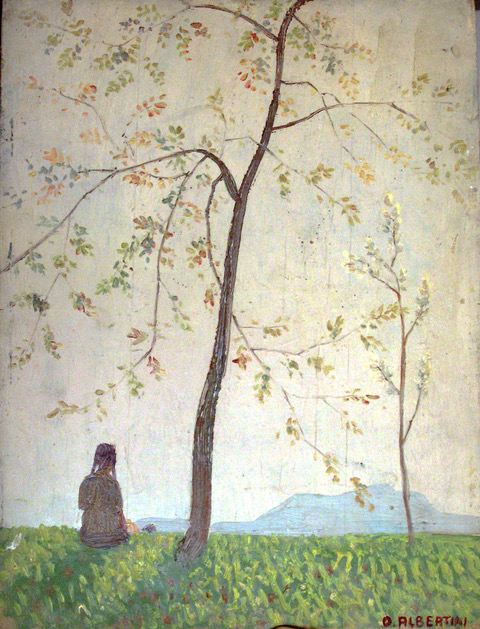
They need words to exist, people and places and pages, of course. But in that case, are they life or art? Let’s be ambiguous; for your birthday I send you again art from my family, by grandfather Oreste. I come from that garden, around it were fields and mountains beyond the lake, in Switzerland.
Grandfather painted me near the petunias. As I am made of time, strange intangible word, I moved out and far. Also, I never left the garden. These paintings keep me anchored.
Stories are told to my eyes by the light sweeping the small scene, almost burning the mountains’ tops during the sunset, and by each stroke of color. The act of painting for grandfather, and for me so very often making drawings next to him, were living moments grabbing an image from the passing time. To make an image out of love. Fighting, holding the power of changing not, and forever being. A strong circle connects me to these images as if my life could go back and forth jumping beyond obstacles.
I wish I could walk out of the painting and give you a petunia for your birthday.
Is white ok?
With love, Rosanna
Two paintings by Oreste Albertini, 1947 for the garden and unknown date for the landscape.
Urban life is brought inside, reshaped, regrouped. In the huge abandoned space, the shelves filled with artpieces overlap in the distance becoming a sort of inner landscape, as if all the moments of seeing and sharing we gather in a day had been brought together, transformed, and made surprising. It’s not only disorder. Art is gently arranged for the public viewing. It’s a piece of choral music plus confusion, questions, doubts: Am I right being here? Can I stay? And the old 99¢ Only Store building becomes a fragile castle for dreamers.
Integral to chaos are the threads of the future. If only were we able to grab them and spin them in our mind, instead of crushing them like cigarette butts on the floor. Time is encrusted in our organs, centuries of ruins have covered brilliant civilizations, death and birth are a nuptial nod over the human lives. Messy. The 99¢ Only Store died, a group of artists from San Francisco brought back the space to a week of life. In a place that smells of abandonment, art becomes a phoenix regenerating from the ashes: a portrait of urban life made by many hands, many different minds, cultures, beliefs … walk through until you lose your mind, until your heart beats stronger and a big smile moves your lips. It’s all for not being lonely, self-sufficient or dismissed by the need of order.
Barry McGee marks his own presence with colored geometries scattered among the large population of artpieces without disturbing them. Vivid and silent, his images could expand like fractals, they don’t. Thoughts are organized by hand, limited by vertical and horizontal edges. They merge into the surrounding collection of objects filled with sensitivity, refusing evaluation, announcing their presence.
A rational choicekeeps the exhibition together, hovering in the air, invisible, out of touch. It’s calledequality. Along with its essential companion, the feeling of equality.Past and future are neutralized. We stay in the present and we can embrace it, enlarge it, and drink the air in front of us.
an on line exhibition presented by LA Louver Gallery, Los Angeles, February 2026
“whereas life or reality confines itself to proliferating within the instant, the mind has spun for herself the myth of myths, the undefined element of all myths—which is Time…”
Paul Valéry, 1928
All my thanks to Paul Valéry’s spirit, who assisted me and helped me to decipher Matt Wedel’s plates. All the quotes are from ’A Fond Note on Myth’.
A FEAST FOR THE MIND
by Rosanna Albertini
A dinner for a hungry mind, a forest of branches longing for tentative movements, the same efforts of a vine that elongates her limbs to embrace a dead tree — secretly wishing to bring him back to life?
Let’s blend gradually into our “natural depth and darkness” a place in which the mind looses clarity and gives up, for a while, with problem solving, efficiency, organizing, planning, or looking for fast revolutions, faster political changes, misled by illusions. As if dreams could have a practical side and could walk on a carpet of money plus will to become reality.
In the penumbra – as the curtain is down – the mind forgets how to be busy, then walks on the irregular streams of the imaginary world, only guided by uncertainty, mistakes, hesitations and an infinite number of possibile images or words. No explanation is required, yet the mind sees far, ahead and behind, and is cuddled in between, resting on an impossible, soft image of the present — something that doesn’t exist, a transparent cloud.
From there the mind gives birth to events, stories, situations setting on the table “a candid cosmology,” and more and more naive images nourished by a need of broken causes, human stretches of time, and simple actions: if our heads share a field of blue, shall we call it sky or water? The image doesn’t know. Because, it’s a matter of language, either made of visual signs or words. It is just story-telling; a true intuition sometimes, or a shredded cloud.
“All our language is composed of brief little dreams.”
Matt Wedel is so familiar with the almost natural transformation -looking natural- of heads and vegetal bodies into ceramic creatures, that I’m sure he doesn’t decide what he is making. So many myths are in him, in the garden which is his body, where every part interacts incessantly with near and far parts, with lack of separation between the busy chemical activity of the cells, the movable forest of neurons, and the constant request from outside to open the doors of the mysterious organic machinery, that he has to react creating new myths. Children do it incessantly, with no restraint, before writing and reading educate them to a strange unnatural style: the linear universe. Masters of brief little dreams as they were in the beginning, they quit the imaginary island where it was hard to distinguish dreams from reality.
Rational clarity kills the myths. And “the fauna of vague things and vague ideas wither away… Myths decompose in the light spread by our body combined to utmost degrees of consciousness.”
Apparently, such a disaster doesn’t happen on Matt Wedel’s plates: ideas remain vague. The upcoming risk of disappearance seems incorporated in the way stories are painted and cooked. It’s a physical process. Stories are not easy to decipher. The figures’ edges are soft, flowers are no more than spots of color. The naked cavalier is a white ghost on the back of a goat lost over an unfamiliar site of emptiness. Two women in conversation are on their way to dissolve among the flowers that invade the plate, while both women and flowers start vanishing under the power of the light. Red fruits on a tree aren’t sure where they sprout from: a tree or a head?
My favorite plate (also Dominique Moody’s favorite) is a pre-copernican cosmology: the universe is flat. The long curve of hair woven into a braid, in continuity with the curve of vapor from a boiling pot, are a circle of fantasy flowers around the young girl face to face with the beast. (First image, under the title)
Another girl? Another plate. Maybe she is not, a bow is on her hair, but the body is brown, soft with fur like a teddy bear. The packed non-geometry of stones behind her tells a story of undefined emotions, there could be danger in the air.
Once more, details are canceled by light in the plate of the woman giving birth. The contrast is striking between the figures of fear around her, even in her arms, and the placid resilience of her body. Upside down pots become masks. They are incapable to close their mouths. Red, brown, bloody. From the depth of time to the physical depth of the major event in human life. I do remember. I loved to keep the nine months of pregnancy a mystery revealing some of itself at each day. I refused to read books or ask for medical details. Little by little I slipped into the awareness of my animal nature, waiting with joy for the miracle at the end. I was kissed by the sensation of belonging to a time without Chronos, bringing to light a new human being. Out of me, she stood in another time, forever separate from me. It was the only moment I knew without doubt that names, identity, documents, are dead leaves. I was one with any living beast on earth.
BIBLIOGRAPHY
Paul Valéry, ‘A fond note on Myth‘ in The Outlook for Intelligence, Princeton University Press, 1989
from Bollingen Series XLV,The Collected Works of Paul Valéry, Edited by Jackson Mathews Copyright 1962 Translation by Denise Folliot and Jackson Mathews.
This selection was first published by Harper & Row, Inc. in 1963
LA LOUVER Los Angeles – January 2026 Photos: Matt Emonson
I am a woman, my woman.
I am a girl, my girl.
I am woman, the woman.
I am girl, the girl.
I know how to work.
My feet work.
My hands know.
I am girl, my girl.
I am woman, my woman.
You made me woman.
You gave me woman.
Woman of the Flowers.
Mother of the Sky.
Woman of the Roses.
Girl of the Roses.
Flowery Woman of the Roses.
Daughter of the Rose in Bloom.
You gave me woman.
You gave me girl.
You took a girl out of me.
You took a woman out of me.
……..
You gave me my spirit.
You gave me my death.
You put my soul inside…
—Loxa Jiménez Lopez
Loxa Jiménez Lopez is Mayan woman from an untold time. The legend says that Anjel, “daughter of the Lord of the Caves, whispered in her ear and then, in dreams, showed her the Book with all the magic words to be learned.”***
I imagined Rebecca the painter was not just giving us portraits of flowers. She adds words for each painting, and titles sound like a ritual she started for herself, about herself: the flowery woman. A face surrounded by Gold Hair, wearing a mask of colors from the flowers hidden in her body, blooming from her hands.
Pink Punk Rose — A punk rose starting out like a kid starts out, inexperienced. A flower not yet knowing about her destiny, aggressively confused, spreading fullness and tension. The blue tries to contain the edges, before giving up, becoming lines from the sky.
Dahlia Uprising — The dahlia’s flower is a miracle of geometry. Soft with petals, a head full of hair. The artist brings an inconceivable disorder among the petals, a nervous uprising as if flowers were refusing the vase, trying to go away from the corolla, perhaps asking themselves “why” are they here. Why were they cut off.
Pink Heirloom — Who are they their name doesn’t matter. They are valuable forms. Heavy as if full of juices, ripe to death. So is the vase. The last wish of both flowers and vase was picked up by the artist who suspended disbelief: they float in the air.
Nasturtium Crown — They climb, or fall on the ground. Nasturtium hold all their energy in their colors, they do not raise vertical from stem to stern. As a painted crown, they float in the space missing a surface where to pose, and smile. Except the artist gives it to them, filling the wall with a fan of light that pushes the texture of stick strokes away from oneself, and encourages the flowers to be up, for a while, all they can have.
Blue Hydrangeas — I had them as a child in the back of the house, the shadowy side. Blue and round small umbrellas that stole their color from the sky. In this drawing they look particularly happy, luxuriating in a hat for the lady vase still like a stone, while they play with the light not knowing, maybe, how long.
Afton’s Abutilons — Red lanterns looking down, imperial, full of themselves as they can be. Although, they might shiver inside, and activate inaudible bells, warning about the yellow danger of the table, an alien flatness they cannot avoid.
Preppy Poppy — The starch in their look makes them rigid, or slightly perplexed. Red edges around the petals merge pain into their beauty.
Self Portrait in Green and Red — How vulnerable she makes herself! Yet, to use Eliot’s word “vulnerability was an opening – an ‘entrance.’ Where people were vulnerable was where they had once made room for other people.” Modern people struggled to find a language to “render what is unacceptable about themselves intelligible.” (Adam Phillips) Rebecca Campbell is an artist, feelings and desire are her stem. Images are her language. Not everything can be explained, nor understood. That’s why she lets herself unfold, until touching the ground. She apparently accepts her (our) fate: accepting things that cannot be ignored and cannot be understood. But in the end, green is resilience.
“I am woman, my woman”
REBECCA CAMPBELL
1. Self Portrait with Gold Hair, 2025oil pastel and UV varnish on paper, Image: 14 x 10 in.
2. Pink Punk Rose, 2025 oil stick on paperImage: 21 x 29 in.
3.Dahlia Uprising, 2025oil stick on paperImage: 74 x 49 in.
4. Pink Heirloom, 2025acrylic, oil pastel and UV varnish on paperImage: 19 3/4 x 28 in.
5. Nasturtium Crown, 2025 acrylic, oil pastel and UV varnish on paperImage: 27 1/2 x 19 1/4 in.
6. Blue Hydrangeas for Dot, 2025oil stick on paperImage: 29 x 21 in.
7. Afton’s Abutilons, 2025oil stick on paperImage: 21 x 29 in.
8. Preppy Poppy, 2025oil stick on paperImage: 74 x 49 in.
9. Self Portrait in Green and Red, 2025oil stick on paperImage: 74 x 49 in.
BIBLIOGRAPHY
Jerome Rothenberg, Technicians of the Sacred, University of California Press, 2017 pp. 369-372. For Loxa Himénez Lopez see Incantations: Songs, Spells and Images by Mayan Women, (El Paso, Cincos Puntos press, 2009) a Tzotzil/English version. “The fruit of the work of 150 people across thirty years, these are the first books written, illustrated and put together by Mayan people in nearly a thousand years.”
It was probably my fate to be in Phallus : Fascinum : Fascism. As one of the curators and as an artist, a combination I refused for most of my life. One thing at a time was my motto. But a day comes when old habits stop making sense. I thought I had stopped being a scholar, it wasn’t true. Every inch of my long life is here today tickling my fingers, the ones that write. Only three weeks before the opening in Nov. 15, I received the invitation accompanied by a text that forced me to reconnect with a silenced part of myself: years in which I tried to understand what History is or has been told, mostly invented. Years of swimming in waves of books with two amazing tutors providing help and discussions: Arnaldo Momigliano and Emilio Gabba. A storm of nostalgia submerged me while I was reading Robert Zin Stark’s manifesto. I was inside Borges’ castle without surrounding walls nor center, adjusting my sight to a fog hiding or revealing them like cherished illusions.
This was my state of mind searching for artists to invite. They all appeared in less than a week. They also read the manifesto and followed, as if jumping on a magic carpet. When the whole exhibition was done, filling THE BOX from floor to ceiling with the artworks of 200 artists, the whole gallery became the castle, barely contained by the building. Hard to explain, I felt so good and happy to be in it. I could be nobody. I could not know names and titles of the single pieces, yet it was not hard to enjoy the variety of other reactions to the manifesto, secretly holding everybody together in different ways. The other curators were also a mysterious entity to me.
A photojournalist asked me to point out to him the other curators, so he could take pictures of them. “I don’t know them,” I told him. “But you are a curator,” he replied shouting at me. “Isn’t it enough?” he threw his arms in the air, exasperated, and finally went away. He wanted a center that didn’t exist, like Los Angeles, like the art scene in the whole world.
“We create and destroy with our words” said a young artist in a different exhibition, Made in LA. Let me skip the name. This is not a review. He is someone thinking about the emotions of a flower, and its language. I want to look at the art in the show in a similar spirit, thinking without cages. A dead mother covered with fake jewelry, two enormous black vertical penises, oh, the two towers! A purple cloud cut like a stone, the transformation in fake gold of a plant of corn, a naked artist standing in a wooden replica of his carcass lifting little by little a big, heavy piece of wood positioned as a penis; a cactus trying to scare a snake: “NO ME CHINGAS!” A chair becoming an automatic violinist, a concert for metronomes, a magnified page of the LA Times in which the photographs, one after the other, start moving: the flag, the cars, people. Yes, wonderland, but I’m not Alice. There is a rational choice keeping the exhibition together. It’s called equality. As much as words can still be trusted. And its essential companion, the feeling of equality.
OMG, HOW MUCH I MISS THE FLUXUS AXES, the LIVING THEATER, and BODY ART, the EARLY VIDEO ART and INSTALLATIONS, maybe because they have been the pebbles on the ground guiding me out of from philosophy into contemporary art. The human body was their common catalyst. In our reality so frozen, stiffened in objects supposed to be appealing, with names giving old and new objects a financial validation, this exhibition offers the opposite: a systematic, quiet, elegant proximity of images coming from famous and from completely unknown artists. A large field of drawings, paintings, photos, sculptures asking to be considered for what they are. Known or unnamed blades of grass, an endless variety: a field in the spring before the pesticides. Please forget the rules! Look at them. Be with them. They are alive. So many artist are here that belong to the forest floor of the LA art world. “Inclusion” was not only a word in the manifesto, it’s real. As it rarely happens, the exhibition displays a convinced, beloved, respected notion of equal presences spreading a refusal of hierarchy, a sense of freedom, of lightness. Nobody prevails.
Perhaps my sense of elation will have a short life once THE BOX will dismantle the castle, or not. Every time I ‘ve been in unexpected, exciting situations, not always recognized as “art,” my memory never forgot them. They are in my body, and my fingers can write.
“It is not an image I am seeking. It’s not an idea. It is an emotion you want to recreate, an emotion of wanting, of giving and destroying.” Louise Bourgeois
Photographs and texts by Alberto Albertini – Milano, Italy
LIFE AT 98
My contract with the manager of eternity is about to expire, no, not the contract itself, just the earthly clause which, due to its material nature, is objectively a nuisance. Eternity, because time doesn’t exist, doesn’t exist either. I feel cheated out of my legitimate future!
Now I’ve accumulated so many years that I can no longer go back without stumbling, and I realize that through experiences, mistakes, and enthusiasms, many personalities have followed one another like layers glued on top of each other. I’m trying to peel them off, like an adhesive label sealing a box of strawberries from the supermarket.
Among the many projects I have in mind to keep myself busy in the future, there’s also the one of studying Mahler. I’ve already made some attempts, but without the necessary conviction. There must be something more, beyond the first impression, even the second one; it can’t be that simple and therefore disappointing, despite the substantial size of the orchestra.
Alberto Albertini, Photomontage, 2025
The impression I get is that he’s a professor who knows his subject very well but doesn’t enrich it with musical ideas, at least that’s how it seems to me. I could be wrong: perhaps this is the music he wants: serene walks along paths through green valleys, visions of luminous Alps on a clear morning, the glaciers and the scent of larch resin, the tinkling of cowbells. Serenity, lightness, an almost heavenly boredom, with Heidegger hovering in Bavarian costume.
I can hear the First Symphony from the other room; I have the impression that a film is playing on television, with the symphony serving as the musical commentary: the charge of our heroes arriving, the clash and the battle, the truce, the vast prairies of the West, Monument Valley… Visconti used the Fourth Symphony to accompany the opening credits of Death in Venice, credits superimposed on a long tracking shot of the sea, thus confirming the descriptive nature of Mahler’s music. Hence, film music. A scene can completely change its meaning depending on the musical commentary, provided that the musical discourse is not valid without the scene to which it is associated, as it could distract the viewer. Will a scene always be necessary to support Mahler, or will it be sufficient to listen to him in the other room?
The room is silent, the objects surround me affectionately, the control is mine. I could turn on the radio and fill the room with music, but the atmosphere would change immediately, and the control would pass to it. I wouldn’t mind, but I don’t do it. Why? I don’t know. Is it always a delicate balance? Two worlds separated by a thin line of indecision.
When I told myself that I loved women so much that I would accept them even as just friends, I was lying. The pleasure I felt in conversation wasn’t just friendship; it was a controlled intrigue, a subtle thread stretched between two brains that were weaving a dialogue hidden from both of us. I’m sure the conversation was more pleasant and flowing because the two opposite poles were circulating the fluid, the electric current. The conversations were longer, more relaxed, and more fulfilling, and now I feel calmer.
To keep his brain responsive to the social and political present moment in Italy, AA writes regularly his observations and sends them to a Milanese Daily Newspaper: DOMANI (TOMORROW)Most of the time they are published. Here one of most recent: RA
DOMANI, November 10, 2025 What if human intelligence were in charge of governing us? I booked an appointment through the National Health Service at the Monzino Cardiology Center. I arrived at the appointment early. Ten minutes before the scheduled time I was called in for a preliminary examination, and at the exact time of my appointment I was taken in for the consultation. Before I left, the doctor advised me to keep in touch for any event or need, and I was given a phone number to book my next appointment. A (human) person answered the phone and scheduled my next appointment.
Due to a mistake in the email address, I sent a message to customer service, and the next day I called. At extension number 6, a person (always a real human being!) answered and told me that they had read the message and forwarded it to the person in charge! So it is possible! I think that even within the intricate web of bureaucracy, much can still be done to improve the quality of life. The lingering question remains: what will become of human intelligence? The ancient masters built palaces and cathedrals that we don’t fully understand how they constructed, how they took measurements and performed calculations. Today, a surveyor no longer carries a tape measure in their pocket, but a laser, and without walking back and forth, the laser instantly takes the measurements and performs the calculations. Why shouldn’t they use it? Thanks to it, they could have more free time, but instead, they use it to work even more.
The situation can be summarized as follows: an ever-deepening chasm splits our society: on one side, increasingly specialized scientific excellence with remarkable achievements in research and invention; on the other, the broader society that embraces and uses scientific progress to avoid thinking, leading to cultural decline. Between these two sides of the chasm lies a new political class detached from both, incapable of understanding them and seeking to consolidate an ephemeral power by manipulating democracy before the next elections. Perhaps this is the great project that is missing: how to heal the wound. AA
Nativity is in my mind for all beings on earth, not only human.
I like the creche more than the tree.
The lyric I found
quoted by William Carlos Williams poet in a rumination
about language labored “with speech and history”
turned on surprising reaction in the readers
unimaginable to me I am Italian
my husband Peter read it with the rhythm of a song
Dominique Moody told me when she was young
during the winter those lyrics were used to advertise Campbell Soup,
a company where her father used to work.
Yet, it was the freshness of the caring words
I cherished, people we love they belong to us.
You belong to me only a little bit, dear readers,
for the time you spend grazing my words
and whipping art images to peel off a meaning.
To all of you my goodwill, not yet contaminated by thinking.
The lyrics of Button Up Your Overcoatwere written by B.G.De Silva and Lew Brown. The music was written by Ray Handerson. The song was published in 1928.
Penso alla natività per tutti i viventi, non solo umani.
Il presepe mi piace più dell’albero.
La lirica che ho trovato come citazione
in una pagina di William Carlos Williams poeta
che ruminava le parole pregne di lingua e di storia
ha acceso nei primi lettori
una reazione sorprendente per me italiana.
Peter il mio consorte ha letto la lirica con un ritmo di canzone a lui ben nota.
Dominique Moody mi dice che quando era giovane
queste liriche d’inverno erano in uso
come pubblicità delle Campbell Soups, la ditta dove suo padre lavorava.
Quanto a me invece, ero presa dalla freschezza
di parole tenere, accostate per unire le persone care
all’idea che stranamente ci appartengono.
Caro lettore anche tu mi appartieni per un momento,
nel tempo che passi a brucare le parole
e a frustare le immagini delle opere per svelarne il senso.
A tutti la mia volontà buona, incontaminata dal pensiero.
The artwork gives a body to an intellectual drama. Our thinking gives up with prestige accepting to be nothing more than intelligence making appearances visible and covering them with images that don’t have reason to be. If the world was clear, art would not exist.
Expression begins where thinking stops.
ALBERT CAMUS. From Le mythe de Sisyphe, 1942
Dis-like, dis-quiet, dis-member, dis-traction, D I S, the 3 (greek) letters that have lived hundreds years and found a place in many languages of today, give the words a strange uncertainty: DIS ARM for instance, it’s an arm and it is not. Fiona Banner decided it is the arm of a clock. Time is gently held inside the hand, it’s human time. As the arm moves around invisible hours the human touch replaces certainty. Time is not written. Movement, inner timing, the unpredictable, surprising clock in our body hosts an infinite shrinking, or enlarging time, the son of emotions. Silent and invisible. Not a hero.
We all are, including the artist, prisoners of languages that we love and dislike.
They are a constant challenge. Words are the most tricky. On paper they slip away fast. If we stop on them more than a few seconds each word becomes a deep hole, understanding goes to hell. Paul Valéry showed me that. But placed on the floor cast in industrial fonts — using melted aluminum that was once the wing of a jet attack aircraft originally used by the British Royal Air Force and the French Air Force — the surviving word, V U L V A, becomes heaviness, sculpted mixture of meanings; an object, an absurd object in our face.
As I look down between my legs, I feel my vulva — the delicate architecture of the porch to my sexual life: a soft, flexible, humid and warm system of lips — falling down to be transformed into a metallic word. What language does. The common usage of it. In her countryside wisdom my grandmother used to say, bathing the child me, that my butterfly needed care and constant cleanliness, because it was my second face. Another usage of language.
V U L V A : Fiona Banner exposes the hard core of this word : there is no way out. She is right. And I thank her, because feeling the vulva pulsing in me I do know it’s an unwritten fairy tale. The artist also must have felt the harshness of the metal. She added her own feelings in graphite on paper with soft, nuanced images. VULVA is barely readable, absorbed into a cloud of gray.
But my mind surprises me. She starts dancing, my camera moves around the still word on the floor: yes, upside down, diagonal, with Brian’ s feet, without, how much time is congealed in it, devoured by language. Not a hero.
Camus wrote that the artwork comes from intelligence giving up: art is “the triumph of the carnal. Clear thinking gives rise to it, yet in so doing abandons its claims.”
The whole exhibition dances around me, pieces of body painted, or thrown in the air for a video. The scene is completely separate from the earth, only clouds and the blue of the sky. Real pieces of a plastic mannequin dance among the clouds apparently having a lot of fun. No AI, no 3D computer graphics. Feet, hands, head, hair, and a bust with only one leg, don’t seem destined to come back to the ground. A headless, painted feminine bust floats on the canvas upside down. ORCHESTRA is written over the breasts.
We are so imperfect that we can’t even be always unhappy, wrote an old French guy. Art makes no exception.
I walked out of the gallery thinking of writing as a crazy dance picking ideas from everywhere, and moving them in a smiling, displaced, imaginary conversation with the artist. I can’t avoid thinking that in music, and rhythm, time is a hero.
Rosanna Albertini
Fiona Banner, time, the anti-hero, 2025, Mixed media, mannequin arm, paint, clock mechanism, electrical components, 57″ diameter
Fiona Banner, VULVA VOLVO (2021 now), 2025, Aluminum from Sepecat Jaguar XZ118, 63 v 6 x 4″
Fiona Banner, Vulva Volvo (2004-2012), 2025, Graphite on paper, aluminum from Tornado ZE728, glass, 16.5 x 31.5″
Fiona Banner, Obsolete, 2025, oil on canvas, 7 x 5″
Fiona Banner, Recto, Verso, 2025, Oil on canvas, 7 x 5″
Fiona Banner, Orchestra, 2025, Oil on canvas, 7 x 5″
She doesn’t need to split off from the fullness of life. She swims in it, stitching together private stories — her mother’s voice about her life before Roe — with images of American stories far from our present or we believe they are far, as we ignore they existed. Their film version was mainly ignored, but the effects of legal/political decisions on giving birth, having the freedom or the medical necessity of not to do it, are and were visible to everybody.
Time is endlessly dark, hiding the edges of things. So this artist works on the edges: sewing into geometrical figures fragments of 35mm polyester film with polyester thread, and painting colored ink on sections of film. Kept in their regular sequence the photograms stretch the most simple gesture into a long geometrical time. Madame’s Cravings, a 1906 b&w film, becomes a dismembered story in film-quilts. The same happens to a 1934 documentary showing doctors and midwives on horseback in the snow riding to deliver home care in rural Appalachia.
Imagine a pond with all these quilts like floating flowers… Yes they are vertical on the walls, and yet… In each of them the limited time of the original films disappears, and the layout is playful; the translation of moving images in a still system makes me think of a new birth helped by the artist’s hands, by her smiling mind. They float in my mind.
The Forgotten Frontier (Kentucky Star), 2025 35 mm polyester b/w film, polyester thread, LEDs 27 3/8 x 27 1/8 x 3 inches
Madame’s Cravings (Absinthe), 2025 35 mm polyester b/w film, polyester thread, etching ink, LEDs 19 3/4 x 20 x 3 inches
Madame’s Cravings: Sweet, Bitter, Smoky,, 2025 35 mm film, polyester thread, etching ink, LEDs 19 x 19 x 3 inches
Reality remains, an unfriendly swing that seems to escape from human measure, feelings and physical risks. Legal, illegal, what? What’s humanly convenient? What’s a decision? An executioner’s sword chopping a previous decision? A glimpse into the past tastes like a bitter medicine, and yet it helps to perceive what’s really real: reality moves and changes. Timing is not geological. Things happen at human measure. No one more than an artist knows it. Each art piece comes out of the struggle between the single, personal effort to be in the world with an eye on its infinite possibilities, and a castle of facts all around that only look able to be here always, trying to obliterate any contrast, any “other condition.” ( Robert Musil) It can happen that the castle crumbles before the goal is reached.
“Therefore there is the universe.
Because it is flying around.
It is interesting.
Anything that is flying around is interesting.
Human nature government propaganda is not flying around adventure is not flying around, it is flying to or from therefore it is not interesting.
And romance and the human mind.
….
The human mind is interesting and the universe.
About romance well supposing we just like it like that but not by definition.”
That’s a different story, The Geographical History of America by Gertrude Stein, 1936.
Sabrina Gschwandtner’s as well as Gertrude’s art make me happy. In the film-quilts beginning and end disappear. Movements appear and turn and bring us in, and we don’t disappear. In Gertrude’s pages we get mad at our own impatience, stumble over the words that are often jewels, we do not get lost.
“One participates in things (understands their language). In this condition understanding is not impersonal (objective), but extremely personal, like an agreement between subject and object.
In this condition one really knows everything in advance, and the things merely confirm it. (Knowing is re-knowing.)”
Robert Musil not afraid of subjectivity.
That’s why the film-quilts are flowers. I’m trying to bring Sabrina’s art out of art formalisms. Back into the big world she has embraced with humor and intelligence. Nothing could be better than the subversive idea she had picking a story where the pregnant mother smokes a cigar, steals candies, drinks absinthe and in the end, quite naturally, squats down on a cabbage. The baby is born. A nativity? Why not?
We are in “the art of the every day.”
1984 Allen Ruppersberg, Fifty helpful hints on the art of the every day:
I pick five of them:
“Art should be familiar and enigmatic, as are human beings.
“Use everything.
“Art should make use of common methods and materials so there is little difference between the talk and the the talked about.
“There is a quotidian sense of loss and tragedy.
“The individual search for the secret of life and death. That is the inspiration and the key.”
Madame’s Cravings (B/W),, 2025 35 mm b/w polyester film, polyester thread, LEDs 72 x 48 inches
BIBLIOGRAPHY and FILMOGRAPHY
Alice Guy-Blaché, Madame’s Cravings, B7W 35 mm. film, 1906
Marvin Breckinridge, Chronicles from the Frontier Nursing Service, documentary film, 1931
(after the 1934 Hays Code, childbirth and abortion disappeared from American cinema for decades)
Robert Musil, Precision and the Soul, edited and translated by Burton Pike and S. Luft. The University of Chicago Press, Chicago & London, 1990. Paperback edition, 1994
Gertrude Stein, The Geographical History of America, Copyright 1936 by Random House, Inc. The John Hopkins University Press, Baltimore & London, 1995. The John Hopkins paperback edition, 1995, was published by arrangement with Random House, Inc.
Allen Ruppersberg, The Secret of Life and Death, The Museum of Contemporary Art Los Angeles, Black Sparrow Press, February 1985. Published in occasion of Allen Ruppersberg’s retrospective exhibition at The Museum of Contemporary Art, Los Angeles.


You must be logged in to post a comment.