ALBERTO ALBERTINI from Milan about ORESTE ALBERTINI
Italy 1925, Beginning his life as a painter

ORESTE ALBERTINI, Grigna II. 1926
Oil on canvas, 240 x 126 cm.
The socialist painter, positivistic and progressive as he was, paradoxically became the painter of the good and healthy Lombard bourgeoisie. Not only though, for his notoriety extended as far as Rome. The reasons why this happened are numerous, but the way he painted comes first: not conventional nor revolutionary.
Let’s go back to earlier times. His training dates from the dawn of 1900 in a symbolism-divisionism atmosphere. Gaetano Previati, Giuseppe Pelizza da Volpedo, Giovanni Segantini. OA’s paintings actually had a short period of divisionism. He ignored futurism, but judged rightly the value of Boccioni. The beginning of his professional life as a painter coincided with the coming of Fascism. Cultural isolation was a state of mind for OA, partly due to the nature of the Italian territory, and partly to the financial straits in which he grew up. The fascist era, moreover, caused him to keep a firm distance from the official trends that were supported by the government, I remember Carrà, Sironi. Unfortunately, I love Sironi’s urban landscapes.
OA had intentionally refused to be involved in Italian cultural life, which was also far from the Parisian ferment. Having the opportunity to be in a collective trip with painters to Paris, he gave up. A demanding trip? Who knows! Bad and good, this Italian isolation makes me say the important painting of the beginning of the 1900’s is Italian. Paris was certainly a melting pot of ideas and great artists, but many of them were foreigners; and the Italian journey wasn’t less significant, on the contrary.
I don’t believe OA would have been a different artist had he embraced a more international life; even shaped by culture, tradition and places, what prevails in an artist is his character. And OA’s character included two parallel pillars: the pride not to yield to the spirit of his time and an extraordinary technical ability. He was a high end artisan, from family tradition and professional practice. The way he could give a body and material consistency to the landscapes’ volumes seems to me extraordinary.
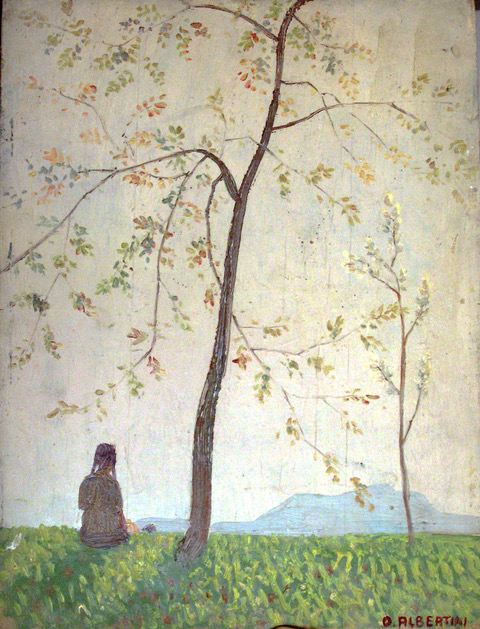
My presence next to him as a child, while he painted, fills my vision. I often went out with him and watched him while painting outdoor, and more than anything else I absorbed the charm around him. I used to curl up by a hill’s shoulder to protect myself from the wind. In March the sun is barely warm. I could perceive the same atmosphere he was painting. He was able to transfer his perceptions into the painting; that’s what his paintings give me back, those immersive moments. If this was the goal, his painting couldn’t have been different, nor did he really want to paint in a different manner. It wouldn’t be fair to say he was out of his time: stylized trees, as well as the houses’ volumetric consistency, when houses appeared, talk of 1900. His ambition was to follow his own road pursuing his personal aim (like the invention of a point for a drill). In times of revival of the 1400’s style of painting – which brought up quite good outcomes – OA’s search wanted to be self-directed even if, as we know well, time is where we belong. In the end the artist emerges and the public, also the bourgeois public, understands him -maybe their reading will be different from mine- but they grab it, the value of his art.

ALBERTO ALBERTINI, Photographic portrait of Oreste
A note about “superior dilettantism,” and Eugenio Montale resisting the fascist rhetoric.
By WILLIAM ARROWSMITH
In his 1925 essay, “Style and Tradition,” Montale [Italian poet Eugenio Montale] expressed the hope that his work “might contribute to the development of a cordial atmosphere of allusion and understanding in which an artistic expression, however modest, might emerge without being misinterpreted.” The result would be a welcome climate of what he termed “superior dilettantism.” By this he meant … knowingly mediated and humanly discerning engagement with tradition, an attitude utterly distinct from the Fascists’ shoddy pretense of renewing a past greatness of which they had no understanding whatever. … What mattered to Montale was that living men should not do violence to their own memories by declaring, like the Futurists, that the past has been superseded; or like the Fascists, that the past was Fascist too; or by the mandarin littérateurs, tat the past they had embalmed should mortify the living.
Paradossalmente il pittore socialista, positivista e progressista, fu il pittore della buona e sana borghesia lombarda, ma non solo di quella perché ebbe sempre ottimi riscontri fino a Roma. Questo si spiega in tanti modi ma soprattutto con la sua pittura, né convenzionale né rivoluzionaria. Occorre rifarsi alle epoche. La sua formazione risale agli albori del ‘900 in clima di simbolismo – divisionismo. Previati, Pelizza da Volpedo, Segantini. Di fatto ebbe un breve periodo divisionista. Ignorò il futurismo ma apprezzava Boccioni. L’inizio dell’attività pittorica definitiva coincise con l’avvento fascista. L’isolamento culturale in cui OA si muoveva era già sensibile sia per la natura del territorio italiano, sia per le condizioni economiche in cui era cresciuto. Il periodo fascista poi determinò il suo distacco completo dalle correnti ufficiali supportate dal regime, mi ricordo di Carrà e Sironi. Malauguratamente amo i paesaggi urbani di Sironi! Volutamente non aveva voluto partecipare alla vita culturale italiana, se vogliamo, staccata dai fermenti parigini. Avrebbe dovuto partecipare a un viaggio collettivo di pittori a Parigi ma non ne fece nulla. Un viaggio impegnativo? Mah! Questo isolamento, relativo dell’Italia, mi fa dire che in realtà la pittura del primo novecento è italiana. Parigi era sì un crogiuolo di idee e grandi artisti, ma in gran parte erano stranieri e il percorso italiano è stato diverso ma non meno significativo, anzi. L’OA, comunque, penso non si sarebbe comportato in modo diverso perché è vero che gli artisti sono il frutto di molte componenti di cultura tradizioni luoghi, ma soprattutto, se sono artisti, prevale il loro carattere. E OA era caratterizzato dall’orgoglio di non piegarsi allo spirito dei tempi e parallelamente da una capacità tecnica straordinaria. Era un alto artigiano, di famiglia e per le professioni che aveva praticato. La capacità di dare corpo, consistenza, materalità ai volumi dei paesaggi mi pare straordinaria. Io tutto questo lo vedo in relazione alle mie presenze, da bambino, quando dipingeva. Spesso uscivo con lui e lo vedevo dipingere ma soprattutto assorbivo l’incanto che vi aleggiava. Mi raggomitolavo contro una riva, al riparo del vento, al sole tiepido di marzo. Percepivo l’atmosfera che lui dipingeva. Penso che avesse le stesse percezioni e queste riusciva a trasferire nel dipinto, questo mi rievocano i quadri, l’atmosfera, quei momenti. Se questo era il suo obiettivo la sua pittura non poteva essere diversa, né lui voleva che fosse. Né si può dire che fosse fuori dal suo tempo; la stilizzazione degli alberi, la consistenza volumetrica delle case, quando vi apparivano, indicavano che il ‘900 non era assente. La sua ambizione era quella di percorrere una strada personale, sua (come l’invenzione della punta da trapano), che mirasse al risultato che si era prefisso. In tempi di ricerca e ritorno alla pittura del ‘400, che peraltro ha dato frutti niente male, le sua ricerca voleva essere autonoma, anche se sappiamo che dei tempi si è comunque figli. L’artista alla fine emerge e il pubblico, anche borghese lo percepisce, forse non legge l’opera dal mio punto di vista, ma ne afferra il valore.


You must be logged in to post a comment.