BETYE SAAR : HER WONDER

An imaginary dialogue between

BETYE IRENE SAAR and WILLIAM CARLOS WILLIAMS

Paterson  New Jersey    and     Los Angeles  California 

BETYE SAAR, Every Secret Things (Almost) 1982 Mixed media collage on paper 20 x 13.25" Courtesy of the artist and Roberts & Tilton, Culver City, CA

BETYE SAAR, Every Secret Things (Almost) 1982. Mixed media collage on paper 20 x 13.25 in  Courtesy of the artist and Roberts & Tilton, Culver City, CA

Note from the editor, Rosanna Albertini. This dialogue is based on my impression that her visual poems made with found objects and his poems made with words -we find them as well around us, since the time our ears could grasp them- are nothing but small machines endowed with an “intrinsic, undulant, a physical more than a literary character.” (W.C.W.) Not only they are not sentimental, their subject is not their point. As works of art Saar’s visual poems are made as islands of perception, imaginary cages for human stories touched with gentleness, not to break their skin or alter their movable presence in her mind.

The price she pays to shape her land of wonder is distance: objects coming from other  lives, and fragmented images that were probably lost or hidden in her brain if she needs to add stitches to drawings and glue as if preventing them from vanishing, pinning them down. Time, in her art, seems to struggle against the eternal present of the art work when it’s finished, and becomes a still, impenetrable combination of feelings about all the things that stir our lives and do not have the same clarity of words. Directions, orientation, destiny, chance? They are cages for feelings before they solidify in concepts. Collages on paper, three-dimensional  assemblages are simply things living their own life.

They declare nothing. It is the hidden sparkle they surround with beauty that pulls our hair.

Their eyes look at us forcing us to wonder about what we do not, we can not see. The poet writes:

So let us love
confident as is the light
in its struggle with darkness

and the visual artist takes the wind in the same direction, through darkness and light. Darkness is time painted by history, and caged in words, but for her as an artist darkness is a fact that patiently, stubbornly, she brings back to light. Game of chance, or game of destiny: she is standing in the shadow of love. Which is the real step out of darkness, and makes each piece of her art a strong physical metaphor, a cage for magic, and a house for ideas.

(The poem is the second part of Shadows, in William Carlos Williams Selected Poems, (selected by dr. Williams himself), first published in 1949, New York, New Directions Books.

The images are from Betye Saar’s double exhibition: Blend and Black White at Roberts & Tilton Culver City, CA Oct.-Dec. 2016)


BETYE SAAR. Standing in the Shadow of Love

BETYE SAAR, Standing in the Shadow of Love  2000, Mixed media assemblage  18 x 26.25 x 1.50 in  Courtesy of the artist and Roberts & Tilton, Culver City, CA


BETYE SAAR, Destiny of Latitude and Longitude

BETYE SAAR, Destiny of Latitude and Longitude, 2010.  Mixed media assemblage  54 x 43 x 20.5 in  Courtesy of the artist and Roberts & Tilton, Culver City, CA

Ripped from the concept of our our lives
and from all concept
somehow, and plainly,

the sun will come up
each morning
and sink again.

BETYE SAAR, To Follow Separate Stars 1982, Mixed media collage on paper 18 x 15.5" Courtesy of the artist and Roberts & Tilton, Culver City, CA

BETYE SAAR, To Follow Separate Stars 1982, Mixed media collage on paper 18 x 15.5 in   Courtesy of the artist and Roberts & Tilton, Culver City, CA

So that we experience
violently
every day
two worlds
one of which we share with the
rose in bloom
and one,
by far the greater,
with the past, the world of memory,
the silly world of history,
the world
of the imagination.

BETYE SAAR, Heartbreak Hotel, 2016 Mixed media assemblage 15.75 x 8.75 x 4" Courtesy of the artist and Roberts & Tilton, Culver City, CA

BETYE SAAR, Heartbreak Hotel, 2016 Mixed media assemblage 15.75 x 8.75 x 4 in Courtesy of the artist and Roberts & Tilton, Culver City, CA

BETYE SAAR, Heartbreak Hotel, 2016 Mixed media assemblage 15.75 x 8.75 x 4" Courtesy of the artist and Roberts & Tilton, Culver City, CA

BETYE SAAR, Heartbreak Hotel, 2016 Mixed media assemblage 15.75 x 8.75 x 4 in Courtesy of the artist and Roberts & Tilton, Culver City, CA

BETYE SAAR, Illusion of Freedom,

BETYE SAAR, Illusion of Freedom, 2009 Mixed media collage  8.5 x 18.5 x 11 in  Courtesy of the artist and Roberts & Tilton, Culver City, CA

Which leaves only the beasts and trees,
crystals
with their refractive
surfaces
and rotting things
to stir our wonder.

BETYE SAAR, Always Just Out of Focus 1982, Mixed media collage on paper 18 x 13.5" Courtesy of the artist and Roberts & Tilton, Culver City, CA

BETYE SAAR, Always Just Out of Focus 1982, Mixed media collage on paper 18 x 13.5 in   Courtesy of the artist and Roberts & Tilton, Culver City, CA

BETYE SAAR, Collecting Twilight Corners 1982, Mixed media collage on paper 19.5 x 14.75" Courtesy of the artists and Roberts & Tilton, Culver City, CA

BETYE SAAR, Collecting Twilight Corners 1982, Mixed media collage on paper 19.5 x 14.75 in   Courtesy of the artists and Roberts & Tilton, Culver City, CA

Save for the little
central hole
of the eye itself
into which
we dare not stare too hard
or we are lost.

BETYE SAAR, Red Bone Black Scouts

BETYE SAAR, Red Bone Black Scouts, 2001   Mixed media collage on paper  17.5 x 25 in  Courtesy of the artist and Roberts & Tilton, Culver City, CA

The instant
trivial as it is
is all we have
unless-unless
things the imagination feeds upon, the scent of the rose,
startle us anew.

BETSYE SAAR, Dark Times 2015, Mixed media on vintage washboard 21.25 x 8.5 x 2.5"

BETSYE SAAR, Dark Times, 2015   Mixed media on vintage washboard 21.25  x  8.5  x  2.5 in   Courtesy of the artist and Roberts & Tilton, Culver City LA

BETYE SAAR, Serving Time

BETYE SAAR, Serving Time, 2010  Mixed media assemblage  64 x 17.25 x 9.75 in  Courtesy of the artist and Roberts & Tilton, Culver City, CA

A SPARKLING GOODBYE

JEAN-LOUIS GARNELL’S  Photographic Plenitude

from Chatenay-Malabry (Paris) FRANCE

LE BOUT DE LA TABLE ― THE EDGE OF THE TABLE

1998-2010

BOUT DE LA TABLE (6)

A Sparkling Goodbye   by Rosanna Albertini

A mental distortion, perhaps caused by my American life, shows me at a small scale the photographic representation of a big historical ending: European good manners’ last sparkle, humble objects in a splendid farewell.

Goodbye to the Age of Empire and to flaking off dreams of primacy that European countries had thrown like blankets over distant, different civilizations. It doesn’t matter that a new globalization has replaced the first one, built at the end of the nineteenth century. Each European country, the people in them, grow the arts and self awareness out of a specific state mind: a silk thread still holding the civilized road, despite the absence, today, of Eurocentric illusions. The notion of style, maybe, is stronger than political or intellectual empires. Bossuet and Pascal, longer lasting presences than Foucault and Derrida.

“The qualities of the spirit are not something we acquire by habit, we can only perfect them; from which we will easily see that delicacy is a natural gift, not at all acquired by art.”

“To be attached to one thought that doesn’t change, tires and ruins our spirit.”

Pascal, Discours sur les passions de l’amour

Delicacy, maybe, is Jean-Louis Garnell’s secret style.

BOUT DE LA TABLE (3)

BOUT DE LA TABLE (2)

Objects are dumb by nature, they have no speech. Not so their images, changed in spirit by human senses. Viewers indeed won’t stop wondering about their fantastic transfiguration, spreading thoughts like dead leaves on the ordinary life they come from.

George Steiner* wrote that poems, statues, sonatas, and we might add visual poems, “are not so much read, viewed or heard as they are lived.”* Did he open the magic gate? An invisible grid of feelings and intuitions, a crowd of unsettled thoughts produce in human lives a space for the arts. It is so boring that words must be precise trying to pin down such an uncertain matter.

BOUT DE LA TABLE (1)

BOUT DE LA TABLE

Intimacy, through this changeable texture, is a molecular cohesion of humans searching for aesthetic forms they can love, maybe understand, if they accept that their thoughts are exhausted by life, and discolored by light. Only in embracing death as a fact can an artist bring the most mundane, fragile glass to an instantaneous, elusive smell of infinity. Words won’t catch it.

Shaped by daylight, stories we tell to ourselves are temporary and movable, like the dance of reflections the artist has captured, expanded life already flat and colorless. But among the lines and flat bodies around the edge of the table and the images of glasses and leaves on the table, of more leaves printed on the tablecloth, spreads the beauty of freedom. Visual joy as it might come from meeting a new, glorious day.

BOUT DE LA TABLE (10)

Jean Louis Garnell lights a candle, puts up an electric lamp. “An apple after Cézanne? more than one. Repetition isn’t only time, it’s also a new feeling of light that plays with human thoughts and contemplates them.”

BOUT DE LA TABLE (7)

The foreground, a devalued surface that seems to be the land of nobody because there is nothing beyond le bout de la table, is his secret planet. There, Garnell is a petit prince, inevitably grown up.                

BOUT DE LA TABLE (4)

*GEORGE STEINER, Real presences, Chicago – London, 1989

(A different version of A Sparkling Goodbye is published in the volume JEAN-LOUIS GARNELL, Centre photographique de Marseille, 2016)

BLACK and WHITE


PHOTOGRAPHS OF ORESTE ALBERTINI’S PAINTINGS

by Rosanna Albertini

1095 B-N

I am in this painting, the little girl sitting in the foreground, 1949?

We say BLACK: as if the night was an impenetrable bucket of ink and a pupil was a colorless spot in the middle of the iris instead of a hole, calling for light to come, hello mister brain, would you please activate your colors.

WHITE, instead, is an imaginary brush canceling lines, mess, imperfection, the same as snowflakes in New York sticking on the sidewalk. Piles of garbage bags become hills of the city covered with a white mantle.

I was torn by a dilemma for a few days: some of my grandfather Oreste Albertini’s paintings, reproduced in black & white photos, seemed to me utterly beautiful, not less than his oil landscape paintings that I see every day before my eyes. But these are photos of old paintings that I had never seen. Regression, toward a sentimental confusion? And what about the myth of the original art piece, usually treated as a religious icon? Am I committing an abstract sacrilege? What’s more important: the object or the intangible aura spread by the painted object, in which the art secret is held like a hostage. A high price in tension is required to set it free.


1078 B-N

1103 B-N


Oreste’s paintings in my house are not decorative complements of my daily life, they are fragments of my own life magically brought together in one canvas or on a small wooden surface. The very moment of my birth is posed on a 15 x 11 inch painted tablet. The painter’s feelings are there, in the silent vibration of light over a day of labor, soaking grass and mountains with faltering strokes.

In the white shelter of our skull, through the gray matter of the brain, an almost unthinkable conversation between light and our neuronal trees unfolds flowers of color, sentiments, sounds.

Colors, sounds, sentiments, are different for each person. They are the body and soul of the arts. That’s why ideas, maybe, are the most conventional and convenient food of our lives, from mouth to mouth, resting on pages, never definitive. They only sound like the daughters of certainty.

1107 B-N

Wanting company, I looked for original, clear minds. I found Giuseppe Panza di Biumo* and his memories as a collector, Mark Rothko,** Fernando Pessoa*** and Alberto Albertini, Oreste’s son.

Fernando Pessoa  “Life for us is what we conceive in it. For the peasant, whose little farm is everything, that empire is a little farm. … In point of fact, we possess nothing more than our own sensations; within them, therefore, and not within what they see, we just find the reality of our lives.”

Mark Rothko  “…making close the remote in order to bring it into the order of my human & intimate understanding. …”
“Here, says the painter, is what my world is composed: a quantity of sky, a quantity of earth, and a quantity of animation. And he lays them out on the table for me to observe at the same distance, to hold in the palm of my understanding without editorship – and these are eyes or a head – that are the desires and fears and aspirations of animated spirits.”
“I am interested only in expressing basic human emotions – tragedy, ecstasy, doom or so on – and the fact that lots of people break down and cry when confronted with my pictures shows that I communicate those basic human emotions. … The people who weep before my pictures are having the same religious experience I had when I painted them. And if you, as you say, are moved only by their color relationships, then you miss the point!”

1094 B-N

Giuseppe Panza “The relationship between idea and form, so difficult, almost impossible to define, is the secret and mystery of art, its obscure and powerful core; its force that overcomes the limits of reason and connects to the unknown, to the mystery of life. As if one would touch something impossible to imagine, arising from the springs of life. Not an intellectual operation, rather a phenomenon that precedes and goes beyond us as human beings.”

1063 B-N

Alberto Albertini “My presence next to him as a child, while he painted, fills my vision. I often went out with him and watched him while painting outdoor, and more than anything else I absorbed the charm around him. I used to curl up by a hill’s shoulder to protect myself from the wind. In March the sun is barely warm. I could perceive the same atmosphere he was painting. He was able to transfer his perceptions into the painting; that’s what his paintings give me back, those immersive moments.”     (  https://albertini2014.blog/2014/07/07/the-socialist-painter/ )

My dilemma remains, along with my love for the black & white ghosts.

Oreste-ideas002


Oreste Albertini, Notebook

Alberto Albertini, A Socialist Painter, in this blog

Giuseppe Panza, Ricordi di un collezionista, Milano, Jaca Book Spa, 2006

Mark Rothko, Writings on Art, Yale University, 2006

Fernando Pessoa, The Book of Disquiet, Boston, Exact Change, 1998


PER FRANCESCO E DIEGO:

IN BIANCO E NERO

PHOTOGRAFIE DEI QUADRI DI ORESTE ALBERTINI

NERO: lo dico ed è come se la notte fosse un secchio di inchiostro impenetrabile e la pupilla una macchia senza colore nel mezzo dell’iride invece che un buco, un buco che chiede alla luce di entrare, signor cervello buondì, mi faccia il piacere di accendere i colori.

BIANCO, invece, è un pennello immaginario che cancella segni, tracce di caos, imperfezioni, come fanno i fiocchi di neve sui marciapiedi di New York. Sacchi della spazzatura ammucchiati diventano colli urbani coperti da una mantello bianco.

Un dilemma mi ha turbato per qualche giorno: alcuni quadri del mio nonno pittore Oreste Albertini mi sono parsi bellissimi nella versione fotografica in bianco e nero, non meno dei quadri a olio che ho sotto gli occhi tutti i giorni. Eppure sono fotografie di vecchi quadri che non ho mai visto. Stavo regredendo verso una confusione sentimentale? Cosa ne faccio dell’opera d’ arte originale come mito, che di solito si tratta come un’icona religiosa? Sto commettendo un sacrilegio astratto? Che cos’è che importa di più: l’oggetto di per sé oppure l’aura che emana dall’oggetto dipinto, che quasi tiene in ostaggio il segreto dell’arte. Per liberarlo, ci vuole una tensione che non ha prezzo.

I quadri di Oreste nella mia casa non accompagnano la mia vita quotidiana come decorazioni. Sono momenti e luoghi della mia vita, dei frammenti che rivivono come per magia su una tela oppure su una tavoletta dipinta. Il momento esatto della mia nascita si è posato su una tavoletta di 38 x 29 centimetri. Sensazioni dell’artista, luce che vibra in silenzio sulle fatiche di un giorno, mentre i campi e le montagne prendono forma impregnate da un pennello esitante.

Nel ricettacolo bianco del cranio, attraverso la materia grigia del cervello, una conversazione inconcepibile fra la luce e gli alberi neurali sviluppa una fioritura di colore, suoni e sentimenti.

Suoni, colori e sentimenti sono diversi persona per persona. Sono corpo e anima delle arti.
Forse per questo le idee sono il cibo più convenzionale e opportuno, di bocca in bocca, qualche sosta sulla carta, niente di definitivo. Figlie della certezza solo in apparenza.

In cerca di compagnia, ho trovato alcune voci oneste e originali: Giuseppe Panza di Biumo, un collezionista con le sue memorie, Mark Rothko, Fernando Pessoa e Alberto Albertini, figlio di Oreste.

Fernando Pessoa “La nostra vita è solo quello che riusciamo a vederci dentro. La fattoria è tutto per il contadino, l’impero è una piccola casa. … E’ un dato di fatto che non possediamo niente più delle sensazioni; è al loro interno, non in quello che vediamo, che siamo in grado di trovare la nostra vita come è in realtà.”

Mark Rothko “… rendendo vicine le cose distanti per portarle nell’ordine della comprensione umana & intima …”
“Ecco, dice il pittore, i mio mondo è composto di: un po’ di cielo, un po’ di terra, e un po’ di animazione. E dispone le dosi sul tavolo per farmele osservare alla stessa distanza, perché le tenga nel palmo della mano senza alterazioni – questi sono occhi o una testa – che sono i desideri, o le paure, e le aspirazioni degli spiriti animati.”
“La sola cosa che mi interessa è esprimere emozioni umane fondamentali – tragedia, estasi, rovina o cosi via – e il fatto che un sacco di gente si emoziona e piange davanti ai miei dipinti mostra che ho trasmesso emozioni fondamentali. … Chi piange davanti ai miei quadri sta vivendo la stessa esperienza religiosa che avevo avuto quando li ho dipinti. E se tu, come dici, sei toccato solo dalle relazioni fra i colori, ti perdi l’essenziale!”

Giuseppe Panza “Un riesame del rapporto tra l’idea e la forma, rapporto difficile da definire, anzi impossibile da definire, è il segreto e il mistero dell’arte, è il suo nucleo oscuro e potente, è la sua grande forza superiore ai limiti della ragione, è il punto di connessione con l’ignoto, con il mistero della vita e di tutte le cose. E’ come toccare qualche cosa che non si può neppure immaginare, e come arrivare alle sorgenti della vita. Non è un’operazione intellettuale, è un fenomeno che precede il nostro essere e lo supera.”

Alberto Albertini “La capacità di dare corpo, consistenza, materalità ai volumi dei paesaggi mi pare straordinaria. Io tutto questo lo vedo in relazione alle mie presenze, da bambino, quando dipingeva. Spesso uscivo con lui e lo vedevo dipingere ma soprattutto assorbivo l’incanto che vi aleggiava. Mi raggomitolavo contro una riva, al riparo del vento, al sole tiepido di marzo. Percepivo l’atmosfera che lui dipingeva. Penso che avesse le stesse percezioni e queste riusciva a trasferire nel dipinto, questo mi rievocano i quadri, l’atmosfera, quei momenti.”

AND I MAKE IT ALL WRONG

 MERNET LARSEN and her ‘irrational’ geometry.

By Rosanna Albertini

(From “Mernet Larsen: Things people do” some studies
at James Cohan Gallery, New York)

It’s a painted world based on measurements, but staging the least reasonable forms and social stories. A nosy face sends the nose inside another face to see what, who, why to describe? It’s delightful nonsense.

MERNET LARSEN, Dialogue 2012, Acrylic on Bristol board 15 1/2" x 19" Courtesy of the artist and james Cohan Gallery

MERNET LARSEN, Dialogue 2012, Acrylic on Bristol board 15 1/2″ x 19″
Courtesy of the artist and James Cohan Gallery

MERNET LARSEN, Study for Couple #2 2004, Acrylic on Bristol board 19" x 16" Courtesy of the artist and James Cohan Gallery

MERNET LARSEN, Study for Couple #2 2004, Acrylic on Bristol board 19″ x 16″
Courtesy of the artist and James Cohan Gallery

MERNET LARSEN, "Couple" Study #3 2004, Acrylic on Bristol board 17 3/4" x 11 3/4" Courtesy of the artist and James Cohan Gallery

MERNET LARSEN, “Couple” Study #3 2004, Acrylic on Bristol board 17 3/4″ x 11 3/4″
Courtesy of the artist and James Cohan Gallery


Bodies in the drawing are supported by a metrical grid like fish in the net. The artist brings them into a space that seems constructed, at times, with broken shards of glass suspended in mid air. I love her studies. The geometrical preparation is still visible, it refuses analog replicas of life, although colors suggest odd metamorphosis: a piece of sky that fills a human block sitting at the table, a tree who plays being human. Green light blue men similar no eyes no legs maybe the table is a cloud pretending to be solid.

MERNET LARSEN, Study for Cube 2005, Acrylic on Bristol board 19" x 24" Courtesy of the artist and james Cohan Gallery

MERNET LARSEN, Study for Cube 2005, Acrylic on Bristol board 19″ x 24″
Courtesy of the artist and James Cohan Gallery

There is no way a single viewpoint can explore these visual stories without feeling destabilized, or without engaging the many viewpoints at work inside each piece, or conflicting with the natural perception outside the piece, until the brain isn’t sure. Except, Larsen’s people look as if shaped by a pasta machine, caged in parallel lines. This is evident. Forward or backward, parallels run like freeways dragging bodies out from the natural space, maybe into a timeless land.

MERNET LARSEN, Faculty Meeting Study 2008, Acrylic on Bristol Board 19" x 24" Courtesy of the artist and James Cohan Gallery

MERNET LARSEN, Faculty Meeting Study 2008,   Acrylic on Bristol Board 19″ x 24″
Courtesy of the artist and James Cohan Gallery

MERNET LARSEN, Study for Reunion 2014, Acrylic on Briston board 19" x 24" Courtesy of the artist and James Cohan Gallery

MERNET LARSEN, Study for Reunion 2014, Acrylic on Briston board 19″ x 24″
Courtesy of the artist and James Cohan Gallery

In this blog I usually don’t split art history hairs. I try to forget I was an eighteenth century philosophy scholar for a long time. But I can’t dismiss the reference to El Lissitzky and Chinese landscapes I found in Larsen’s statement and in every essay written about her. By old habit, I plunged my brain into Russian axonometry, Proun volumes floating in virtual spaces, [Proun: Design for the confirmation of the new], and the revolutionary hostility against the idea and practice of perspective since European renaissance painting.
“Space has been limited by perspective, closed into edges. In art, bodies of numbers have become more rich…” El Lissitzky. Mathematical thoughts defy infinity, political passion feeds a search for limitless expansion of geometrical ideas beyond Euclid, unconditioned by gravity or historical frames.

And really Chinese landscapes are light, slow motion eye movements presenting trees water and mountains not as they are, they are not realistic, just as a continuous expansion in space. The vanishing point? Impossible.

I can see Mernet Larsen inspired by both.

Yet, I would like to link her unique perception of our present reality, her search of an essence, to a post industrial experience I had not a long time ago, walking through the factory of Ferrari, near Bologna. I had the awkward sensation of moving my feet and legs across multiple crossings of invisible, parallel lines designed for robotic creatures. Humans weren’t welcomed. At every step they had to negotiate their space with fast metallic ‘artuditus‘ programmed to be efficient, not to observe good manners.

The factory is a climate controlled pavilion where air and humidity are adapted to the needs of chemical areas, fusion pits, and protected containers in which the car’s single separate organs and limbs are generated, with no intervention of human hands. Only robots can keep the required level of precision. They often look like the long bar legs and arms of Larsen’s creatures. Tropical plants in pots give the illusion of a green house. Some historical Ferraris at one of the edges look like a monumental bunch of flowers. Nobody knows why such marvelous technological champions are not able to win the races.
Although the factory makes it all right, the result is not what everyone expected.

“I want the mechanisms of my paintings to be fully visible, each painting an index of my painting behavior: measuring, layering, carving, texturing, coloring, pasting.”

“These paintings are at once a tribute, affectionate parody, and critique of Renaissance narrative painting. They reflect a longing for something lost, and a desire for a sense of space and narrative unity more in accord with contemporary concepts of reality.” Mernet Larsen

MERNET LARSEN, Indecisive Woman 2000, Acrylic on Bristol board 19" x 24" Courtesy of the artist and James Cohan Gallery

MERNET LARSEN, Indecisive Woman 2000, Acrylic on Bristol board 19″ x 24″
Courtesy of the artist and James Cohan Gallery

MERNET LARSEN, Gunfighters 2001, Acrylic on Bristol board 15" x 24" Courtesy of the artist and James Cohan Gallery

MERNET LARSEN, Gunfighters 2001, Acrylic on Bristol board 15″ x 24″
Courtesy of the artist and James Cohan Gallery

MERNET LARSON, Getting Measured Study 1999, Acrylic on Bristol board 19" x 24" Courtesy of the artist and James Cohan Gallery

MERNET LARSON, Getting Measured Study 1999, Acrylic on Bristol board 19″ x 24″
Courtesy of the artist and James Cohan Gallery

It’s always illusion. Geometry is based on mathematical magnitudes generated by the human mind, it is a space with no equivalents in nature. Outlines and forms we discover through our senses: mountains or houses or horses, “are absolutely different from the space of geometry.” Poincaré, 1905.

But the human landscape infects Larsens’ geometrical figures with attitudes that it is impossible not to recognize. The arms grow following the position of shooting, become longer when uncertainty fills them, shrink in the act of waiting. Heads like bricks little gray hearts maybe not beating how to survive monsters who are bigger in the distance if one doesn’t have legs to escape? Shaped and reshaped by movement, and by sense of humor. Heads, witty heads without bodies are able to smile behind their flatness, even between the lines, they are still human.

JOHN OUTTERBRIDGE: THE SOWER

from:   Sankofa, 2006

Leiden: John Outterbridge’s installation at Naturalis, The National Museum of Natural History, The Netherlands. 


_DSC1499

_DSC1501

_DSC1504

Photos: Peter Kirby

John Outterbridge’s statement:  Nature in the city, the city in nature: rocks, gnarled roots and tangled twigs, bicycles and plants, dried and desiccated bones, a sailing ship of old, birds and animals, sprouting potato and yams, together beneath a glowing orb (is it moon-ness, the female?)

It is a microcosm of our environment, a fertile garden from which we can harvest ideas and reflect on our history and our present existence, on our connectedness and the spirit that informs it all. It is a metaphor that speaks of change, of fossils in dormancy or in transition, as well as of the organic that germinates and nourishes. All of this together signals the living future.


to:   JOHN OUTTERBRIDGE‘s assemblages and sculptures in RAG MAN at ART + PRACTICE,

Los Angeles 2016,  until February 27.

A FULLNESS OF LIFE      by Rosanna Albertini 

Sankofa was the dream of a sower, il seminatore. I looked at Outterbridge for a week while he was preparing the installation, and the key moment wasn’t the display of bones and animals from the museum’s collection interspersed with tiny bicycles, it was the final throw of white beans all over the floor of his fossilized garden, the accurate positioning of yams and potatoes, some already sprouting. Only then did we sit down, as gardeners do, waiting for the natural growth as an infusion of living into the dryness of history. For the first time we spent a considerable length of time together, letting the talk veil curiosity about one another and the many things art can be. I was writing portraits of women artists then, a bunch of interesting flowers indeed, and John gave me as a present one more flower to discover after, back in Los Angeles: Dominique Moody. “Legally blind, she goes by bicycle” -he said, and laughed remembering that his attempt at being a real dutchman on a bike along with the many swarming through Leiden like mosquitoes, had just ended in a spectacular fall.

JOHN OUTTERBRIDGE, Caged, 2008 Mixed media

JOHN OUTTERBRIDGE, Caged, 2008  Mixed media   Courtesy of the artist and Tilton Gallery, New York    Photo: Peter Kirby

Never is his art separate from the feeling that living things and people could be lost and broken down forever if there isn’t somebody caring for them, presenting them in a personal, surprising way, as if art were an offering to life asking for clemency, or inclusiveness. Universe isn’t an audience, doesn’t listen, cares even less. If it wasn’t for humans, lady earth wouldn’t have a face, the many faces she shows to the sky who still cries tears and storms over their eternal separation.

JOHN OUTTERBRIDGE, Rag and Bag Idiom II, 2012, Mixed media

JOHN OUTTERBRIDGE, Rag and Bag Idiom I, 2012, Mixed media, The Eileen Harris Norton Collection    Photo: Peter Kirby

JOHN OUTTERBRIDGE, Rag and Bag Idiom VI, 2012. Mixed media, 14 " x 12" x 6" The Eileen Harris Norton Collection Photo: Peter Kirby

JOHN OUTTERBRIDGE, Rag and Bag Idiom VI, 2012. Mixed media, The Eileen Harris Norton Collection Photo: Peter Kirby

As an artist making assemblages, John Outterbridge is the sower who picks up, and takes in, debris left on the ground by rush and forgetfulness. Some debris were recently wrapped up in small bags: soft, irregular forms of a self  contained visual idiom.  We don’t  know exactly what they are, sometimes they became pillows, three of them placed on top of  a rag almost a flying leaf that carries bodies bigger than she. If the leaf is a soul, I can see the artist painting the heaviness of the burden with the colors of a fruit salad: yellow, orange and green and a touch of watermelon.

Colors, fabrics, shapes, are the harvest of thousands of years chewing them till they mutate. Art works become dust and dirt despite the efforts of the art conservators. Yet an artist like John doesn’t care, his creatures were born old, they look old, already damaged at birth. Like the Asante Adinkra symbol in Ghana, he is the bird turning his head backwards to take an egg off his back. Sankofa: go back and get it. You don’t forget that a couple of wings are not enough for a machine to fly, they rest in a box almost protected by the lives they had, folded tenderly against their skin. Rags and bags? So are we.


Sankofa_bird


This post is first of all addressed to John Outterbridge, as a token of mine and Peter’s affection. I just received from Dominique Moody two evocative photos: the first is a bicycle made by an African boy, donated to John in South Africa during a trip that followed his visit to Leiden-the city of bicycles; the second is a picture of John Outterbridge and Dominique Moody taken by Tami Outterbridge at the opening of RAG MAN, December 12, 2015.

bicycle

John and Dominique

LIFE AS IT IS

according to GREG EDWARDS, painter

IN A SKETCHBOOK, A STROKE OF BEAUTY IN THE IRON AGE

By Rosanna Albertini

Artist Greg Edwards has driven and drives most of his urban life in Los Angeles and San Francisco. He paints and draws, draws and drives. He paints abstract actions on large canvases in his studio. His body, big and tall, towers over my caucasian, limited size. He needs a big car. Like most artists, he must work in order to survive. Greg is a limousine driver. The first year I moved to Los Angeles, about twenty five years ago, he showed me his paintings in an exhibition hosted by a shopping center in Crenshaw. He was proud to bring me among his people, the African American community in Los Angeles. I ate my first gumbo. I felt ‘white.’ To me, white and European, it was only a deeper immersion in a foreign world, no more surprising than other Korean, Japanese, or Mexican communities in Los Angeles. So many street names sounding perfectly Italian, with effort I had to tell myself they were Spanish, made me feel at home.

GREGORY WILEY EDWARDS, Sketchbook Drawing, bac814, ink on paper, 12" high x 9" wide Courtesy of the artist


GREGORY WILEY EDWARDS, Sketchbook Drawing:“On The Razor In Paris” ink on paper, 12″h x 9″ w
Courtesy of the artist

I think I decided that day I would never considered Greg Edwards a ‘black’ artist, just a very interesting artist. Time showed me I was wrong. It took years to learn an American history that for most Italians was a fantasy around Uncle Tom and cotton fields. Gone with the wind and no more. Our imagination was stuck in the Eurocentric confidence that we knew almost everything, which is worse than having our thoughts blocked by their own limits. Imagination is the key to what we do not know.

Greg’s art has become to me as important as his friendship. Many obstacles we had to overcome to built a reciprocal trust through personal wounds and stories of pain and separation, and stories of daily violence in the U.S. despite new written rules and equalized civil rights. It’s the IRON AGE: humans must work for survival, they can’t contain their passions, nor regulate the amount of pain they suffer or inflict. They kill, place explosive belts around their waist, lie and betray their families. Hesiod had seen it coming six century before Christ appeared. Terrorism and wars wear iron shoes. I can’t write a new post pretending the massacre in Paris did not happen. Not to mention others in Africa, Turkey, Lebanon, India, Iraq, Palestinian territories and in the U.S., only some among many.

GREGORY WILEY EDWARDS, Sketchbook Drawing, 818, ink on paper, 12" high x 9" wide Courtesy of the artist


GREGORY WILEY EDWARDS, Sketchbook Drawing: “The Purchase Of Sky And Forest” ink on paper, 12″ h x 9″ w
Courtesy of the artis

GREGORY WILEY EDWARDS, Sketchbook Drawing bac821, ink on paper, 12"high x 9" wide Courtesy of the artist

GREGORY WILEY EDWARDS, Sketchbook Drawing: “Visionary Roadmaster At Home” ink on paper, 12″h  x  9″ w
Courtesy of the artist

The paintings made by my grandfather Oreste, and the war stories recently written for this blog by his son Alberto, happened in a worse time of bombs, starvation, and dedicated fascists, practicing torture on their human companions if they believed they had different ideas about civility. Yet grandfather kept painting, and his mountains, his lakes were free from the surrounding violence. They emanate hope.

GREGORY WILEY EDWARDS, Shetchbook drawing, bac824, ink on paper, 12"high x 9" wide Courtesy of the artist

GREGORY WILEY EDWARDS, Shetchbook Drawing: “The Spirit Of Monk’s Girlfriend” ink on paper, 12″h  x  9″w
Courtesy of the artist

I feel the same in front of Greg Edwards’ drawings: beauty is held by his big hands in a warm human cave among the lines that life has written on his palms. He drives, he has to wait for indefinite time. There, in a buffer space before the necessary adaptation to somebody else’s needs, he opens his notebook and lets his fingers to put images down, shadows of things seen hovering on his mind, already light. He draws them as presents of the moment, as they take place in the thickness of time: textures of feelings as if art allowed him to collect them from the daily confusion and lie them on a paper floor, half dream, half geometry, decoration as well as vanishing wishes more than real in his mind.

Beautiful things

like a mouse, like

a red slipper, like

a star, a geranium,

a cat’s tongue or ―

thought, thought

that is a leaf, a

pebble, an old man

out of a story by

Pushkin       .

Ah!

rotten beams tumbling,

.       an old bottle

mauled

from: WILLIAM CARLOS WILLIAMS – Paterson, 1946

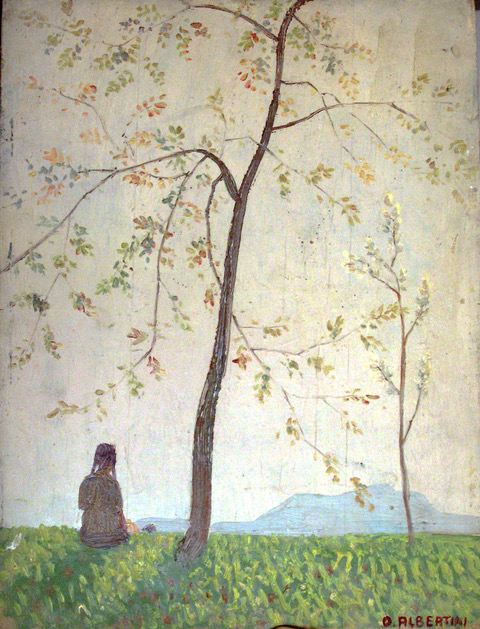
ORESTE ALBERTINI

ORESTE ALBERTINI, Primavera (Springtime) 1946 

THE CHALLENGE: IN 2001 HE BECAME A TREE

 because the artist can only be a humble flower bed, ASKING FOR APPROVAL (AL SERVIZIO DEL CONSENSO) Giuliano Nannipieri from Livorno, Italy.

THE CHALLENGE OF UNDERSTANDING by Rosanna Albertini

Here we are again. It would be a revolution in the arts if artists could give up being eccentric, like stars that refuse to rotate around the sun. Money perhaps? It would be simple if artists were spreading around their visions, images not needing the walls of a cave to exist for a long time. Or, some of the time.

Giuliano Nannipieri didn’t see limits to what an artist can be. Still does not. Philosophical weeds fed him deeply, but ideas became disposable for him if they were not bringing sparkles to his heart. Patient enough to graduate in philosophy, he couldn’t accept rules and impositions from the organized art world. He teaches art in a primary school.

He never gave up being a vessel of provocative, meaningful actions. Not far from Hirokazu Kosaka throwing arrows in the space between naked bodies in movement. But the Italian artist was the only one at risk: why not be, uninvited, at the Venice Biennale? In June 6, 2001 he went, exposed his physical metamorphosis, was thrown out. Yet, there was no violence on his side: he was just a tree. The metaphor of the artist’s body showing bandages over the painful transformation into a decorative commodity. Yes, with no price, he will not be purchased. It’s in the premise. Such a derisive, self-destructive commitment would lead, no need to say, to the death of any artist.

Guliano-1    Guliano-2


Guliano-3

Guliano-4


Guliano-5

Guliano-6


 GIULIANO NANNIPIERI – The artist can only be a humble flower bed, al servizio del consenso.

VENICE BIENNALE unofficial performance 6/6, 2001,  6 Polaroids

That’s why I’ll try to uproot his tree and show what Nannipieri did in Venice, as in many other circumstances, by rewriting a page by Emmanuel Levinas. Impossible to translate word by word. It’s a verbal performance,  mine after his.

How can we be if our living time disappears and

we walk through the void?

Let’s imagine things

and people never were, so we could

breath such emptiness in and out

and feel murmurs of silence

subject and names are gone

a field remains of impersonal vibrations

the simple fact of an existing energy field

as impersonal as ‘it rains’ ‘it’s cold’ ‘it’s foggy’

names can’t tell about it, verbs maybe can

no offense to time and space they don’t count

compared with human energy

incurable daughter of fate

no one nothing will change her

what kind of art now?

(free reference to Emmanuel Levinas, Le temps et l’autre, 1979, pp.25-26)

Although I couldn’t tell, I do know some artists feel it in the air, in their blood, in their longs. And it’s against the fossilized values of this marketplace. Now, not in the future. Listen to the silence.


HUMAN COLORS

Painter MATSUMI KANEMITSU, nickname MIKE

by Rosanna Albertini

Early 1950s in New York. It seems that Jackson Pollock started to call him Mike. Kanemitsu was one of the artists going to the Greenwich Village Cedar Bar as Pollock did, and Franz Kline, Robert Motherwell, de Kooning, Phillip Guston, Joan Mitchell, Gregory Corso, Jack Kerouak, Frank O’Hara, Lee Krasner. Women, I read, were treated like cows. “In 1956 his work was included in a Whitney Annual, and in 1962 Kanemitsu was one of the 14 Americans at the Museum of Modern Art. And yet, his name remains largely absent from most histories of the New York art world in the fifties.” (John Yau)

Please read the beautiful story written by John Yau for The Brooklyn Rail, May 16th, 2008: “Kanemitsu in California during the 1960s and 1970s.”

Why his name disappeared from the New York scene remains a page of unanswered questions. Maybe Mike was tired of New York. Or he was more Japanese than American: although born in Utah in 1922, he grew up near Hiroshima from the age of three. After coming back to the U.S. in 1940 he was drafted in the army (442nd infantry) and had his first one man show on the army. Had he stayed in Japan he would have been drafted in the Japanese army. The place, in time of war, becomes a demanding home. For a double citizen, the war is a splitting knife. Los Angeles had a bigger sky, just in front of Japan. Maybe a less vertical city than New York, a better place for scattered lives keeping two souls, or more, in one body. Mike stepped out of human time in 1992, we can’t ask him.

MATSUMI KANEMITSU, The Hunter, 1960, Oil on canvas Courtesy of Nancy Uyemura

MATSUMI KANEMITSU, The Hunter, 1960  Oil on canvas
Courtesy of Nancy Uyemura

But his work is here, I’ll ask his paintings. They resurfaced from his studio only at the end of last year, 2014, for a double exhibition at The Mistake Room, Los Angeles: Ed Clark—Matsumi Kanemitsu. Exposed to the public for the very first time. Once more, I resist calling them ab-s-tractions as if they were portraits of real fragments, cut out from the space around us, or pulled off the ground like a tree. That’s a pre-neurosciences standpoint. Colors are not qualities of things separate from us.

Artists participate in the sacred dance of nature like everybody else. But their work goes further, disclosing the personal forms of pain, joy, surprise and their difficult conversation. Which could be what happens in The Hunter, Kanemitsu made it in New York in 1960. There were sky and sun and depth somewhere, until a black looking like bitumen floated over a sort of screen bringing flatness, hiding them. Not completely though; figures of light, Proserpina’s hands, push from underneath the edges of blackness. The dark blocks could be bodies (not necessarily human) making love, or uncertain petals of an unknown flower. Time to leave.

MATSUMI KANEMITSU, Hawaii #3, 1973  acrylic on canvas Courtesy of Nancy Uyemura

MATSUMI KANEMITSU, Hawaii #3, 1973  Acrylic on canvas
Courtesy of Nancy Uyemura

Colors are like pain, no one feels pain −and sees colors− in the same way. So it’s a real mystery the way artists go beyond intellectual barriers, the countless ways they manifest the world absorbed and reshaped in playful, unpredictable forms. Hawaii #3,1973, is a fluid dream of bodies with no edges, liquid and impermanent, made with air and water and long necks veined with red, to remind us of blood and all those channels, even in fantasy creatures. In Winterstorm, 1978, we can feel the tension of a mental storm. Yet, I could be completely wrong. It’s hard to be a viewer. Like Ed Clark’s paintings, Mike’s canvasses expel the stiffness of meanings and categories. They are gentle, and free. They are beautiful.

They make me dream of an age (imagined, of course) in which “words and things were not yet separate — different beings adapted to one another, trees connecting to the animals, the earth with the ocean, and humans with everything around them.” (Michel Foucault) In the natural magic, all the figures in the world would relate to each other by similarity: the sky has eyes and the earth has mouths. No need of words.

MATSUMI KANEMITSU, Winterstorm, 1978  acrylic on canvas Courtesy of Nancy Uyemura

MATSUMI KANEMITSU, Winterstorm, 1978  Acrylic on canvas
Courtesy of Nancy Uyemura

A MAGIC BROOM

ED CLARK – painter               by Rosanna Albertini    

 It’s not so much art as it is…life (John Cage)

His life. An American artist born in 1926. He went from Chicago to Paris in the Fifties when Picasso, Braque, Chagall, not to mention Sartre and Camus and Simone de Beauvoir, walked in and out through clouds of smoke: Paris as it happened to be in the fifties. Nevertheless, the artist to whom Clark felt closest to was Nicolas de Stael. Maybe Ed Clark recognized in his landscapes the desperate passion of someone who tried to keep his visions separate from war’s tragedies and the immediate after war poverty and lack of fortune, but who also gave up and jumped onto the void in 1955. Clark tried to paint in the style of his friend. Probably his way to put himself in another artist’s mind, an extreme act of sympathy: The City, 1953. It’s a dark painting. Maybe Ed Clark gave to the city blocks a New York light, or it was his friend’s sadness.

The very young African American painter fell in love with Paris. I can see him converting “the very pulses of the air into revelations” (Henry James), finding a broom and sweeping his feelings over the canvas -the canvas is on the floor. He added freedom and energy to the impulses coming to him from an old, wounded world.

EDWARD CLARK, The City, 1953, oil on canvas. Private collection. Courtesy of The Mistake Room, Los Angeles

EDWARD CLARK, The City, 1953, oil on canvas. Private collection.
Courtesy of The Mistake Room, Los Angeles

PARIS IN THE 50s FROM ALBERT CAMUS’ NOTEBOOKS (1951-59), with bugs interpolated.

Man of 1950: he fornicated and read the newspapers.

Did he, an American in Paris?

Never attack anybody, especially not in writing. The time of criticism and polemics is over – Creation.

From now on, the single and constant affirmation. Understand them all. Love and admire but few.

The public no longer accepts intelligence except within idiotic commentaries.

The more I look at Ed Clark’s most recent paintings, the less I want to put words on them. They exude physical strength and joy of discovery: meanings fly around them almost embracing the canvas, and yet they don’t dare to interrupt with shadows the paintings’ inner life. Directions, stories, sounds, pierce his mind before they fall on the canvas: and every time it’s a new conversation between colors and forms. Because the natural disorder becomes human, captured by an impulse of love, love for the living present, in front of the newness of a painted landscape borrowing natural colors and lights, but escaping time. Clark’s voice: “Wherever he is, an artist, you know, has to do what he believes it’s right.” As if the action of painting had told him what to do: don’t reproduce anything you have seen.

EDWARD CLARK, Untitled, 2013, acrylic on canvas. Collection of the artist Courtesy of The Mistake Room, Los Angeles

EDWARD CLARK, Untitled, 2013, acrylic on canvas. Collection of the artist
Courtesy of The Mistake Room, Los Angeles


EDWARD CLARK, Untitled (China Series), 1995, acrylic on canvas. Collection of the artist Courtesy of The Mistake Room, Los Angeles

EDWARD CLARK, Untitled (China Series), 1995, acrylic on canvas. Collection of the artist
Courtesy of The Mistake Room, Los Angeles

“It’s not so much art as it is … life.” Life’s physical threads, movements, changes, adaptations, dimensions, the power of center as well as the softness of marginal strokes. The beauty of a sense of balance. Clark’s paintings are islands of visual music, linked to the heartbeats.

Abstractions? I’d like better not to say so. First word everybody mumbles in front of these paintings, as if the viewers had eyes in their mouth. I’m paraphrasing John Cage. His 1967 attack of impatience: “As they listen to music they start talking. Do they have ears in their mouth? Are they stupid?” True, there is no such thing as silence. Can they just listen? Can we just look, look and wait until the painting awakes in each of our cells, matter talking to matter, and then we’ll see?

“If anything is communicated by art, it happens without any explicit desire for communication. It is communicated by art, involuntarily and to the same extent, to both the artist and the spectator. If the spectator is amazed by a work, so is the artist, unaware as he is of his “achievement.” (Giulio Paolini)

SPACE OF HOPE

ROSANNA ALBERTINI about HILJA KEADING

 “Well, daily life little by little becomes a thing in which there is space for hope.” (Ludwig Wittgenstein)


© HILJA KEADING

 Amazing Grace, Single Channel Video, 1978, Length 6:03 


A twelve year old Hilja, legs already long for her age, swings her new little radio on a chain. Music fills her body down the gravel road. The radio is red. “Feelin’ groovy,” she sings, “ Ba da, Ba da, Ba da, Ba da, / All is groovy.” The night of her 50th birthday, as she turns the radio on in the kitchen, Simon and Garfunkel’s voices unexpectedly sing in the room: “Slow down, you move too fast.” How many lives did Hilja Keading expand into, after that walk on the gravel, is hard to say.

At least a hundred lives. All the lives an artist needs to grow out, they are leaves of the same bush. Art picks you, one of her teachers told Hilja. It doesn’t work by decision. Then, would art be a matter of persistence? Stripping life from illusion. Filling art with truth. Keading became a maker of stories. Made with time and sounds, they don’t last. That’s the secret, maybe. Her stories don’t have to last, don’t have to be revealed. They tell us they exist behind silence or noise, behind the image of a smiling ten years old girl who lost her front teeth, still like a statue except for the fluttering of the collar near her neck.

Experience comes first, facts are erased along with their noisy flags announcing evidence, rather than truth. Keading pushes us to feel her invisible, intangible and distinctive truth, and to give up with easy explanations. There are none. Sounds and images touching us for opposite reasons, bring a phantom within, a cloud of wonder which is the major claim for every human being. Myth or soul, maybe they are the same thing: fleeting, ungraspable unless one image calls for them:

HONEY IN THE HANDS-CUP DRIPS THROUGH THE FINGERS, WITH DEAD FLIES TRAPPED INTO THE SWEETNESS

                                                                                                           fingers trying to brush something away from the collar bones, something prisoner in the chest

A NAKED WOMAN CROUCHED ON HER KNEES PICKS UP HANDFULS OF BROKEN GLASS FROM THE FLOOR

naked fingers hold a dead bird,

then they drop it, and start shaking like

feathers while a piercing bird voice

speaks a very loud mocking song.                                                                                                                        

AMAZING GRACE


 “Experience is all-absorbing, subordinating observed fact, drowning even truth itself, if truth is conceived of as something apart from impulse and instinct and from the will.” (W.B. Yeats)