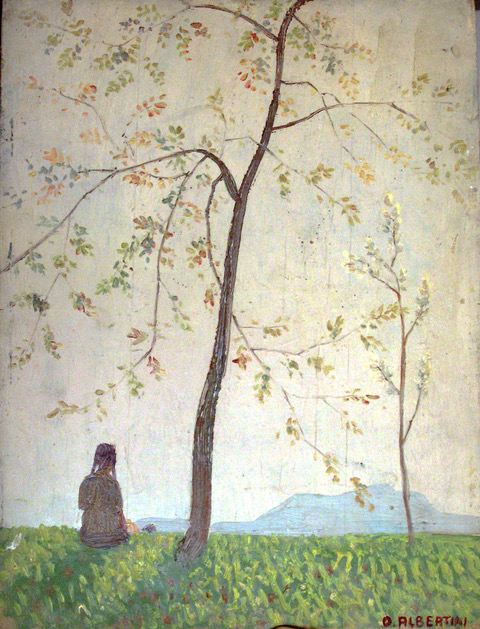


The day’s first twilight.
Morning that once was dawn.
Day that once was morning.
The crowded day that will become the weary evening.
……………………………………………………………………………………………..
I was made of a brittle substance, of mysterious time.
Maybe the source is in me.
Maybe out of my shadow
the days arise, inevitable and unreal.
Jorge Luis Borges, In Praise of Darkness, 1969

IRENE
by Rosanna Albertini
I woke up at four. Dawn was barely starting. Not sure where the day was springing from, if it was me, or the house called Irene —the artist who had lived there— or produced by the desert. As the light became bright, the heat in the air gave me a state of oblivion, far from the big world and the small daily habits, only able to see and feel the long table with metal chairs, the small window with bars keeping at bay the land’s dryness, a ceramic Medusa head, and the climbing Jasmin half-alive for years, never dead. Sometimes I touch my head, it has that same kind of endurance. Waiting to wake up in a better time? Not really clear, yet the promise is there.
Early in that morning, there was no promise. I was aware the clock’s tic toc had disappeared. Time was mine and it was light. Life’s insanity could stop. A small black hawk landed between the mesquite’s spines screeching from the bottom of his throat: “time has vanished and everything is good.” Not bad to stand up between infinity and the feet on a dry portion of ground. A wall surrounds the garden.


Back home in LA, still vacuumed by the un-indulgent breath of the desert, I open a book without knowing why. A poem jumps into my eyes, pitiless: don’t sleep, don’t bury yourself in the daily routine.


These are all Irene’s watercolors (no title, no year)

And for the time, just one exists:
I.
Just one exists and I am time,
I am the whole of light.
the whole of time.
Wallace Stevens, Moment of light.
OK Wallace, I understand the intensity of your moment, mine is similar but perhaps less hinged on the I. I felt past, present and future as real and vivid as only one flower with different petals. Yes, in a flash of light. And light replaced time with my “I” submerged by a wave. All the moments I had spent in Irene over the last thirty years -one season after the other leaving intangible roots- came to me at once. Not really memories: scattered moments were all around me in the same place, out of my brain. I thought for an instant this is my real house but no, it’s Irene’s: the place of an artist who painted and taught watercolor. Perched on my shoulder, she stared at her pictures along with me.


To me Irene, I mean the house, was a lake when the heavy sweet water is so flat that stepping inside seems a sacrilege, almost breaking glass. A lake in which a goddess used to make cookies for neighbor children … I know nothing about her, does it count? Her stove, the old locks of the kitchen cabins, they still contain the touch of her fingers. The house made me prisoner like a lake in Maine, very hard to get out, the fairies keeping me there, what does it mean to go home? Enchantment is an addiction for me, woods and grass of my childhood hold my soul. My garden sucks me in. The desert light in the afternoon melts the image of my body as it does with trees and clouds, almost unreal clusters of particles. The day keeps going inevitably, without concessions: whether one likes it or not.


Instead of painting, Irene the artist writes to her students how to put down the strokes of color, and to observe what produces distance by modulating colors, almost as if playing a clarinet. Her instructions, quite precise, are good for any painting. Drawing, drawing is the first thing —she wrote. I noticed dryness in her words. The watercolor art I know was a mess of wet paper. Irine’s watercolors are so well done the struggle disappears. The fall turned into winter stripping all the leaves from the nut tree. School had started for my small person already old at eight years. The elementary school in my Italian village had two big rooms. Two classes per room with the same maestra. A woman always wearing a black dress, feminine version of the black tunic on the priest’s body, used to enter every morning with a fiasco in her hands, containing the ink she poured very carefully into a hole in each small table. I leave to your imagination what we used to do with that ink, beyond writing, of course. That’s why we also had a black over-dress on the regular clothes. The back of the old building near the church included one more big room -I saw it that way- for the art school in the evening, from 8 to 10 pm. Nobody had TV in the nineteen fifties. Kids and adults learned the basic techniques for visual arts. Not more than five or six people. Ercole the wall painter was our teacher, my grandfather’s student in the same room. After grandfather moved to the clouds it seemed normal to send me to the evening school that was ten, fifteen minutes walking from home. I was initiated to water coloring. So difficult under the vibrant, loud voice of the teacher terrifying me. My reward was the walk home by myself, when the night had already spilled her own ink. I was friend with every inch of my space. The first snowflakes in the dark under a gray, low sky seemed to me a dance of frozen fireflies keeping me company, melting on my hands. Irene looks perplexed.

Too young for watercolors —she mumbles shaking her dark hair, those I saw in her portrait on the wall over the fireplace. Never had I the sense of the right time for learning in my early ears, nor later. Hunger for making my own task, in my own way, was somewhere hidden in me. With impatience. No surprise I started to write, design, bind by hand, and publish my own American books to avoid the ordeal of begging for money to reach good publishers. I like publishing as an adventure. The first time was at Irene’s. In the heat of the summer, dropping sweat from my thick hair and pinching my fingers with a long needle. From her portrait, Irene smiled. Obeying my teacher I made two or three blank books every day. My fingers had to be trained to manage the tension between paper and the thin linen thread that required to be waxed and cut according to the number of pages. In my craziness I didn’t pay attention to Irene’s presence. She knew it, anyway pleased because I was learning an art, and was aware of the silent power of her adobe embracing my days, protecting my instinct.


When my friend Jane crossed the Acheron to reach the time of the dead, I was at Irene once more, as I am now. Nothing disappears. Irene passes a weary hand across her forehead half sad, half surprised. Her living room, the porch in the garden are a factory of flowers preparation for the memorial. I sit on the couch in front of the large and low round table. I practice making paper flowers with a Japanese technique and use crumpled pieces of paper —remains from an art school nearby. I don’t really know where I am, follow my hands. Where are the ashes? I ask. Somebody answers: just here, behind you on the black furniture. Jane is having the last tour of her Inn, moves from a cabin to another, also to Irene’s adobe, of course. Near me on the couch appears a skinny five year old girl impatient to move her hands on the pieces of paper. What’s your name? I ask. Gwynnett, she replies. Smiling, lively, curious, fearless Gwinnett. She picks the petals’ colors. Jane’s granddaughter, one of the many. Can we add a butterfly on each flower? She asks. We will certainly do it —I reply. Nostalgia doesn’t make sense. Through dirt and bodies, the frenzy of life doesn’t stop. Small and new, with black long hair and bright dark pupils, there is a Jane sitting next to me. Irene assents, understanding.


Photos: Rosanna Albertini & Peter Kirby for the watercolors.
NOTES
Irene’s adobe has become part of the Twentynine Palms Inn, in Twentynine Palms, CA, after Irine passed away in 1997, at the age of 95. Irene Zimmers had married in 1967 Gerald Charlton, the architect who had built the adobe in 1933-34, “banished to the desert” from British Columbia to cure his tubercolosis.
Irene Zimmer was a water colorist. She was also an art teacher and became the President of the 29 Palms Artist Guild. The “High desert water color society” dedicated a commemorative tablet in bronze to her, which is now in the house.
You must be logged in to post a comment.